
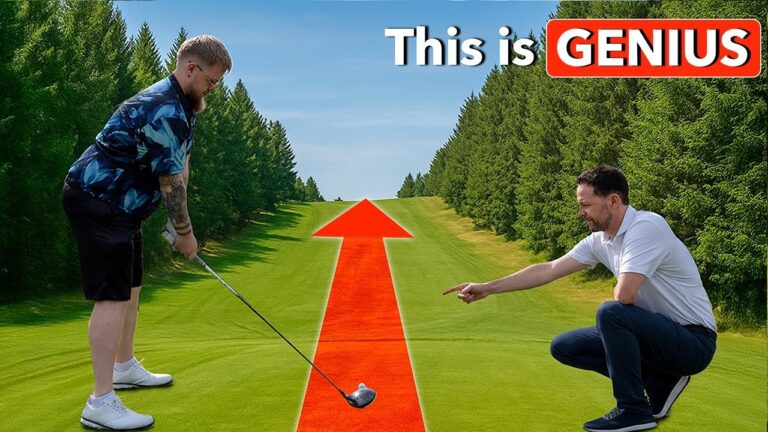

An effortless golf swing is not created by forcing your body into a checklist of positions. It develops when you give your body a clear task, allow it to organize the movement, and then add just enough awareness to control the clubface and strike.
Many golfers stand over the ball thinking about hands, hips, weight shift, rotation, contact, and swing path all at once. The result is often a tight, ball-focused motion that feels difficult to repeat. A more productive approach is to recognize that every golf shot has two connected targets: where you want the club and ball to go, and how the club meets the ball on the way there.
Table of Contents
- Step 1: See Why a Clear Task Can Create an Effortless Golf Swing
- Step 2: Identify the Two Targets of an Effortless Golf Swing
- Step 3: Keep the Clubface Aware While You Swing to the Target
- Step 4: Accept That Giving Up Control Can Improve Control
- Step 5: Use the Ball Throwing Drill to Link Direction and Contact
- Step 6: Practice Ground Contact Without Losing Your Swing Arc
- Step 7: Build a Natural Golf Swing With the Step-In Drill
- Step 8: Take the Two-Target Approach to the Course
Step 1: See Why a Clear Task Can Create an Effortless Golf Swing
A striking example came from a golfer who, frustrated after a poor shot, threw his club out toward the range. The motion was not intended as a golf swing, yet it contained several features golfers work hard to manufacture.
When the goal became simply to throw the club a long way toward a distant target, the body organized itself naturally. There was a shift toward the lead side, the clubhead trailed behind the hands, the arms extended through the release, and the hips moved forward ahead of the chest and head.
Those are all useful ingredients in a powerful golf swing. They appeared not because the golfer consciously instructed every body part, but because the task demanded an athletic movement toward a target.
This does not mean throwing a club produces a playable shot. In this case, the clubface was open, so the strike would not have been reliable. The bigger lesson is that your body can produce weight shift, rotation, extension, speed, and release without you trying to force each one separately.
For an effortless golf swing, replace internal instructions such as “move my hips first” or “get my hands here” with an external task that gives your motion a purpose. Your body is remarkably capable when the objective is clear.
Step 2: Identify the Two Targets of an Effortless Golf Swing
The first target is the primary target: the place out in front of you where you want to send the club and ultimately the ball. This target gives the swing direction, flow, and intent. Think of throwing the club out toward the fairway, not trying to manipulate it around the ball.
The second is the secondary target: what happens at impact. This includes awareness of the clubface and where the club contacts the ground relative to the ball.
Neither target works well in isolation.
- If you think only about sending the club toward the target, you may create freedom and speed but leave the face open or strike the ground in the wrong place.
- If you think only about hitting the ball perfectly, you may become tense, short, and overly controlling through impact.
- If you link the outward target with the impact target, you can preserve athletic motion while improving control.
This is the central idea behind an effortless golf swing: keep the distant target driving the motion while using impact awareness to guide it. The ball matters, but it should not become the master of the whole movement.
Step 3: Keep the Clubface Aware While You Swing to the Target
Once you have the sensation of swinging or throwing the club toward your intended target, add clubface awareness. Rather than making “square the clubface” your entire thought, feel the face squaring through impact as the club continues out toward the target.
This distinction is important. A face-focused thought alone can pull your attention back into mechanical control. A target-only thought can leave the face uncontrolled. The useful blend is to maintain the flow outward while sensing that the face is returning squarely to the ball.
Try this progression during practice:
- Make a few slow rehearsal swings with the feeling of sending the club toward a spot downrange.
- Notice the direction the clubface would be pointing through impact.
- Repeat the motion while feeling the face square as the club travels outward.
- Hit gentle shots with the same intention, allowing the target to remain the main focus.
You are not trying to freeze the clubface in a perfect position. You are learning to sense it within a flowing motion. That is a far more useful route to control than attempting to hold every segment of the swing in place.
Step 4: Accept That Giving Up Control Can Improve Control
It can feel risky to stop trying to control every inch of the swing. If your strike has been inconsistent, your instinct may be to stare at the ball, guide the club down, and demand perfect contact. After a few poor shots, that instinct becomes even stronger.
But this is where many golfers lose the very motion that helps them strike the ball well. Excess attention on impact can make your movement guarded and restricted. Your body starts organizing around “do not miss” rather than a positive athletic task.
Learning to get control by giving up control means accepting that some early attempts may feel unfamiliar or even reckless. You may hit a few poor shots while you learn. That does not mean the approach is wrong. It means you are building trust in a different movement pattern.
Use a sensible progression. Start with rehearsal swings, then half shots, then gradually build toward fuller swings. Retain the outward target throughout. Your secondary target, the clubface and ground contact, should inform the motion without taking it over.
Step 5: Use the Ball Throwing Drill to Link Direction and Contact
A simple ball throwing drill, inspired by Pete Cowen, helps you feel the two targets without a club. You can do it indoors, provided you have a safe clear area and a suitable soft ball.
Stand facing a wall or an open target area. Throw the ball so it bounces on the ground in front of you and then travels toward the intended target. The task is not merely to throw down at the floor, and it is not merely to throw outward. You want both outcomes at once.
If the ball travels too far to your right, for example, your throwing direction was off. If it fails to land in the desired spot, your ground-contact target was off. The drill gives immediate feedback while encouraging a free, target-oriented action.
How to perform the ball throwing drill
- Pick a clear target ahead of you.
- Choose a spot on the ground where you want the ball to bounce.
- Make an athletic throwing motion that sends the ball through both targets.
- Repeat until you can sense the relationship between the bounce point and the outward direction.
The feeling is similar to golf. Your swing must travel on toward the target, but it also needs to meet the ground and ball in the right place. The drill teaches that you do not have to sacrifice flowing movement to improve precision.
Step 6: Practice Ground Contact Without Losing Your Swing Arc
Golf is played with angled clubs, and the club moves on an arc. That means a helpful practice focus is to notice where the club strikes the turf as you continue to swing toward the target.
Make practice swings with the clear feeling of throwing the clubhead out toward a point downrange. Then pay attention to the divot or brush mark. Is the club contacting the ground too far behind the ball position? Is it occurring where you intended?
If the club is striking the ground too far behind the ball, you can begin to move your body forward. However, do not abandon the primary target and obsess only about clipping the turf. Keep the two tasks connected: swing the club out toward the target while improving where the club reaches the ground.
This approach is especially useful if you tend to chunk shots. Instead of trying to make a perfect downward hit with a rigid motion, use the ground mark as feedback. Let it help you adjust while the swing remains flowing and directed outward.
Step 7: Build a Natural Golf Swing With the Step-In Drill
The step-in drill adds movement, rhythm, and a clear intention to your practice. It encourages you to create the natural forward motion that can disappear when you stand still and become too focused on the golf ball.
Begin just to the trail-side of the ball. Look down the fairway and picture the arc you want the club and body to travel through. Then step into the shot and swing, imagining that you are sending the club down the fairway while collecting the ball along the way.
Use these keys during the step-in drill
- Look outward first: Establish a clear downrange target before moving into the shot.
- Picture the arc: Your eyes, shoulders, and club should feel as if they are moving through a continuous arc, not dropping vertically onto the ball.
- Step with purpose: Allow the step to create a sense of motion toward the target.
- Collect the ball: The ball is part of the movement, not the sole object controlling it.
- Finish freely: Allow the club and body to continue through to a balanced finish.
At first, this can look and feel a little unstructured. That is normal. The drill is designed to move you away from a frozen, over-managed swing and toward a more natural athletic action. As you gain trust, bring the same flowing intention back into your normal address position.
Step 8: Take the Two-Target Approach to the Course
You do not need to think about every drill while playing. The goal is to carry one simple priority: let the target drive your golf swing, while maintaining enough awareness to manage clubface and strike.
Before a shot, choose a specific target. Make one rehearsal motion that feels as though you are sending the club out toward it. Then address the ball and retain that same intent. If you need an impact cue, keep it simple: feel the face square through the hitting area, or notice the desired ground-contact point.
Avoid turning the ball into a threat. When you focus solely on “please hit it well,” you are likely to retreat into control and lose speed. When you focus on a task beyond the ball, you give yourself a better chance of producing the weight transfer, extension, and release associated with an effortless golf swing.
The aim is not careless golf. It is organized golf. Your primary target provides the motion. Your secondary target refines it. With practice, those two intentions can work together and help you create a swing that is freer, more powerful, and easier to repeat.
Effortless Golf Swing FAQ
What is the main focus for an effortless golf swing?
Make the target beyond the ball your primary focus. Feel as though you are swinging or sending the club toward that target, while keeping a secondary awareness of clubface position and ground contact.
Should you stop caring about ball strike?
No. Strike is the secondary target. Pay attention to where the club contacts the ground and how the clubface meets the ball, but do not let impact become the only thing organizing your entire movement.
Why does a natural golf swing sometimes feel reckless?
If you are used to tightly controlling the swing, a freer motion can initially feel unfamiliar. Build trust through slow rehearsals, short shots, and drills before taking the feeling into full swings.
Can you practice the ball throwing drill indoors?
Yes, provided you have enough safe space, use an appropriate ball, and can throw it toward a clear target or wall. Focus on bouncing the ball at a chosen ground spot while sending it toward the target.
0 Comments