
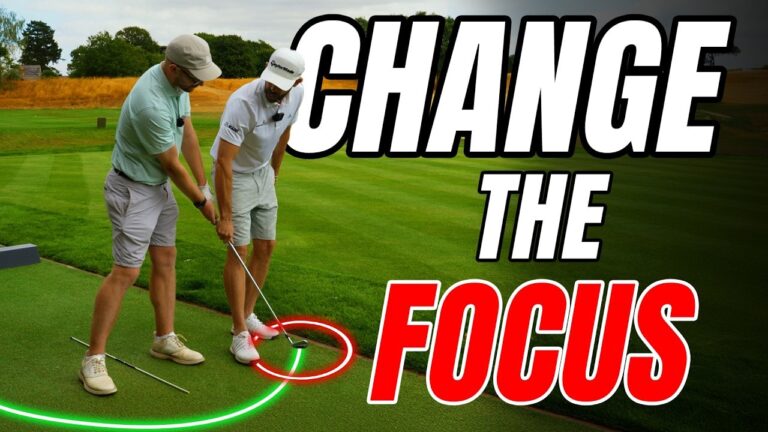

Poor golf iron shots rarely come from just one isolated fault. A pull, low hook, heavy strike, or inconsistent starting line can be the visible result of several compensations working together. When your clubface is closed, for example, your body may instinctively find a way to send the club out to the right to stop every shot diving left. That compensation can then create its own contact and direction problems.
This practical golf drill uses an unusual ball position to create the opposite movement pattern. You first exaggerate a leftward club path and later ground contact, then gradually return the ball to a normal position while keeping the improved motion. It is not intended to become your permanent setup. It is a training tool to help you replace an in-to-out, shallow delivery with a more neutral iron strike.
Table of Contents
- Step 1: Identify the Ball Flight Pattern in Your Golf Irons
- Step 2: Make Your Golf Grip Less Likely to Close the Face
- Step 3: Set a Clear Golf Swing Task Instead of Chasing Body Positions
- Step 4: Use the Left of Stick Golf Drill With No Ball
- Step 5: Move the Ball Forward to Force a Different Golf Delivery
- Step 6: Work the Ball Back Gradually While Keeping the New Feel
- Step 7: Blend Direction, Face Control, and Contact in Your Golf Practice
- Step 8: Make the Golf Drill Transfer to the Course
Step 1: Identify the Ball Flight Pattern in Your Golf Irons
Before changing your golf swing, be clear about the shot you are trying to improve. This method is especially useful if your iron shots tend to:
- Start right of the target and draw or hook left.
- Miss left as a pull, pull draw, or low hook.
- Produce occasional heavy contact.
- Feel shallow, with the club approaching too far from inside the target line.
These misses can be linked. A closed clubface tends to send the ball left. To manage that leftward curve, you may unconsciously swing farther to the right of the target. You may also add excess side tilt and deliver the club too far behind your hands.
Those adjustments can make the ball start farther right before curving left. However, they also make consistent golf iron contact harder. A club that is too shallow or too far behind the hands can reach the ground too early, leading to heavy shots. With a closed face and a rightward path, you can alternate between pushes, hooks, and solid draws without knowing which one will arrive.
The important point is that your swing is often trying to solve a problem, not simply creating one. If you improve the face without addressing the compensating path and body movements, the ball may suddenly fly right. That is why this drill deals with both the clubface and delivery.
Step 2: Make Your Golf Grip Less Likely to Close the Face
Start with the grip because your hands control how readily the clubface rotates. For a right-handed golfer who is fighting a closed face and left miss, the useful adjustment is often to make the trail hand slightly weaker.
Keep your lead hand largely as it is. Then relax your trail hand and rotate it a little more on top of the grip. The trail-hand index finger and thumb should feel as though they sit at a similar distance down the handle. Hold the grip more in the fingers rather than allowing the hand to sit excessively under the club.
This may feel dramatically different at first. That feeling is normal. A trail hand positioned too far underneath the grip can make it easier to rotate the clubface closed through impact. Moving it slightly on top gives you more opportunity to control the face without having to build compensations elsewhere in the golf swing.
Expect early shots with this weaker trail-hand grip to move right. Do not rush to reverse the change after one or two balls. A rightward start is useful feedback that the clubface behavior has changed. The next steps will help you reshape the club path and strike to match it.
Step 3: Set a Clear Golf Swing Task Instead of Chasing Body Positions
Many golfers try to change by collecting instructions: reduce tilt, keep the shoulder lower, move the arms differently, shallow less, or rotate more. Those details can help, but an external task can be a more effective way to create a new movement pattern.
Place an alignment stick on the ground in the middle of your heels, perpendicular to the target line. Make slow, no-ball rehearsal swings with a half backswing. Then give yourself two tasks:
- Swing the club to the left of the target through impact.
- Brush the ground after the alignment stick, toward the target.
For a golfer who normally swings out to the right with too much tilt and a shallow delivery, these tasks demand the opposite. They encourage the club to travel more leftward through impact and to bottom out later. The goal is not a picture-perfect rehearsal. The goal is to explore a movement your current golf swing does not normally make.
Use modest speed. Make several half swings and exaggerate the feeling. It is better to begin too far in the new direction and ease back later than to make a tiny change that your old habit immediately absorbs.
Step 4: Use the Left of Stick Golf Drill With No Ball
Continue with the alignment stick between your heels and rehearse an exaggerated version of the opposite delivery. Your club should feel as if it travels far left of the target line, almost over the top, while its low point occurs later than usual.
This is intentionally a strange golf movement. Do not judge it by how elegant it looks. A golfer who has spent months or years delivering the club too far from the inside may need a very exaggerated sensation before the actual motion becomes neutral.
Focus on the two outcomes only:
- Path: left of the target.
- Low point: after the stick.
As you rehearse, notice how a leftward swing direction and later ground contact alter your body motion without requiring a long technical checklist. The task naturally counters excessive backward chest movement, too much tilt, a club stuck behind the hands, and a shallow approach.
Step 5: Move the Ball Forward to Force a Different Golf Delivery
Now comes the bizarre but highly effective part of the drill. Move the ball much farther forward than your usual iron ball position. The ball should also be slightly closer to you, because the club moves on an arc and the forward point of the arc is nearer to your body.
Start with the ball around eight inches forward of your normal position. That placement should feel wrong, and it is supposed to. If you tried to make your old swing with the ball this far forward, you would risk missing it. Your instincts will therefore make a different motion to find the ball.
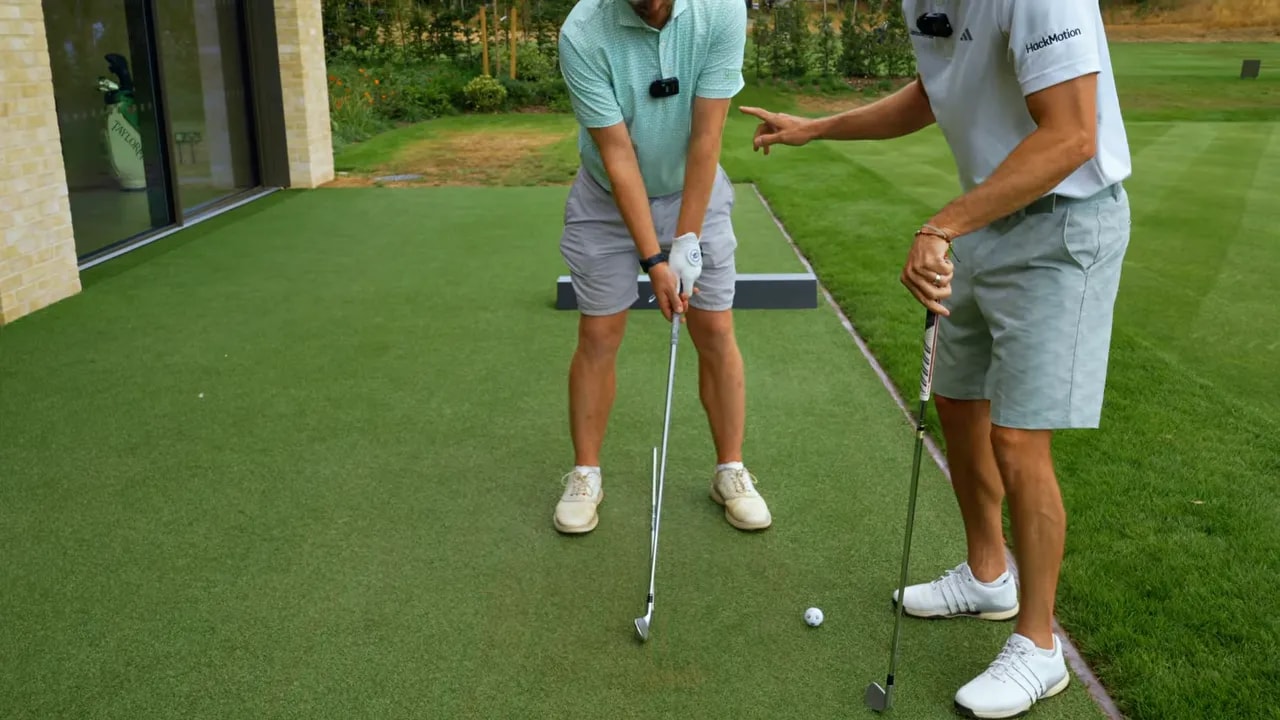
Set up normally, retain the slightly weaker trail hand, and repeat the same assignment:
- Hit the ground later.
- Sling the club far left through impact.
- Start the ball left of the target-line stick.
The ball may start left and fade back toward the target. That is a productive practice shot for this pattern. The forward ball position helps transform an in-to-out, shallow action into an out-to-in, steeper action. In the lesson example, the club path moved from right of target to roughly 8 degrees left, while the attack angle became nearly 5 degrees downward.
That is too extreme for normal play, but it proves that the golfer can create the opposite of the old pattern. You are not trying to play every round with a severely forward ball position or a steep leftward path. You are creating a reference point for better golf iron delivery.
Step 6: Work the Ball Back Gradually While Keeping the New Feel
Once you can produce a left-starting shot with a small fade or controlled flight, move the ball back part of the way toward your normal position. Do not make a sudden jump from the exaggerated drill straight to your usual setup.
A useful progression is:
- Stage one: Ball very far forward, around eight inches beyond normal.
- Stage two: Move it back to around four inches forward.
- Stage three: Return it to your regular iron ball position.
At every stage, preserve the original task. You still want the sensation of brushing the ground later and swinging left through the shot. You can also picture an imaginary brick wall on the right side of the target line. If the ball starts right, it would rebound from that wall, so your job is to avoid sending it there.
The exaggerated forward setup initially creates a much more leftward path than you need. As the ball returns toward normal, the path should become less extreme and settle closer to neutral. In the example, moving the ball back reduced the path from about 8 degrees left to about 4 degrees left, with better strike quality.
This is the value of exaggerated golf practice. You deliberately go beyond the desired final movement so that, when you reduce the exaggeration, you arrive in a useful middle ground rather than falling immediately into the old habit.
Step 7: Blend Direction, Face Control, and Contact in Your Golf Practice
When the ball returns to a conventional position, shift your attention from mechanics to a simple target outcome. Keep the same swing feeling, but choose a specific finish point for the ball. With wind moving from the left, for example, a useful task may be to finish the shot just left of the flag.
Your goal is a balanced combination:
- A clubface that is no longer excessively closed.
- A path that is neutral or only fractionally left.
- A descending strike with the low point ahead of the ball.
- A starting line that is much closer to the target.
Better golf iron shots may fly farther even when you do not swing harder. A ball that travels on a straighter route covers the direct distance to the target rather than using some of its travel curving left or right. More importantly, your strike and dispersion become more dependable.
Do not assume that the correct change must feel comfortable. Sometimes an effective change feels awkward because it is genuinely new. Other times it feels immediately good because it produces a better strike and flight. In either case, measure progress by ball flight, contact, and repeatability rather than by whether the motion resembles your old swing.
Step 8: Make the Golf Drill Transfer to the Course
Hitting several good shots in a row is encouraging, but it does not automatically mean the new move is ready for the course. Consecutive shots make it easy to repeat the same feel while it is fresh. On the course, you have interruptions, changing lies, targets, and time between swings.
Build transfer into your practice. After a good shot, step away. Take a drink of water, walk around briefly, or change clubs. Then return and try to reproduce the same start line, strike, and controlled shape.
This small reset tests whether you understand the movement rather than merely repeating a recent swing. If your old hook starts returning, use the practice reference that helped you: move the ball a little forward during range work, rehearse the late low point, and feel the club traveling left. Use the exaggerated version as a training reset, not as an emergency on-course fix.
The wider lesson for your golf improvement is simple. Understand what impact is doing to the ball, learn which movements influence that impact, and give yourself tasks that create the required movement. That approach leaves you with a practical way to self-correct when your iron shots drift away from the target.
Golf Iron Shot FAQ
Why do my golf iron shots start right and hook left?
This pattern can occur when the clubface is closed but the club path travels to the right of the target. The rightward path can start the ball right, while the closed face helps curve it back left. Excessive body tilt and a shallow delivery may be compensations for the closed face.
Should I permanently play golf with the ball far forward?
No. The unusually forward ball position is a practice exaggeration designed to force a different club path and low point. Gradually move the ball back to your normal iron position while retaining the improved feel.
Why does a weaker trail-hand golf grip help with hooks?
For a right-handed golfer, placing the trail hand slightly more on top of the grip can reduce its tendency to rotate the clubface closed. This can make face control easier when left misses are a problem.
What should I focus on during the left of stick golf drill?
Focus on two simple tasks: swing the club left of the target and brush the ground after an alignment stick positioned between your heels. Start without a ball, then add a ball in the exaggerated forward position.
How can I make this golf swing change hold up on the course?
Practice breaks between shots. After a successful shot, step away, reset, and then try to reproduce it. This makes the task less dependent on immediately repeating the previous swing.
0 Comments