


Golf swings on elite tours continue to evolve, but one recent pattern is especially striking: through impact, many exceptional ball strikers keep the trail foot grounded longer, keep the trail knee from driving excessively toward the ball, and maintain a noticeable side tilt in the neck and head. The result is a powerful, spacious delivery position that can support both speed and control.
Jackson Koivun provides a dramatic example of this emerging golf swing look. At 21, he has already produced extraordinary ball striking, including a 25 under par performance without a weekend bogey, while finding roughly 80 percent of fairways at high speed. His motion is extreme and should not be copied wholesale. Still, the underlying principles can help you improve impact, sequence, and consistency without forcing your body into uncomfortable positions.
Table of Contents
- Step 1: Recognize the modern golf swing pattern
- Step 2: Understand why space improves golf impact
- Step 3: Keep your trail foot down longer in your golf swing
- Step 4: Maintain your side tilt and your golf viewing room
- Step 5: Train the “hit, foot” sequence
- Step 6: Use the 55-degree golf shoulder-plane reference
- Step 7: Combine the pieces into one safe golf practice routine
- Step 8: Avoid copying extremes and measure what you can do
Step 1: Recognize the modern golf swing pattern
The visible feature of this golf swing evolution is simple to describe but difficult to perform at tour speed: the head stays out to the side while the legs stay back and in. Through impact and into the follow-through, the player’s head does not immediately pull backward or level out. At the same time, the trail leg remains down and the trail knee works inward rather than lunging toward the ball.
This creates a distinctive shape. From face-on, the upper body appears to remain inclined toward the ball, while the lower body continues to rotate through. The player has room for the arms and club to move through impact rather than becoming cramped.
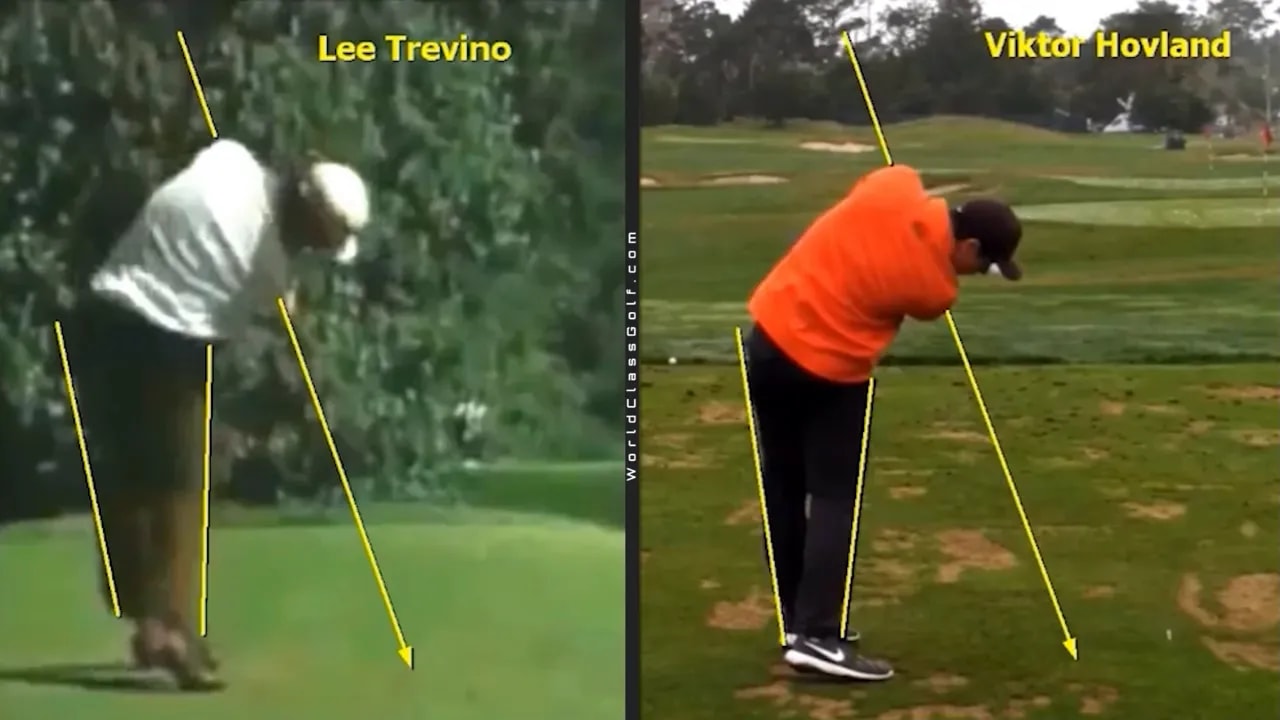
This is not entirely new. Lee Trevino displayed a related look in an earlier era, and his ball flight was widely admired. What is different now is how frequently similar movement patterns appear among modern elite golfers, including players such as Joaquin Niemann and Sahith Theegala.
Do not interpret this as an instruction to push your head dramatically away from the target or to hold your trail heel down at all costs. Golf swings vary, and mobility matters. The useful takeaway is to avoid the common combination of the knee pushing forward and the head pulling backward.
Step 2: Understand why space improves golf impact
The practical advantage of keeping the legs back and the head out is space through the strike. When your trail knee stays down and in for longer, and your neck remains tilted on the side, the club has room to approach and continue through the ball.
That space can support several important golf outcomes:
- Staying down through impact: You are less likely to rise out of posture before the club reaches the ball.
- Less tendency to hit left: A crowded, early-standing motion can make the club work abruptly across the ball. More room can help the club remain on its intended path for longer.
- Freedom to accelerate: When the body does not crowd the delivery, you can move through with speed rather than steering the club.
- Better sequencing: The lower body can continue rotating while the upper body maintains its inclination through the strike.
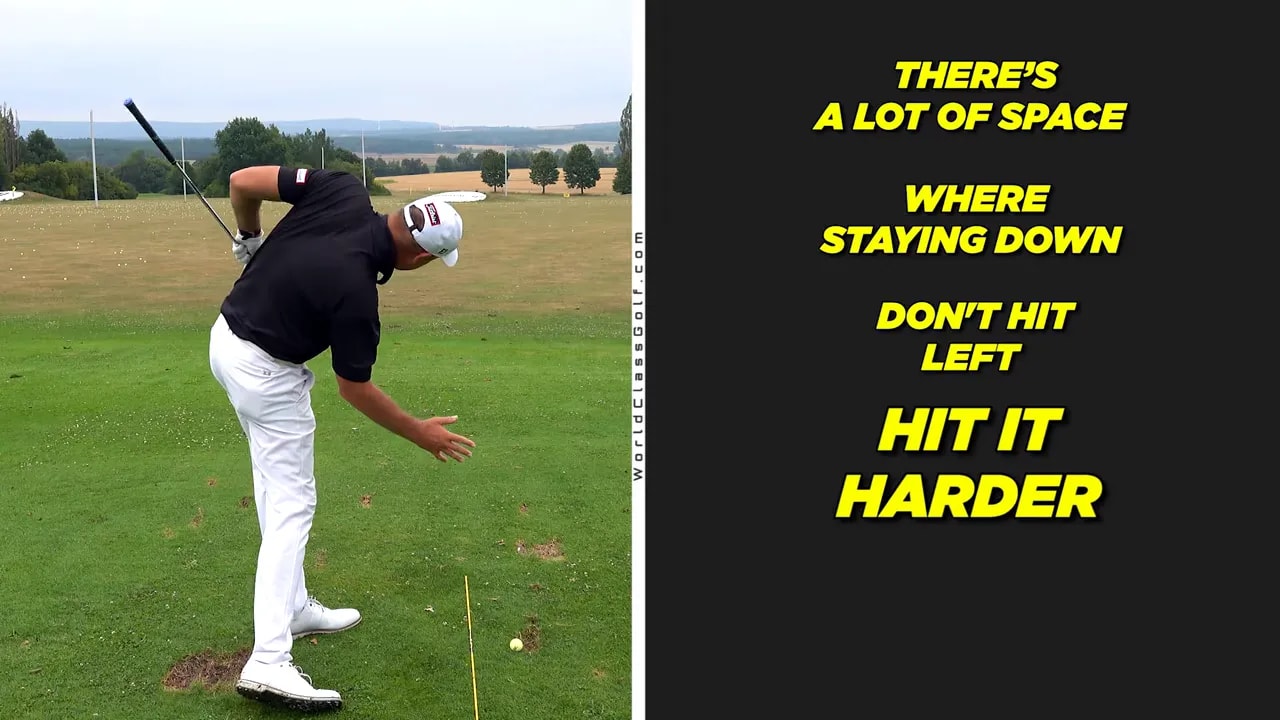
For many amateur golfers, the opposite pattern appears at impact. The trail knee drives forward toward the ball, and the head pulls backward. This can make you lose your inclination, crowd the arms, and come out of the shot.
A useful way to simplify the issue is this: do not allow the lower body to rush toward the ball while the upper body retreats away from it. Your goal is a supported rotation through the shot, not a dramatic slide or a forced lean.
Step 3: Keep your trail foot down longer in your golf swing
One of the most accessible feels in this golf move is to keep your trail foot on the ground for longer through impact. For a right-handed golfer, that means delaying the moment when the right heel lifts. As the trail foot stays grounded, the trail knee is less likely to shoot outward toward the ball.
The feeling is not “freeze the lower body.” Your body should still rotate and move toward a balanced finish. Instead, the trail foot provides a brief period of stability while the club travels through the hitting area.
Use a simple toe-line barrier drill
Place an object just outside your trail toe line. A large water bottle, an alignment stick placed safely, or a cut-down club shaft can work. The object gives you immediate feedback: if your trail knee kicks outward aggressively, it will approach or strike the barrier.
- Set up to a ball with a short or mid iron.
- Place the object on the ground along the trail toe line, far enough away that it does not interfere with the club.
- Make slow rehearsal swings first.
- Feel the trail knee remain down and work inward as you rotate through.
- Hit gentle shots, keeping the trail foot down longer without forcing it flat after your natural release point.
You can begin with a teed-up ball, similar to a short par 3 shot, because a slightly elevated ball can make it easier to rehearse the motion without worrying about turf contact. Build up gradually. The aim is a better impact position, not an extreme imitation of a young tour player’s mobility.
Step 4: Maintain your side tilt and your golf viewing room
Where you look after impact is an excellent checkpoint for golf swing inclination. Instead of turning the head level and pulling it away from the ball, maintain a slight sideways neck tilt as you move through. Think of your head being positioned to look at the ball from the side, not from above.
This position has been described as your viewing room. If your head remains on the side through impact, your body has a better chance of preserving the bends and tilts that supported your address position. If your head snaps backward and levels out early, it is often a sign that your swing has become too upright or too level through the ball.
A practical image is to imagine water dripping from your trail-side ear. This is only a feel, not a demand to tip your head excessively. The purpose is to preserve a side-on perspective and avoid pulling your head back.
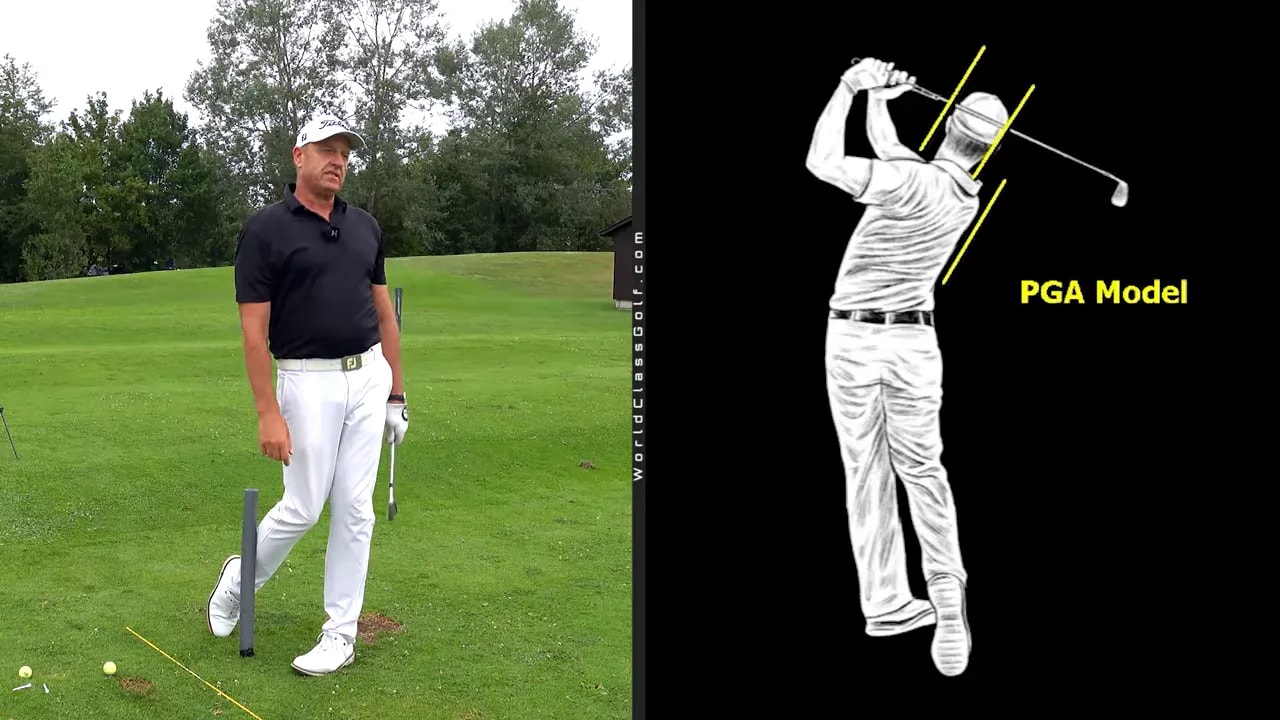
This distinction matters particularly for older golfers. A side tilt should come from a well-supported turn, not from forcing the spine into a painful position. There is an important difference between physical discomfort and a technical issue. If you feel pain, stop and seek appropriate professional guidance. If you feel stable, mobile, and balanced, you can work toward a more functional tilt at your own pace.
Step 5: Train the “hit, foot” sequence
Timing is at the center of this golf pattern. In many strong swings, the ball is struck while the trail foot still has meaningful contact with the ground. The foot then releases naturally as the golfer continues toward the finish.
A concise rhythm cue is: “hit, foot.” In other words, impact happens first, then the trail foot fully releases. This can help you avoid spinning out too early or jumping away from the ball before the strike.
Use the cue during slow practice swings:
- Turn into the backswing with balance.
- Begin moving through while maintaining your side tilt.
- Feel impact while the trail foot remains down.
- Allow the foot to release as the body continues rotating to the finish.
Do not try to hold the trail foot down indefinitely. A complete golf finish still includes rotation, pressure moving into the lead side, and a natural release of the trail heel. The drill simply improves the order of events.
Step 6: Use the 55-degree golf shoulder-plane reference
Another key feature in accomplished golf swings is the way the shoulders work through the ball. The shoulder plane tends to become steeper on the way through than it was on the way back. A reference value used here is approximately 55 degrees halfway through the through-swing, representing an average measured among PGA Tour players.
This is not a universal target that every golfer must reach. Your height, flexibility, swing length, and physical history all affect what is practical. The value is useful because it shifts attention toward a more effective through-swing shape rather than an overly level turn.
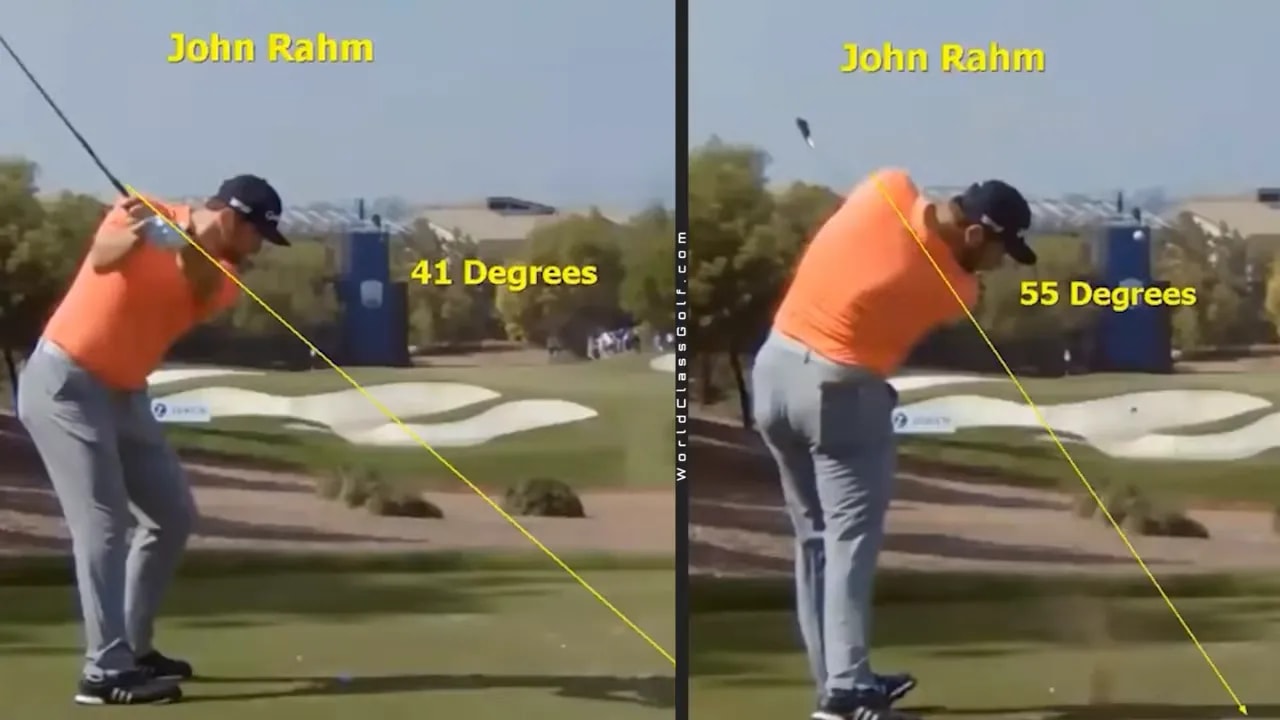
Examples across different eras and styles show a similar directional pattern. John Rahm, Nelly Korda, Sam Snead, Tony Finau, Robert Rock, Lee Westwood, and Collin Morikawa are shown with backswing shoulder-plane values near 40 degrees and through-swing values around 54 or 55 degrees. The exact number varies, but the through-swing generally becomes steeper.
Practice the shoulder-plane feel with a driver
You can rehearse this golf movement without hitting a ball. Take your driver and set up as if you were preparing for an iron shot. Raise your arms to roughly 90 degrees in front of your body, then lower them to about 45 degrees.
From there, turn slowly through and align the club with the direction suggested by your shoulders. Continue rotating as you feel the lead side rise and the neck remain tilted on the side. Then return to address and repeat.
This rehearsal helps you experience the steeper through-swing without trying to calculate angles during a full-speed shot. It also emphasizes rotation. Turning through is important because a committed turn can reduce the urge to compensate by bending or straining the lower back.
Step 7: Combine the pieces into one safe golf practice routine
Golf improvement becomes more reliable when you practice a clear feel instead of chasing several positions at once. Start slowly and use this progression.
- Rehearse the trail knee: Place a barrier along the trail toe line and make five slow movements without a ball.
- Add the head position: Keep the neck gently on the side as you rotate through. Retain the feeling of looking at the ball from the side.
- Add rhythm: Say “hit, foot” quietly during three rehearsal swings.
- Hit half shots: Use a controlled swing and prioritize centered contact over distance.
- Build to fuller swings: Increase speed only if the movement remains comfortable and balanced.
- Check your finish: Your body should finish rotated toward the target, with the trail foot released naturally after impact.
For the first few sessions, do not judge success by ball flight alone. Notice whether you can retain posture through impact, avoid lunging the trail knee toward the ball, and complete the motion without back discomfort. Those are meaningful signs that the new golf feel is becoming more usable.
Step 8: Avoid copying extremes and measure what you can do
Elite golf swings are built around exceptional athletic ability, strength, speed, and range of motion. Jackson Koivun’s positions are informative, but they are not a template for every player. The goal is to move closer to efficient averages, not to reproduce a photograph of another golfer.
Focus on the principles:
- Create room through impact.
- Keep the trail knee from driving outward toward the ball.
- Delay the trail-foot release just enough to improve sequence.
- Preserve your side tilt while continuing to turn.
- Let the shoulders work into a steeper through-swing plane.
Video analysis or movement-measurement tools can help remove guesswork. A side-on recording can reveal whether your head pulls back, whether the trail knee moves excessively toward the ball, and whether you finish with a functional amount of rotation. Compare your own progress over time rather than forcing your body to match a single tour benchmark.
The most productive golf swing change is one that improves your strike while respecting your present physical capabilities. Start with a smaller version of the movement, keep the changes comfortable, and let improved contact guide the process.
Golf Swing Evolution FAQ
Should you copy Jackson Koivun’s golf swing exactly?
No. His swing includes exceptional speed and mobility. Use the general principles of preserving space, keeping the trail knee in, retaining side tilt, and delaying the trail-foot release rather than copying extreme positions.
Why does the trail knee moving toward the ball cause golf problems?
When the trail knee drives forward, it can crowd the arms and club through impact. It is often paired with the head pulling backward, which can make you come out of posture and make consistent ball striking more difficult.
What does the “hit, foot” golf swing cue mean?
It means you aim to strike the ball before the trail foot fully releases from the ground. The foot then comes through naturally as you continue rotating toward the finish.
Do you need to reach a 55-degree shoulder plane in golf?
No. Fifty-five degrees is a PGA Tour average reference halfway through the through-swing, not a mandatory position. Work toward a steeper, more functional through-swing plane that suits your body and remains comfortable.
Can senior golfers use these golf swing drills?
Yes, provided the movements are comfortable. Start with slow rehearsals and short shots. The objective is better technique and sequence, not strain. Stop if you experience pain.
0 Comments