

A technically tidy golf swing can still produce frustrating shots. You may look balanced at setup, move the club into a strong delivery position, and feel as though everything is in place, only to see the ball fly well right or left of the target.
The missing ingredient is often not another position in your swing. It is your ability to control the clubface during the final instant before impact. This is the release: the active use of your hands and arms to bring the clubface from its delivery position into the position needed at impact.
For better golf, you need to develop awareness of where the clubface is, learn how to intentionally alter it, and then combine that control with solid strike and shaft lean. The three-step practice plan below turns that idea into a simple skill-building routine.
Table of Contents
- Step 1: Understand Why a Good-Looking Golf Swing Can Miss the Target
- Step 2: Build Golf Clubface Awareness With the Eyes-Closed Drill
- Step 3: Add Speed to Your Golf Release With Right, Left, and Straight Shots
- Step 4: Add Shaft Lean to Your Golf Release for Better Strike
- Step 5: Progress the Golf Drills Without Losing the Skill
- Step 6: Make Clubface Control the Priority at Impact
- Golf Release FAQ
Step 1: Understand Why a Good-Looking Golf Swing Can Miss the Target
It is easy to judge a golf swing by appearance. One swing may look compact, conventional, and athletic, while another looks awkward or unconventional. Yet the less attractive swing can sometimes create the better result because it delivers the clubface more effectively at impact.
This is an important distinction. A strong setup, backswing, downswing, and delivery position are useful, but none of them guarantees a straight shot. From a textbook-looking delivery position, you can still hit the ball dramatically right or left if the clubface is not controlled during the tiny amount of time between delivery and impact.
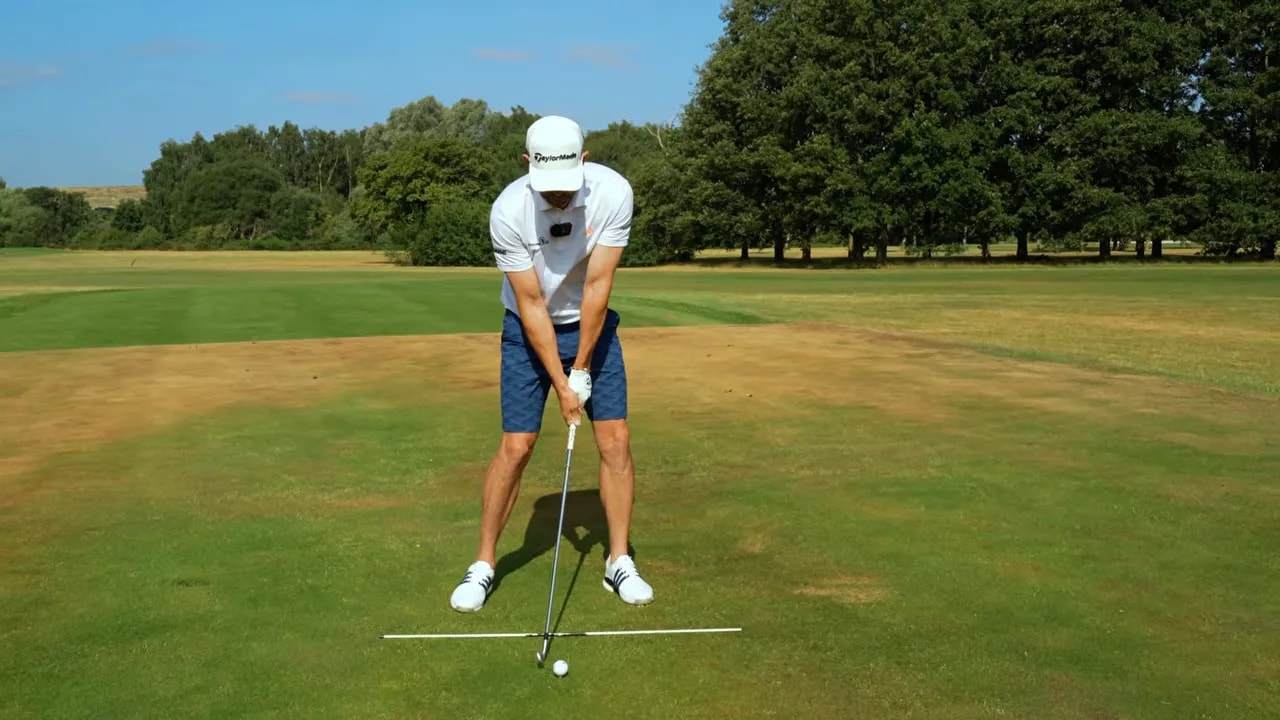
Think about the delivery position with the shaft roughly parallel to the target line, the trail arm bent, and the clubface in a suitable orientation. It may look ideal on a recording. But the club still has to travel to the ball, and its face still has to arrive square enough for the intended shot.
That final move cannot be created by simply turning your body. If you held the club upright in a delivery-style position, the face would point largely upward. Rotating your body without changing your hands or arms would leave the clubface pointing in the wrong direction. When you bend forward into golf posture, that unchanged face would point well to the right of the target.
To return the face to a square position, your lead hand and arm must work. The lead thumb moves down toward the ground as the club lowers, while the arm rotates. These motions are not meant to become rigid technical thoughts during every swing. They explain why the hands and arms must contribute during the release.
The common instruction to remove your hands from the golf swing can be misleading when it is applied to the release. Your hands and arms are not passive. They are essential tools for controlling the clubface. Great players may use different wrist angles and show slightly different face positions, but every effective player must manage the face between delivery and impact.
Your first goal is therefore simple: stop treating a good-looking swing as the finish line. In golf, the face control and strike you produce at impact determine the result.
Step 2: Build Golf Clubface Awareness With the Eyes-Closed Drill
Before adding speed, develop a feel for the clubface in space. This first drill is deliberately slow and simple. It is designed to improve your awareness rather than force you to memorize a collection of body positions.
Set up the practice station
You can perform this drill standing upright with the club in front of you or in your normal golf posture. Pick a clear target in the distance, such as a flag, and use an alignment stick if it helps you identify the target line.
Move the club into your preferred delivery position. The details should be familiar:
- The shaft is approximately parallel to the target line.
- The trail arm is bent and reasonably tucked.
- The clubface is in a delivery orientation that can be released toward impact.
- A ball can be lightly teed if you want a visual reference.
Close your eyes and find impact
Close your eyes. From delivery, move the club slowly toward impact, trying not to knock the ball from the tee. Stop the club at the ground, then open your eyes and inspect the face.
Was it square, open, or closed? Do not judge the result harshly. The result gives you feedback about your current awareness. If the face is open, you have learned that your feel for the clubface did not match its actual position. Repeat the movement and try again.
Your focus is not on consciously forcing your lead thumb into a specific location or mechanically rotating the arm a certain amount. Focus on the practical task: bring the clubface back to square. The hands and arms will begin to organize around that objective.
This is a foundational golf skill. It can initially feel difficult because many golfers have spent most of their practice time learning swing positions rather than learning the release. The purpose of repetition is to connect feel with reality.
Use feedback, not guesswork
Perform several slow repetitions. Each time, close your eyes, return the club to impact, place it on the ground, then check the face. Notice what an open face feels like. Notice what a square face feels like. Over time, your internal sense of the clubhead becomes more accurate.
A square result is not an accident to ignore. Pause and recognize it. You are teaching yourself the feel of a clubface that has been actively controlled through the impact area.
Step 3: Add Speed to Your Golf Release With Right, Left, and Straight Shots
Once you can better recognize clubface position at slow speed, add a little momentum. This phase uses an intentional contrast drill. Instead of trying immediately to hit perfect shots, you deliberately create shots to the right, shots to the left, and then a straighter shot.
This is useful because it builds control. If you can only attempt a straight ball, you may not know whether you truly controlled the face or simply produced a fortunate result. By deliberately changing the clubface, you learn which hand and arm actions create each outcome.
Start with a short swing
Set up from the familiar delivery position. Make only a short backswing and hit the ball roughly 30 to 40 yards. The small swing keeps the task manageable and highlights clubface control rather than power.
Complete the following three-shot sequence:
- Hit one to the right: Intentionally deliver the clubface open enough to send the ball right of the target.
- Hit one to the left: Keep the same basic setup and swing length, but intentionally close the face enough to send the ball left.
- Hit one straighter: Find the middle ground and attempt to return the face closer to square.
The exact distance left or right is not the priority. A ball that starts well right or well left is useful feedback when it was intentional. You are learning that the same broad delivery appearance can produce very different ball flights depending on what the hands and arms do through impact.
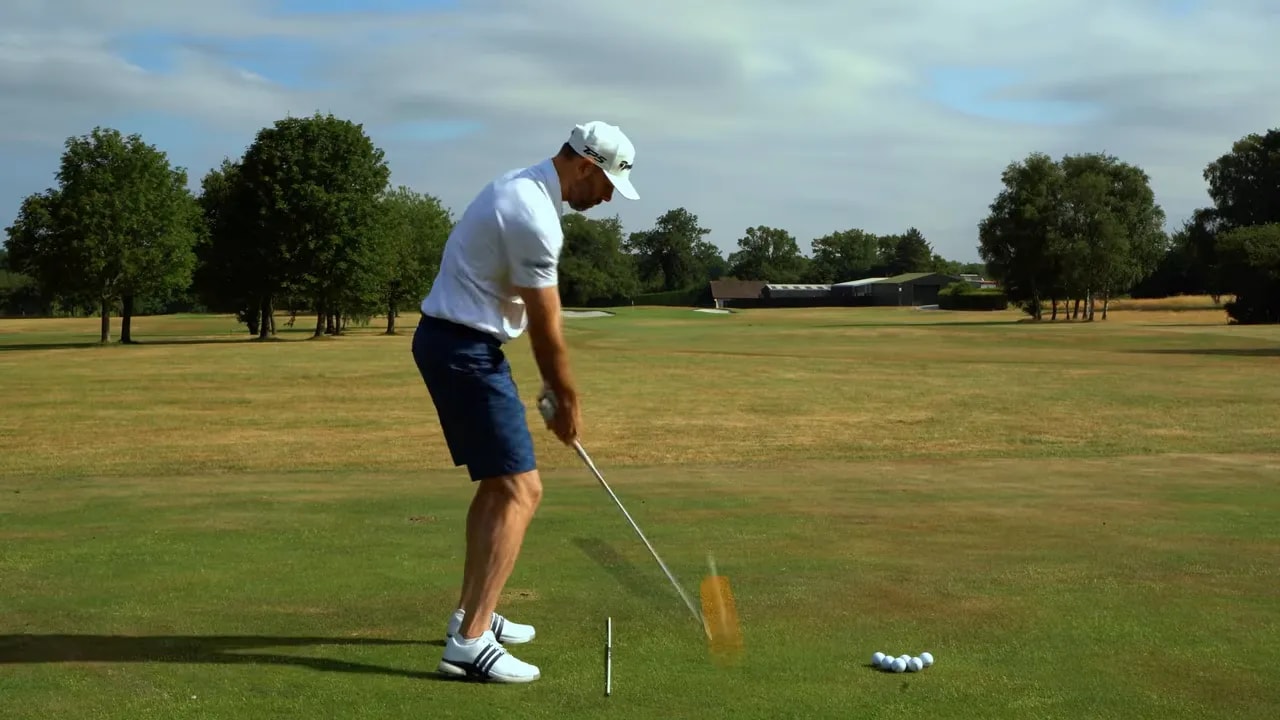
When you intentionally hit the ball right, you are demonstrating that you can keep the face more open. When you intentionally hit it left, you are demonstrating that you can close it more. The straighter shot asks you to blend those extremes into a more neutral delivery.
This is not a recommendation to steer every golf shot with excessive hand action. It is a practice method for developing the skill you need. The goal is to understand that your hands and arms influence the clubface, then gain the ability to apply that influence in a controlled way.
Why intentional misses help your golf
Golfers often label every offline shot as a failure. In this drill, an intentional miss has a purpose. A rightward shot proves you can produce one face condition. A leftward shot proves you can produce another. The eventual straight shot becomes easier because you have explored both sides of the target.
Keep the practice swing short at first. Use the same delivery reference and avoid changing several variables at once. If you lengthen the swing too early, you may lose the awareness developed in Step 2. Build speed only when you can repeatedly create the intended start direction.
Step 4: Add Shaft Lean to Your Golf Release for Better Strike
Clubface control matters, but iron play also requires quality strike. Great iron shots generally feature both a clubface delivered as intended and some shaft lean at impact. Shaft lean helps create compression and supports a cleaner strike.
There are multiple ways to return a clubface to square. One possibility is to leave the hands behind the ball and manipulate the face into a square-looking position. However, this can make it harder to strike the ball in the desired way. The final stage adds a simple obstacle that encourages you to control the face while preserving forward shaft lean.
Place a towel behind the ball
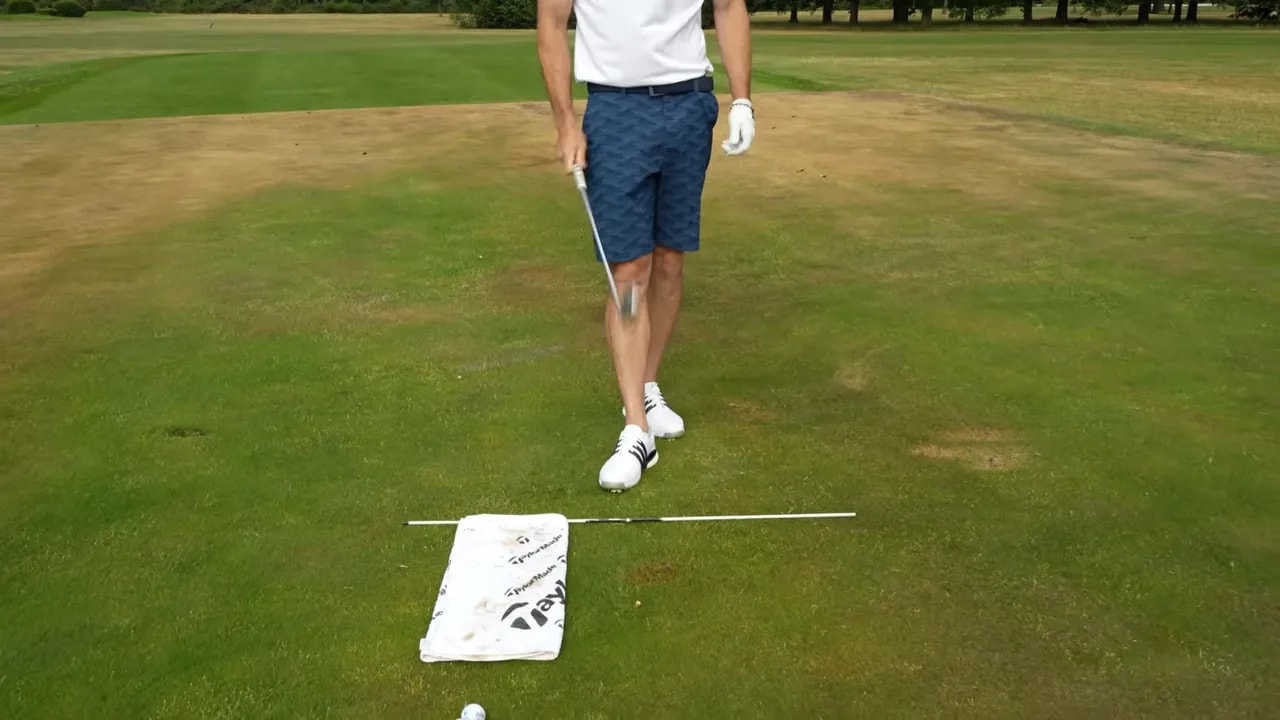
Move the ball from a tee onto the ground. Place a towel behind it, approximately one and a half six-iron clubhead widths behind the ball. The towel is not a target to hit. It is feedback.
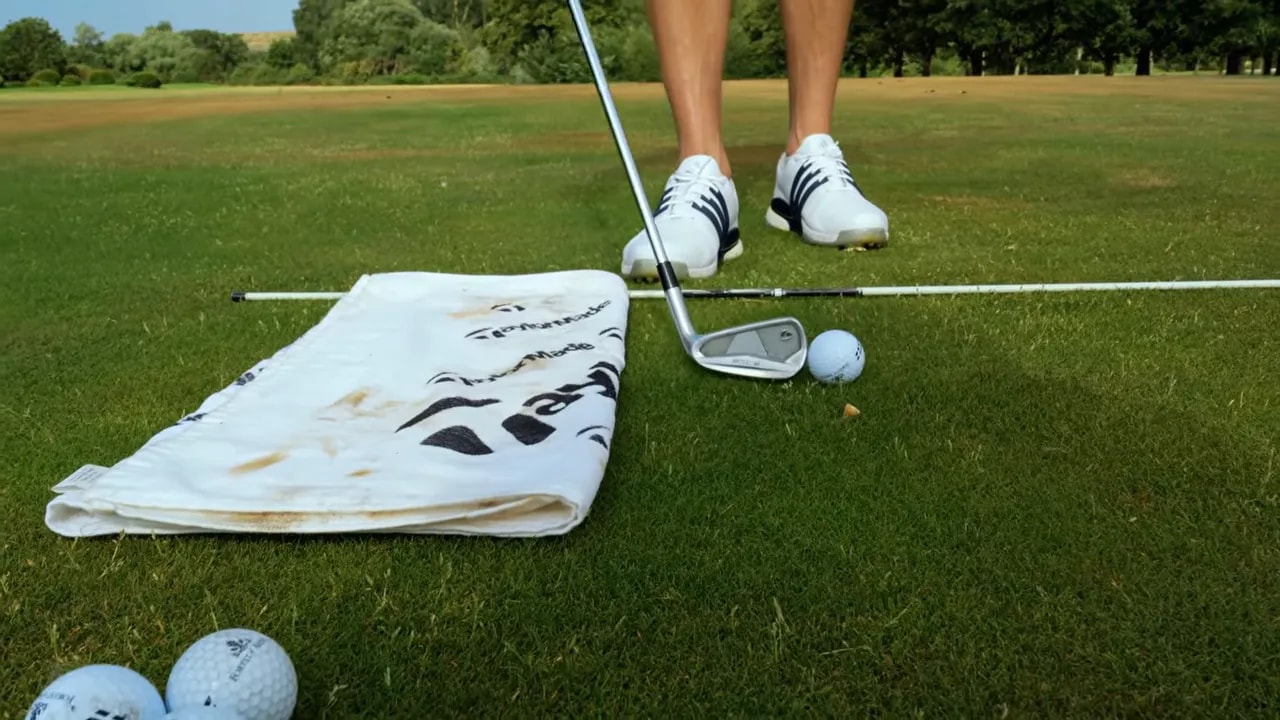
The setup gives you a clear task: strike the ball without clipping the towel. If you try to square the face by allowing your hands to fall too far back, the club is likely to contact the towel. To avoid it, you need to deliver the club with a more forward handle and enough shaft lean to strike the ball first.
Repeat the three ball-flight tasks
Use a longer backswing than in Step 3, but do not rush to full speed. From your delivery reference, hit three shots while missing the towel:
- Intentionally send one ball right of the target.
- Intentionally send one ball left of the target.
- Attempt to send one ball relatively straight.
All three shots must satisfy the same strike condition: the club should contact the ball and ground without catching the towel behind it. This combines two skills that often need to be learned together in golf: face control and shaft lean.
The leftward shot can feel especially demanding because you must close the face enough to change the flight while still keeping the handle forward and avoiding the towel. That challenge is valuable. It requires you to coordinate the release rather than rely on a single simplistic movement.
Do not be discouraged if the three balls finish far apart. In practice, a wide spread can mean you are successfully exploring your ability to change the face. The important questions are:
- Did you intentionally create the general direction?
- Did you strike the ball before the turf?
- Did the towel remain untouched?
- Can you gradually reduce the distance between the right, left, and straight attempts?
Step 5: Progress the Golf Drills Without Losing the Skill
The three stages work best as a progression, not as isolated tricks. Begin each practice session with a few slow eyes-closed rehearsals. This refreshes your awareness of the clubface. Then use short shots to intentionally work the ball right, left, and straight. Finally, bring in the towel and a longer swing to add shaft lean and strike quality.
A useful order for your golf practice is:
- Make several eyes-closed delivery-to-impact rehearsals and check the clubface.
- Hit short shots that intentionally go right and left.
- Hit short shots that attempt to finish closer to the target line.
- Place the towel behind the ball.
- Repeat the right, left, and straight sequence with a longer swing while missing the towel.
- Increase speed only when you can retain control of both ball flight and strike.
Do not make the mistake of judging improvement only by whether every ball is perfectly straight. This training is about building a release skill. You should be able to recognize when the face is open or closed, intentionally change it, and gradually find the square delivery more often.
As your golf release becomes more reliable, the swing you have already built can produce more predictable results. Better clubface control reduces the gap between a swing that looks good and a shot that actually performs well.
Step 6: Make Clubface Control the Priority at Impact
The essential message is straightforward: a technically sound-looking golf swing is not enough on its own. The clubface must be controlled through the final part of the downswing, and your hands and arms are central to that task.
Use the first drill to understand the face. Use the second to gain control through deliberate right, left, and straight shots. Use the towel drill to integrate shaft lean and solid strike. Treat each stage as skill practice, not a search for a single perfect-looking position.
When you can deliver the clubface where you intend while striking the ball before the turf, you have developed a more complete golf swing: one that does not merely look effective, but produces better shots.
Golf Release FAQ
Why can a good-looking golf swing still hit poor shots?
A swing can appear technically strong at setup, backswing, and delivery but still miss because the clubface changes during the final instant before impact. The release determines whether the face arrives open, closed, or closer to square.
Should your hands be passive in the golf swing?
No. Your hands and arms need to help control the clubface through impact. The goal is not uncontrolled or excessive hand action, but the ability to actively manage the clubface during the release.
What is the purpose of intentionally hitting golf balls right and left in practice?
Intentional right and left shots help you learn how your hands and arms change the clubface. Once you can create both outcomes on purpose, it becomes easier to develop a more neutral, straighter ball flight.
Why place a towel behind the golf ball?
The towel provides feedback on strike and shaft lean. Missing it encourages you to strike the ball before the ground rather than square the clubface with the hands held too far behind the ball.
How quickly should you add speed to these golf drills?
Begin slowly enough to recognize and control the clubface. Add speed gradually after you can intentionally produce right, left, and straighter shots while maintaining a solid strike and avoiding the towel.
0 Comments