
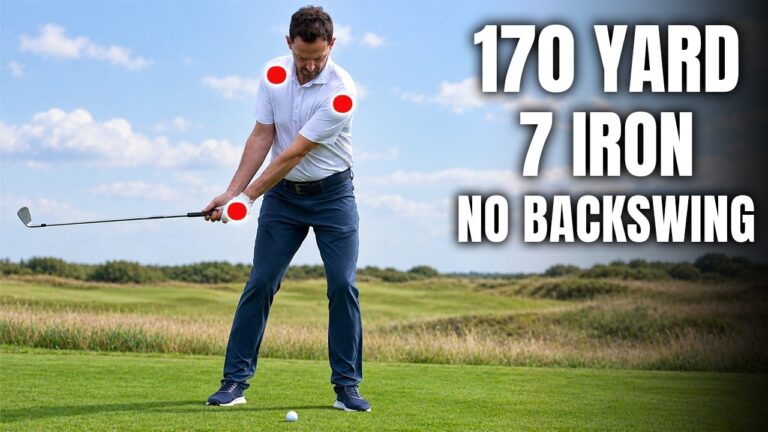

If you want to hit irons further with a short backswing, making your swing bigger is not necessarily the answer. For many golfers, especially those managing limited mobility, past injuries, or simply a preference for a compact motion, trying to create a longer backswing can lead to less consistent contact and even less distance.
Distance comes from how effectively you strike the ball and how well you accelerate the club through impact. A shorter swing can still produce impressive power when your body has a clear finish position and your clubhead speeds up at the right time.
This simple practice drill, known as the Longest Putt drill, helps you build those two essential ingredients. You will learn where your body needs to finish, how to keep your trail shoulder working correctly, and how to catapult the club through the ball without forcing a long swing.
Table of Contents
- Step 1: Understand Why a Shorter Backswing Can Still Create Distance
- Step 2: Set Up for the Longest Putt Drill
- Step 3: Build the Finish Position That Helps You Hit Irons Further With a Short Backswing
- Step 4: Rehearse the Low Trail Shoulder Move
- Step 5: Catapult the Club Through Impact for Effortless Power
- Step 6: Hit Short-Swing Iron Shots Before Adding Speed
- Step 7: Transfer the Drill Into Your Full Golf Swing
- Step 8: Use the Same Feel With Your Driver and Fairway Woods
- Step 9: Follow a Simple Practice Routine for More Iron Distance
Step 1: Understand Why a Shorter Backswing Can Still Create Distance
A compact golf swing does not have to be a powerless golf swing. The key is to stop judging potential distance by backswing length alone. A longer swing may create more potential speed, but only if you can control it and deliver the club solidly.
When your swing becomes too long for your mobility, timing, or balance, common problems can appear:
- Inconsistent strike quality
- Topped or thin iron shots
- A loss of balance through impact
- A high trail shoulder that encourages an over-the-top move
- A lunge toward the ball rather than a smooth rotation
- Reduced clubhead speed at the point where it matters most
To hit irons further with a short backswing, focus on two priorities instead:
- Know your destination. Give your body a clear, athletic finish position to organize around.
- Accelerate the club at the right time. Learn to catapult the clubhead through impact rather than trying to hit from the top of the backswing.
These ideas work together. The finish gives your swing direction and shape. The catapult action gives the club speed. You do not need to force either one.
Step 2: Set Up for the Longest Putt Drill
The Longest Putt drill is designed to make your swing feel small while teaching you a powerful movement through the ball. Begin with a 7 iron, then apply the same concept to your fairway woods and driver once the motion feels reliable.
Set up with the ball just slightly forward of center. Start with a little more pressure on your lead foot, without leaning excessively forward. You are simply favoring the lead side enough to help you establish the correct through-swing position.
Your initial goal is not to hit a hard shot. You are training a movement pattern. That means you should begin with slow rehearsals before you start hitting golf balls.
Keep the swing intentionally short
For this drill, your intended backswing is only around waist height. In practice, the club may travel slightly farther back, and that is fine. The important point is that you are not trying to manufacture speed by making a huge turn or lifting the club to a long position.
This short starting point gives you a major advantage. Your trail shoulder begins lower on the downswing, making it easier to deliver the club on a natural arc rather than throwing it over the top.
Use this compact setup as a reset whenever your normal swing feels restricted, rushed, or out of control.
Step 3: Build the Finish Position That Helps You Hit Irons Further With a Short Backswing
Before you think about speed, learn the destination. With angled golf clubs, your body needs to swing through on an angle too. A level, forward lunge does not match the shape of an iron swing and often leads to poor contact.
Rehearse your follow-through to roughly halfway through the finish. In this position, look for several clear checkpoints:
- Your weight is predominantly on your lead foot.
- Your trail shoulder is lower than your lead shoulder.
- Your eyes and ears have rotated on an angle rather than staying level.
- Your lead arm is higher than your trail arm.
- Your body has turned through the shot on a circular arc.
These details show that you are rotating through the ball rather than lunging toward it. You do not need to hold a stiff pose. Instead, use the position to understand the direction your body is moving.
When you start with the end in mind, your body has a much better chance of organizing the downswing naturally. Rather than adding multiple technical thoughts, you give yourself one useful destination: turn through to an angled, balanced finish.
Why this finish improves iron contact
A common distance killer is keeping the trail shoulder too high as you move through impact. This can make the upper body move forward toward the ball, with the shoulders and head appearing level. The result may be a top, a poor strike, or a weak shot that does not compress the golf ball.
By contrast, the angled finish encourages you to rotate around the corner. Your trail shoulder works from a lower position, your body remains on an arc, and the club can travel through impact with more freedom.
Better contact is a vital part of distance. Before searching for extra speed, make solid strike quality your first win.
Step 4: Rehearse the Low Trail Shoulder Move
Spend time practicing the through-swing without a ball. From your address position, make no backswing at all at first. Simply move into the angled finish position and become familiar with how it feels.
Your trail shoulder should turn toward the target from a lower position. This is very different from starting down with the trail shoulder high and moving across the ball. The lower trail shoulder helps the club work around your body on an arc.
Use a simple rehearsal sequence:
- Set up with slight lead-side pressure.
- Picture your angled finish position.
- Turn your body through so your trail shoulder stays low.
- Allow your arms to travel around with your body.
- Pause and check that your lead arm is higher than your trail arm.
At this stage, slow repetition matters more than hitting shots. The move can feel unfamiliar because many golfers are used to the sensation of the trail shoulder rising too early. Give yourself time to build a new reference point.
If you record your swing from face-on, use the footage to check whether you are finishing on an angle or lunging forward with level shoulders. Visual feedback can help confirm whether the feel matches the actual movement.
Step 5: Catapult the Club Through Impact for Effortless Power
Once the finish position feels more natural, add the second key to hitting longer irons: acceleration. Golf is, in many ways, a throwing action. Your task is not to push the club through impact. It is to allow the club to accelerate and catapult around the corner.
From your compact backswing, feel as though the clubhead is being sent toward the angled finish position. The club should build speed through the hitting area, not use all its effort before reaching the ball.
This is the central sensation of the Longest Putt drill. The swing remains short, but the clubhead moves with purpose through impact.
Use sound to check your acceleration
Sound provides a simple way to practice this feeling. Turn your club upside down and hold it near the clubhead end, or use an alignment stick. Make the compact swing and listen for the whooshing sound.
Your goal is to create the sound as the club moves through and around the corner. If you cannot create much sound, you may be guiding the club rather than accelerating it.
Do not try to make the loudest possible noise by swinging wildly. Instead, use the sound as feedback that the club is being catapulted through the impact area with a smooth, connected motion.
The feeling should be athletic but not violent. Your trail shoulder stays low, your body turns on an arc, and the club accelerates around you.
Step 6: Hit Short-Swing Iron Shots Before Adding Speed
Take the drill to the ball gradually. Begin with several rehearsals, then make a compact swing with the sole purpose of reaching your intended finish position.
After each shot, pause and assess what happened. Ask yourself:
- Did I finish with most of my weight on my lead foot?
- Did my trail shoulder remain lower as I turned through?
- Did I stay on an angle rather than lunge at the ball?
- Was the strike clean?
- Did I feel the club accelerate through impact?
Initially, do not worry about maximum distance. Your first job is to make solid contact while arriving in the correct finish position. A compact swing that strikes the ball well can travel surprisingly far, often farther than a longer swing with poor contact.
Once you can repeatedly strike the ball cleanly, maintain the same swing length and begin increasing the catapult sensation. You are adding speed to the same arc, not adding more backswing.
This progression is important. If you chase speed before you own the destination, old habits such as lunging, lifting the trail shoulder, or coming over the top can return quickly.
Step 7: Transfer the Drill Into Your Full Golf Swing
The Longest Putt drill is not a one-time fix. It is a practice tool that becomes more valuable through repetition. It may feel awkward at first, but regular work helps your body recognize how a powerful through-swing should feel.
When the short-swing version becomes dependable, start extending your backswing naturally. Only lengthen it as far as you can while preserving the same key elements:
- A clear angled destination
- Lead-side pressure through the finish
- A low trail shoulder as you rotate
- A club that accelerates through impact
- A balanced body turn around the corner
The drill teaches an especially useful starting point for the downswing. In the short version, your trail shoulder is already low, so you can feel how it should continue working through impact. As you build toward a fuller swing, keep that same sense of the shoulder staying low and supporting the club’s acceleration.
This can help you avoid the high trail shoulder pattern that often produces an over-the-top move. Rather than attacking the ball from above, you are learning to rotate and send the club through on its natural arc.
Step 8: Use the Same Feel With Your Driver and Fairway Woods
Although this is an excellent drill for irons, the underlying movement can also help with driver and fairway woods. The purpose remains the same: create a clear through-swing destination and accelerate the clubhead without relying on an oversized backswing.
As you move into longer clubs, resist the urge to make the motion complicated. Start with a compact rehearsal. Feel the low trail shoulder, the turn around the corner, and the clubhead accelerating through the shot.
Your full driver swing may naturally be longer than your iron drill swing, but the powerful feeling should remain familiar. You are not trying to swing harder from the top. You are allowing the club to speed up through impact with your body supporting the motion.
For more structured range work, use a practice plan for hitting longer with a shorter golf swing. Repeating short, focused sets is more productive than hitting large numbers of balls without checking your finish and acceleration.
Step 9: Follow a Simple Practice Routine for More Iron Distance
A productive session does not need to be long. The quality of your feedback matters more than the number of shots you hit. Use this sequence to reinforce how to hit irons further with a short backswing.
- Make 10 slow finish rehearsals. No ball, no backswing. Move directly into the angled finish with your trail shoulder low.
- Make 10 compact practice swings. Swing back to around waist height and catapult the club through to the same finish.
- Use sound for 5 swings. Turn the club upside down or use an alignment stick to sense acceleration through the bottom of the arc.
- Hit 10 controlled 7 iron shots. Prioritize centered contact and your finish position.
- Hit 10 more shots with slightly more acceleration. Keep the swing length unchanged while increasing the through-swing speed.
- Finish with a few natural swings. Allow the backswing to lengthen only if you can preserve the same low trail shoulder and balanced finish.
The goal is not to force a dramatic change in a single session. Over time, this compact drill can help you develop cleaner ball striking, more efficient clubhead speed, and effortless power with the swing you already have.
Frequently Asked Questions About Hitting Irons Further With a Short Backswing
Can you hit irons further with a short backswing?
Yes. A short backswing can still produce excellent distance when you strike the ball cleanly, finish on the correct angle, and accelerate the club through impact. A compact swing is often more effective than a longer swing that is difficult to control.
What is the Longest Putt golf drill?
The Longest Putt drill uses a compact, waist-high backswing to teach an angled finish and a catapult-like acceleration through impact. It helps you improve strike quality and create speed without needing a large swing.
Why does my trail shoulder matter when hitting iron shots?
Your trail shoulder should work from a lower position as you rotate through the ball. When it stays too high, you may lunge toward the ball or swing over the top, which can cause topped shots, poor contact, and lost distance.
How can sound help me create clubhead speed?
Turning the club upside down or using an alignment stick lets you hear where the club is accelerating. A clear whooshing sound through the impact area indicates that you are catapulting the club through rather than guiding it.
Can this short backswing drill help with driver distance?
Yes. The same fundamentals apply to the driver: a clear through-swing destination, a low trail shoulder during rotation, and acceleration through impact. Build the feeling with a short swing first, then let your driver swing lengthen naturally while retaining those movements.
0 Comments