
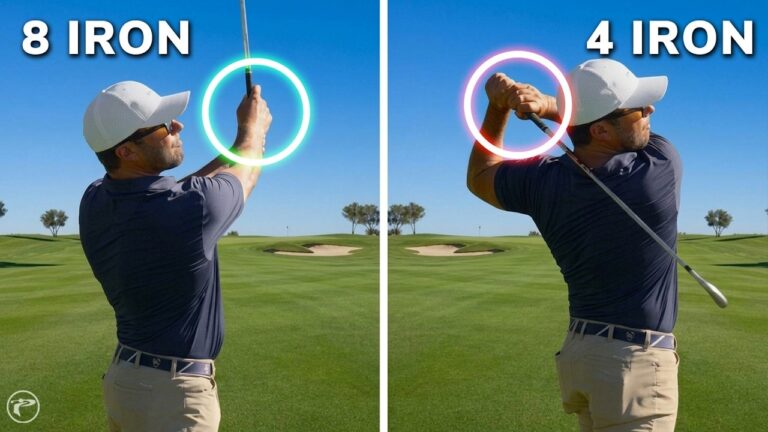

Your pitching wedge feels dependable, but your 5-iron feels like a gamble. That difference does not necessarily mean you need two separate golf swings. You need to understand what changes when the shaft gets longer and the clubface has less loft.
To hit long irons better, use a slightly wider stance, position the ball farther forward relative to your upper body, and make a slightly fuller connected turn. Through the downswing, give the longer club time to return in front of you without trying to scoop the ball into the air.
The tricky part is the release. A freer clubhead release can help if you already retain your wrist angles into the downswing. If you lose those angles early, that same thought can make contact worse.
Use the steps below to learn how to hit long irons while keeping the reliable parts of your short-iron swing.
Table of Contents
- Step 1: Understand Why Your Long Irons Feel Harder
- Step 2: Check Your Release Before Adding a New Swing Thought
- Step 3: Build Your Setup for How to Hit Long Irons
- Step 4: Let Club Length Determine Your Distance From the Ball
- Step 5: Make a Fuller Turn Without Losing Connection
- Step 6: Give Your Arms Time to Return in Transition
- Step 7: Allow the Appropriate Release and Check Your Finish
- Step 8: Practice the Changes in Order and Consider a Hybrid
Step 1: Understand Why Your Long Irons Feel Harder
A short iron gives you a shorter shaft and more loft. The club stays closer to your body, making it easier to keep your arm swing connected to your turn. You can use a compact motion and still produce a useful flight.
A long iron presents a different challenge. The longer shaft puts the clubhead farther from you, and the lower loft requires a delivery that leaves enough loft available to launch the ball.
If you carry your pitching-wedge knockdown approach straight into a stock long-iron shot, you may keep the flight lower than you want. If you try to solve that by throwing your wrists at the ball, you introduce another contact problem.
Keep the foundation, adjust the delivery
Your goal is not a dramatic swing rebuild. Preserve these fundamentals:
- A repeatable posture and natural arm hang.
- A backswing in which your hands move with your turn.
- A consistent wrist-set intention rather than a different hinge for every club.
- A balanced finish.
Change the setup, turn length, and appropriate release feel. Think of a long iron as a different application of your swing, not an entirely new motion.
Step 2: Check Your Release Before Adding a New Swing Thought
Before working on a freer release, decide whether that instruction fits your current downswing. This is an important safeguard when learning how to hit long irons.
The slot refers here to the delivery position approaching impact, with your hands near your trail thigh and an angle remaining between your lead arm and the shaft.
If you retain your wrist angle
If you arrive in that delivery position with your wrist angle intact, you may benefit from feeling the clubhead release more freely as you rotate through the ball. You do not need to keep pulling the handle forward indefinitely.
That release does not mean your clubhead must overtake your hands before contact. You can allow the club to release and still deliver your hands ahead of the clubhead at impact.
If you lose your wrist angle early
If you already throw the clubhead outward early in the downswing, avoid adding a deliberate wrist throw. Your priority is to keep the handle moving through the strike rather than encouraging the clubhead to pass your hands too soon.
A useful feel for one golfer can exaggerate another golfer’s mistake. If you cannot tell which pattern you have, get help assessing your delivery before making a major release change.
Step 3: Build Your Setup for How to Hit Long Irons
Your setup can create much of the difference you need without extra manipulation during the swing. Start with stance width and ball position, then check them together.
Widen your stance slightly
For wedges, a useful reference is to place the outside edges of your feet approximately beneath the outside edges of your shoulders. A pitching-wedge stance may be a little wider.
With a 7-iron or 8-iron, the centers of your feet can sit approximately beneath the outside edges of your shoulders. For longer irons, add a little more width.
You are looking for a modest progression, not an exaggerated spread. The narrower short-iron setup encourages a more sharply descending strike. The wider long-iron setup supports a broader bottom to the swing.
Move the ball forward relative to your chest
Reference ball position to your upper body, not just the gap between your feet. Stance width changes throughout the bag, so your feet alone can give you a misleading picture.
For a right-handed golfer, use these approximate starting references:
- Wedges: Near the center of your upper body, beneath your sternum.
- Pitching wedge: Very slightly forward of that center reference.
- Mid irons: Progressively forward, around the lead side of your face.
- Long irons: Farther toward the lead side of your chest, around the shirt-logo area.
If you play left-handed, reverse the directional references. Treat these as setup checkpoints, not measurements that override your individual delivery.
Keep a downward strike
The slightly wider stance and forward ball position help you deliver a long iron with less downward attack than a wedge. They also give the longer club more time to return and square.
You are still striking down on the ball. A shallower delivery is not an instruction to lean back or help the ball upward with your wrists.
Step 4: Let Club Length Determine Your Distance From the Ball
A longer iron places the ball farther from you, but you should not create that distance by reaching your hands away from your body.
Instead, establish your posture and allow the club’s length to determine where the clubhead meets the ground.
Use these down-the-line checkpoints:
- Your hips sit approximately over your ankles.
- Your shoulders project beyond your toes.
- Your hands hang beneath your shoulders.
- You feel balanced toward the balls of your feet rather than sitting back on your heels.
One rehearsal is to bring your trail arm in front of your body, let it settle into position, and tilt forward into your golf posture. You should feel able to lift your heels rather than easily lifting your toes.
Compare a wedge and a long iron without changing the basic relationship between your body and hands. The longer club reaches farther out. Your hands do not need to chase the ball.
This keeps the setup familiar even though the ball is farther away.
Step 5: Make a Fuller Turn Without Losing Connection
A compact, roughly shoulder-height-to-shoulder-height swing can work well for controlled short irons. Paired with body rotation and a handle-led delivery, it creates a useful knockdown feel.
For your stock long-iron shot, allow a slightly longer backswing. Get that added length from more turn, not an independent arm reach.
Keep your hands moving with your chest
As you turn back, let your hands travel with your body. Keep the same basic wrist-set intention you use with your shorter irons rather than deliberately adding extra hinge.
Your long-iron backswing does not have to reach parallel. A fuller turn that remains controlled and connected is the aim.
You can still use a shorter swing with a long iron when you deliberately want a lower knockdown shot. The mistake is treating that reduced motion as your only option, even when you need a normal launching flight.
Also avoid assuming that more backswing length automatically produces more useful distance. A loose, disconnected motion can sacrifice the efficiency you were trying to gain.
Step 6: Give Your Arms Time to Return in Transition
Your clubhead travels farther than your hands and chest. With a longer club, coordinating those movements becomes especially important.
If your upper body races open immediately from the top, the longer club can become harder to return in front of you. A helpful long-iron rehearsal is to feel your arms and hands begin moving down while your chest stays patient.
Use a patient chest, not a frozen body
For a right-handed golfer, you can rehearse keeping your right shoulder back a little longer as your hands lower. Reverse that reference if you play left-handed.
This is a sequencing feel, not an instruction to stop turning. Your hips and grip can begin moving while your upper body avoids rushing ahead.
- Turn into a connected backswing.
- Rehearse your hands lowering toward your trail thigh.
- Keep your chest from immediately spinning away.
- Continue rotating through the strike.
You are giving the longer club time to arrive, not trying to hit the ball with your arms alone.
Keep this distinction clear: hands moving down sooner does not mean wrists releasing sooner. You can lower your arms while retaining the angle needed for a sound delivery.
Step 7: Allow the Appropriate Release and Check Your Finish
With a short iron, you may feel that your core and chest carry the handle through impact. Your finish can remain compact, with the club more in front of your upper body.
With a long iron, if you retain your delivery angles, you may need a greater sense of freedom through the hitting area.
Rehearse the movement from pocket to pocket
As your hands pass your trail thigh, feel the clubhead release while your body continues turning. Rehearse that movement slowly between your trail pocket and lead pocket.
The intention is not to scoop or abruptly roll your hands. It is to avoid holding the club off so much that the longer shaft never releases naturally through the shot.
If you already lose your angles early, return to the handle-moving-through priority from Step 2 instead.
Use the finish as feedback
A stock long-iron swing can finish with the club wrapping over your shoulder and behind your neck, rather than staying in the compact short-iron finish.
Check whether you can hold your finish in balance and whether the club has completed its motion without a forced stop.
Do not force the shaft onto your neck to manufacture a position. The finish is feedback about the motion that came before it, not a substitute for good contact.
Step 8: Practice the Changes in Order and Consider a Hybrid
Build your practice around one adjustment at a time. You do not need five swing thoughts over the ball.
Use this progression to connect the setup work with your actual shot:
- Establish your short-iron baseline. Make controlled pitching-wedge swings with a connected turn and compact finish.
- Move to a mid iron. Check the gradual change in stance width and ball position.
- Set up with a long iron. Widen slightly, move the ball toward your lead chest, and preserve your natural arm hang.
- Rehearse a fuller turn. Add rotation without letting your arms wander independently.
- Choose one downswing feel. Use a patient-chest rehearsal or an appropriate release thought based on your tendency.
- Assess contact, flight, and balance. Do not judge the change only by your longest shot.
If you lose track of the setup during practice, return to the how to hit long irons setup checkpoints before adding another swing adjustment.
Avoid the common traps
- Trying to lift the ball: Keep a descending strike instead of adding a scoop.
- Using your wedge setup for every iron: Allow stance width and ball position to progress.
- Reaching for the ball: Preserve your arm hang and let shaft length create the extra distance.
- Holding the handle off indefinitely: If your angles are sound, allow the longer club to release.
- Adding release to an early throw: Address the existing angle loss first.
Choose forgiveness when it helps
You do not have to carry a long iron simply because it belongs to your iron set. A hybrid is a practical alternative if you want more help launching the ball.
Hybrids offer a lower center of gravity and a wider sole, providing more forgiveness through turf contact and making more lies playable. Their easier launch can also help you hold greens.
The same broad setup principles still apply: suitable stance width, forward ball position, and familiar posture. Changing clubs does not mean abandoning good fundamentals.
Your next step: Start with setup, then add a fuller connected turn. Only change your release once you understand your current delivery. That gives you a clear plan when you pull a longer club from the bag, instead of simply hoping your short-iron swing will work unchanged.
0 Comments