


When you struggle to hit driver straight, it can feel as though every tee shot is a mystery. One ball peels away to the right, the next turns sharply left, and then an occasional drive flies straight down the middle with no obvious explanation.
The most useful starting point is not a long list of swing positions. It is understanding one relationship that controls the curve of the golf ball: clubface-to-path. Once you can recognise and influence that relationship, you have a practical way to reduce a slice, calm a hook, and produce straighter drives.
Table of Contents
- Step 1: Understand why you cannot hit driver straight
- Step 2: Use the football image to feel face-to-path
- Step 3: Build a draw-biased setup to stop a driver slice
- Step 4: Use the opposite setup if a hook stops you hitting driver straight
- Step 5: Use ball flight to refine your driver setup
- Step 6: Check whether you lose the face-to-path relationship in your backswing
- Step 7: Use feedback to learn the correct wrist feel
- Step 8: Take one simple thought onto the tee to hit driver straight
- Step 9: Make your practice focused and repeatable
- Frequently Asked Questions
Step 1: Understand why you cannot hit driver straight
A curving golf ball is spinning. For a right-handed golfer, a slice curves to the right and a hook curves to the left. That curve is created when the direction the clubface points and the direction the club is travelling through impact do not match.
This is known as the face-to-path relationship. Think of it as the gap between two directions:
- Clubface direction: where the face is aimed at impact.
- Club path: the direction the clubhead is travelling through impact.
If you slice, the clubface is generally open relative to the path. The face may even look as though it is aimed down the fairway, but if the club is travelling left of that face, the ball will curve right. In other words, a face that looks square to the target is not necessarily square to the path.
With a hook, the opposite occurs. The clubface is closed relative to the path, creating leftward curvature for a right-handed golfer.
This is why trying to “swing straight” alone often does not solve the problem. You need the face and path to work together. The objective is not necessarily a perfect zero on every shot. It is a manageable relationship that starts the ball near your intended line and produces a predictable amount of curve.
Step 2: Use the football image to feel face-to-path
A simple football kicking image makes this concept much easier to understand. Imagine that you want to bend a football in the opposite direction to your usual slice. You would not stand square and swing directly down the intended line. Instead, you would position yourself and swing on an angle relative to where your foot is pointing.
That difference between the foot direction and the swinging direction creates the curve. The same principle applies when you hit driver straight or shape the ball with a driver.
If you normally slice, visualise the opposite shot: a gentle draw. For a right-handed golfer, that means creating a setup and swing feel that encourages the club to travel more to the right relative to the face. If you normally hook, visualise the opposite: a controlled fade or cut.
The important point is that you are not trying to make a complicated mechanical change during the downswing. You are creating a new direction and feel before the club begins moving.
Step 3: Build a draw-biased setup to stop a driver slice
For many golfers, the quickest way to stop slicing the driver is to build a corrective face-to-path relationship into the address position. This is particularly useful when you have limited practice time and need a simple on-course feel.
Start by holding the club in front of you, with the face pointing at 12 o’clock. Then turn the clubface slightly to your left, toward roughly 11 o’clock. If your slice is severe, you may need an exaggerated starting point closer to 10:30.
At this stage, the face is intentionally aiming left of the target. Do not simply twist your wrists back to square it. Instead, change your arm and upper-body alignment so the face returns toward the target while your forearms retain a useful offset.
- Turn the clubface slightly left of the target.
- Allow your lead elbow to point more toward the target.
- Allow your trail elbow to point more toward your trail hip.
- Set the clubface back toward the target using this shoulder and elbow adjustment.
- Notice that your lead forearm now sits higher than your trail forearm.
This is a deliberately unfamiliar sensation for a slicer. That is the point. Your usual motion has created rightward curve, so an opposite feel is often necessary before you can settle into a more neutral pattern.
From this setup, make a normal swing while maintaining the general forearm relationship. The intended result is a ball that may begin a little right of the target and curve back left, producing a draw. You may initially overdo the correction and hit a stronger draw or hook. Treat that as useful feedback rather than failure.
Adjust the exaggeration gradually
You do not need to keep the strongest version of this adjustment forever. Start with enough exaggeration to clearly change the ball flight. Once you see the ball turning left rather than slicing right, reduce the amount.
- If you still slice, use a stronger setup feel by turning the face closer to 10:30 before reorganising your elbows and shoulders.
- If you begin hooking, reduce the adjustment by turning the face only to 11 o’clock or 11:30.
- If the ball starts near target and only curves slightly, you are getting close to a useful face-to-path relationship.
Step 4: Use the opposite setup if a hook stops you hitting driver straight
If your common miss is a hook, reverse the process. Begin by aiming the clubface slightly to the right, around the 1 to 2 o’clock position. Then use your arm and shoulder position to bring the face back toward the target without losing the opposite forearm relationship.
This setup encourages a clubface-to-path pattern that can produce a fade rather than a hook. It may feel like a major exaggeration, especially if you normally draw the ball. Again, that is normal. You are trying to experience the opposite of your habitual delivery.

The visual result of an exaggerated open face-to-path relationship is a pronounced rightward curve. This illustrates why a positive face-to-path number, where the face aims more right than the path for a right-handed golfer, can produce a slice.
The goal is not to replace one big miss with another. Use the exaggerated setup only long enough to learn what a corrected relationship feels like, then make smaller changes until the ball flight becomes more neutral.
Step 5: Use ball flight to refine your driver setup
Ball flight gives you immediate feedback. Rather than judging a swing only by how it feels, look for the combination of start direction and curve.
| Ball flight | Likely face-to-path pattern | Practical response |
|---|---|---|
| Starts near target and curves right | Face is open relative to path | Add more draw-biased setup feel |
| Starts right and curves left | Face is closed relative to path | Reduce the draw exaggeration if the curve is too large |
| Starts left and curves farther left | Face is very closed relative to path | Use the hook correction and rehearse a fade feel |
| Starts near target with minimal curve | Face and path are working closely together | Keep the same simple setup and swing feel |
A straighter shot can come from a face-to-path figure that is close to neutral. In one example, a value around one degree out produced a straight result. The useful lesson is that small differences matter, but you should first learn the larger feel before chasing precision.
Step 6: Check whether you lose the face-to-path relationship in your backswing
A good setup is the best place to start, but it does not guarantee that you will hit driver straight. Some golfers create the right relationship at address and then unknowingly change it during the backswing.
A common problem is opening the clubface as the club travels back. You may set the face and forearms correctly, but then alter your wrist position at the top of the backswing. By the time you begin down, the original correction has disappeared and the slice returns.
The key is to identify the point at which the clubface changes. If you build a draw-biased setup, rehearse taking the club back while preserving the wrist and clubface relationship you established at address. Do not force a complicated position. Simply keep the feeling that the face has not opened during the takeaway and backswing.
This can feel very different from your normal swing. A golfer who is used to opening the face may initially feel as though the wrist is in an unusual position even when the club is simply remaining more stable.
Step 7: Use feedback to learn the correct wrist feel
When you cannot tell where the face changes, immediate feedback can be valuable. A wrist sensor such as HackMotion can indicate when your wrist movement changes the clubface relationship during the backswing.
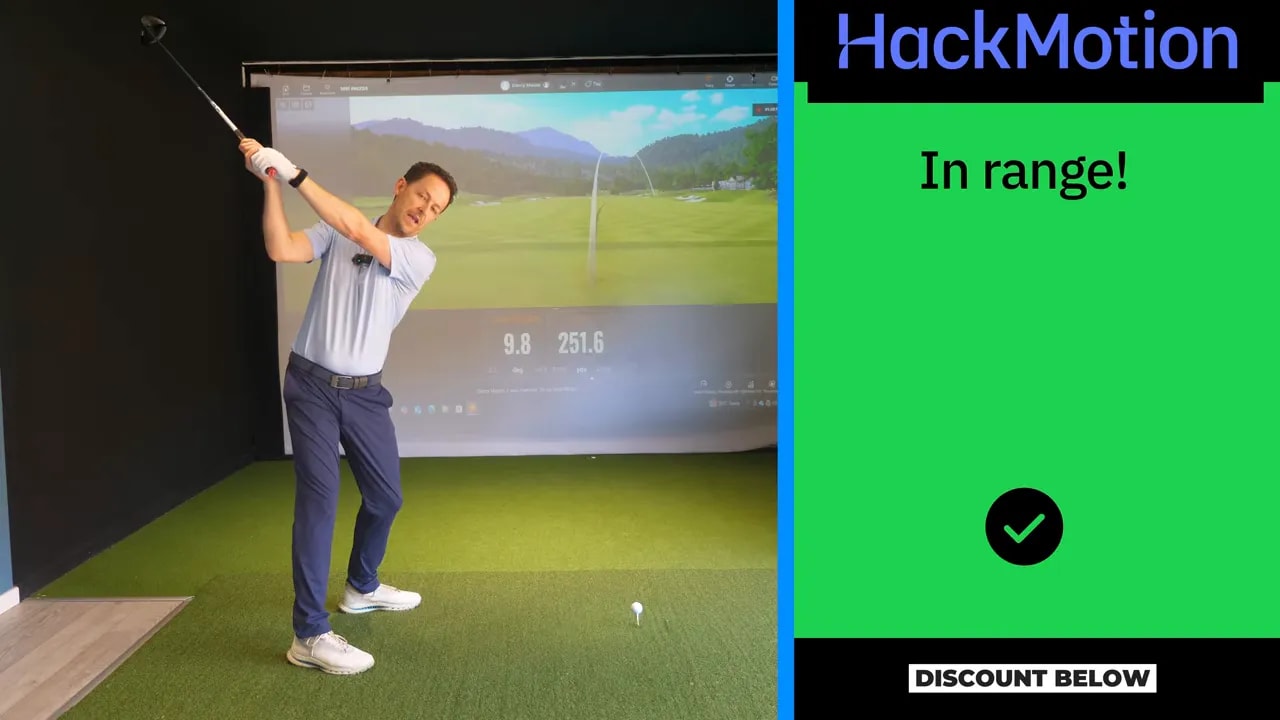
This kind of measurement is not a substitute for developing feel. Its purpose is to reveal a movement you may not sense on your own. Once you know that the face is opening at a particular point, rehearse the alternative, receive confirmation that it remains in range, and then transfer that sensation into normal shots.
A practical sequence is simple:
- Set up with your slice or hook correction.
- Make a slow backswing rehearsal.
- Maintain the wrist and clubface feel established at address.
- Pause at the top if necessary.
- Hit shots while prioritising the same feel over technical thoughts.
Technology can help you find the movement, but feel is what you can rely on when you are standing on the tee. The best practice is therefore progressive: start slowly, exaggerate the correction, hit shots, observe the curve, and gradually make the motion more natural.
Step 8: Take one simple thought onto the tee to hit driver straight
Trying to control every moving part of the golf swing rarely helps under pressure. Keep your on-course approach simple. Your primary job is to create an appropriate face-to-path relationship before you start, then preserve that relationship through the swing.
If you slice, your thought might be: set up for a gentle draw and keep the face feeling stable going back. If you hook, your thought might be: set up for a gentle fade and avoid letting the face become too closed.
Use the result to guide your next adjustment. A slice means you likely need more of the draw-biased feel. A hook means you have probably overdone it and need less. Over time, this turns random ball flight into useful information.
The same face-to-path principle also applies to irons. The club is different and your setup may vary, but the reason the ball curves remains the relationship between where the face points and where the club is travelling. Learn to manage that relationship with the driver, and you gain a transferable skill for the rest of your bag.
Step 9: Make your practice focused and repeatable
Use a short practice session to make the change stick:
- Hit several normal drives and note the typical curve.
- Make three slow rehearsals using the opposite ball-flight setup.
- Hit five shots with an exaggerated corrective feel.
- Reduce the exaggeration if you begin to overcurve the ball.
- Finish with several drives using only one clear cue.
The aim is not to manufacture a perfect golf swing. It is to develop awareness of the clubface relative to the path, create a dependable setup, and maintain that relationship well enough to produce a predictable tee shot.
Frequently Asked Questions
Why do I slice when my driver face looks square at address?
A square-looking face at address does not guarantee a square face-to-path relationship at impact. If your club path travels left of the face through impact, the face is open relative to the path and the ball can curve right.
Should I try to swing more in-to-out to hit driver straight?
Path matters, but it must be considered alongside clubface direction. A useful first step is to build a better face-to-path relationship into your setup, then make a natural swing while preserving that feel.
What should I do if the anti-slice setup makes me hook the ball?
Reduce the exaggeration. Instead of turning the face strongly left before reorganising your arms, use a smaller amount. Your target is a modest draw or a nearly straight drive, not a large hook.
Can this face-to-path method help with irons?
Yes. The same relationship controls curvature with irons as well as the driver. The setup details may differ, but matching the clubface direction more closely to the club path helps make iron shots more predictable.
0 Comments