
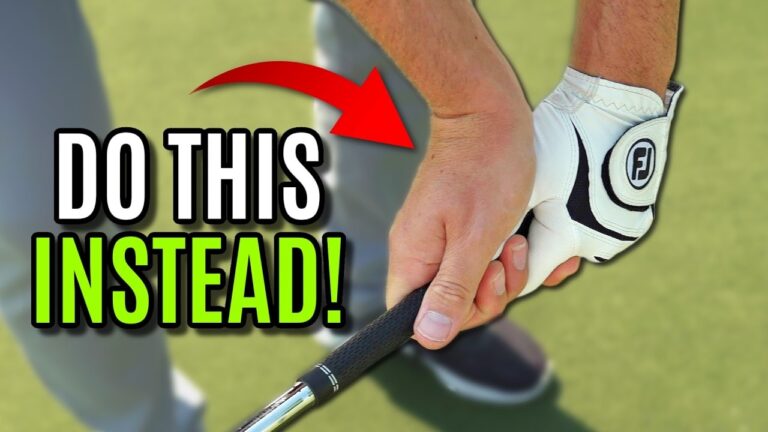

“Low and slow” has been one of the most repeated pieces of golf instruction for starting the club back. The intention is understandable. A smooth takeaway can help you avoid snatching the club away from the ball. But for many golfers, trying to keep the clubhead low for too long creates a bigger problem: the club moves too far inside, the upper body drifts away from the target, and the swing gets under plane before the backswing has really started.
A more productive golf swing takeaway thought is wide and up. Pair that with centered and turned for your body, and you have a simple framework for starting the backswing in a stronger position.
This step by step guide explains why the low and slow takeaway often goes wrong, the exact checkpoints for a wide and up golf swing takeaway, and two drills that help you build the motion without overthinking it.
Table of Contents
- Step 1: Replace Low and Slow With a Better Golf Swing Takeaway Thought
- Step 2: Understand Why Low and Slow Can Put the Club Under Plane
- Step 3: Build Width in Your Golf Swing Takeaway
- Step 4: Get the Clubhead Up While Your Hands Stay Below Hip Height
- Step 5: Keep Your Body Centered and Turned
- Step 6: Use the Lead-Hand-Only Drill to Learn Width and Turn
- Step 7: Use the Trail-Hand-Only Drill to Exaggerate Width
- Step 8: Blend the Drills Into a Full Golf Swing Takeaway
- Step 9: Check Your Golf Swing Takeaway From Two Camera Angles
- Step 10: Use This Golf Swing Takeaway Checklist on the Range
- FAQ
Step 1: Replace Low and Slow With a Better Golf Swing Takeaway Thought
The problem with “low and slow” is not necessarily the desire for a controlled start. The issue is how easily golfers interpret it. In an effort to drag the clubhead low along the ground, you may pull the club sharply behind you. That sends the shaft and clubhead too far to the inside of the target line.
Once the club gets excessively inside early, you often need compensations later in the swing. You may lift the club abruptly, reroute it during the downswing, lose face control, or struggle to strike the turf consistently. It can make a simple swing feel like a complicated rescue mission.
Instead, use this golf swing takeaway phrase:
- Wide with your arms and hands.
- Up with the clubhead.
- Centered with your head and upper body.
- Turned with your chest and core.
This does not mean you should force the club straight back or rigidly hold your body still. It means the club, arms, and body should work together so the club travels on a useful early path.
Step 2: Understand Why Low and Slow Can Put the Club Under Plane
At address, the clubshaft creates an angled reference line when seen from down the line. During a sound takeaway, the club should generally work up along that setup shaft line rather than immediately disappearing far behind your body.
When you try to keep the clubhead low and slow for too long, it often travels low and inward. The handle can become narrow, the clubhead can stay below the hands, and the shaft can work under the intended plane.
This pattern is frequently accompanied by too much lateral body movement. Rather than turning around a stable center, your head and chest may drift away from the target. That movement makes it harder to create proper width and can leave you out of position before the club reaches waist height.
A reliable golf swing takeaway should make the rest of the motion easier. If the club starts on a workable plane, you have a better chance of returning it to the ball with a descending strike, a divot after the ball, and solid compression.
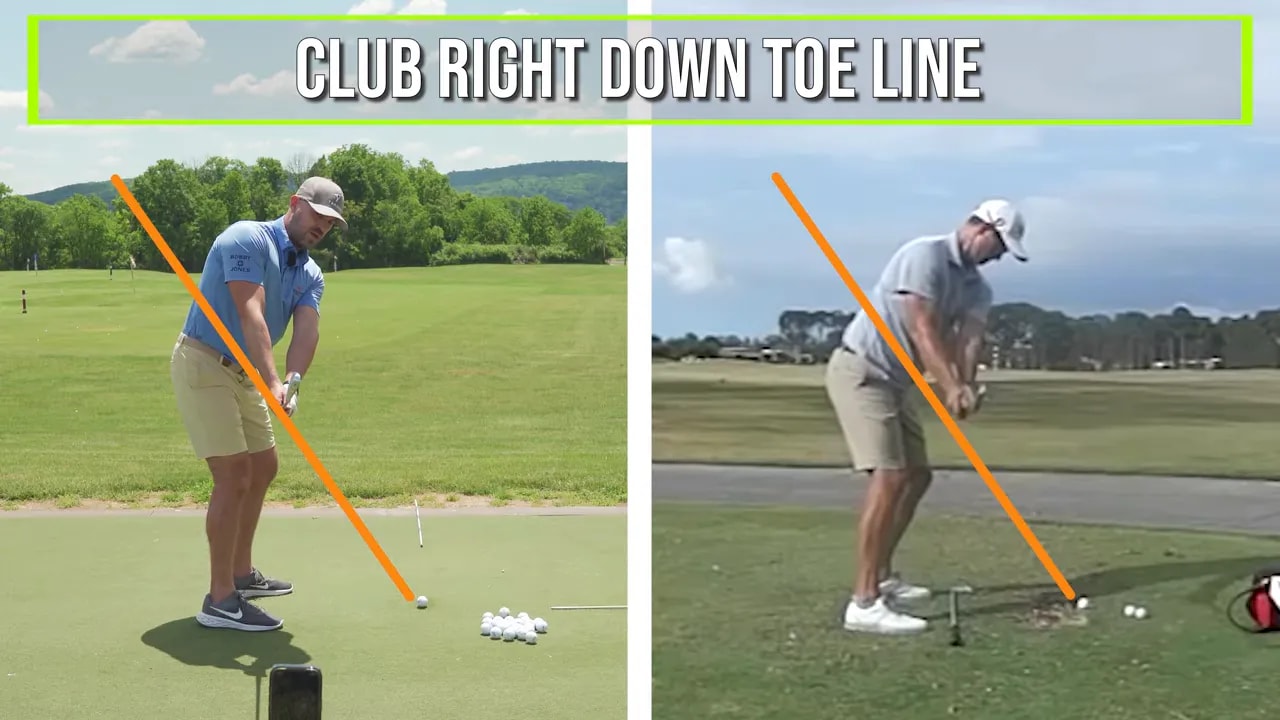
What an overly inside takeaway often feels like
You may recognize this issue if you feel as though you:
- Roll the clubhead behind your trail leg immediately.
- Pull your hands inward toward your body instead of away from it.
- Shift your head and chest away from the target during the first part of the backswing.
- Need to lift the club steeply after taking it back too flat.
- Struggle with inconsistent contact, blocks, hooks, or an overly shallow downswing.
The solution is not to make the takeaway stiff or mechanical. Your goal is simply to establish better early geometry.
Step 3: Build Width in Your Golf Swing Takeaway
“Wide” refers to the relationship between your hands, arms, and body during the beginning of the backswing. You want the club handle to move outward enough that, when the shaft is roughly parallel to the ground, the butt end of the club is outside your trail thigh.
For a right-handed golfer, that means the handle should be outside the right thigh rather than tucked tightly behind it. For a left-handed golfer, reverse the directions.
Width is valuable because it helps you create space and gives your swing room to develop. A narrow, inward takeaway tends to collapse the structure of the backswing. A wider arm and hand path helps the club move around you without getting trapped behind you.
Do not confuse width with reaching. Your arms should not become rigid, and you do not need to push the club far away from your body with tension. The wider position comes from a coordinated turn of the torso, not from trying to move your hands independently.
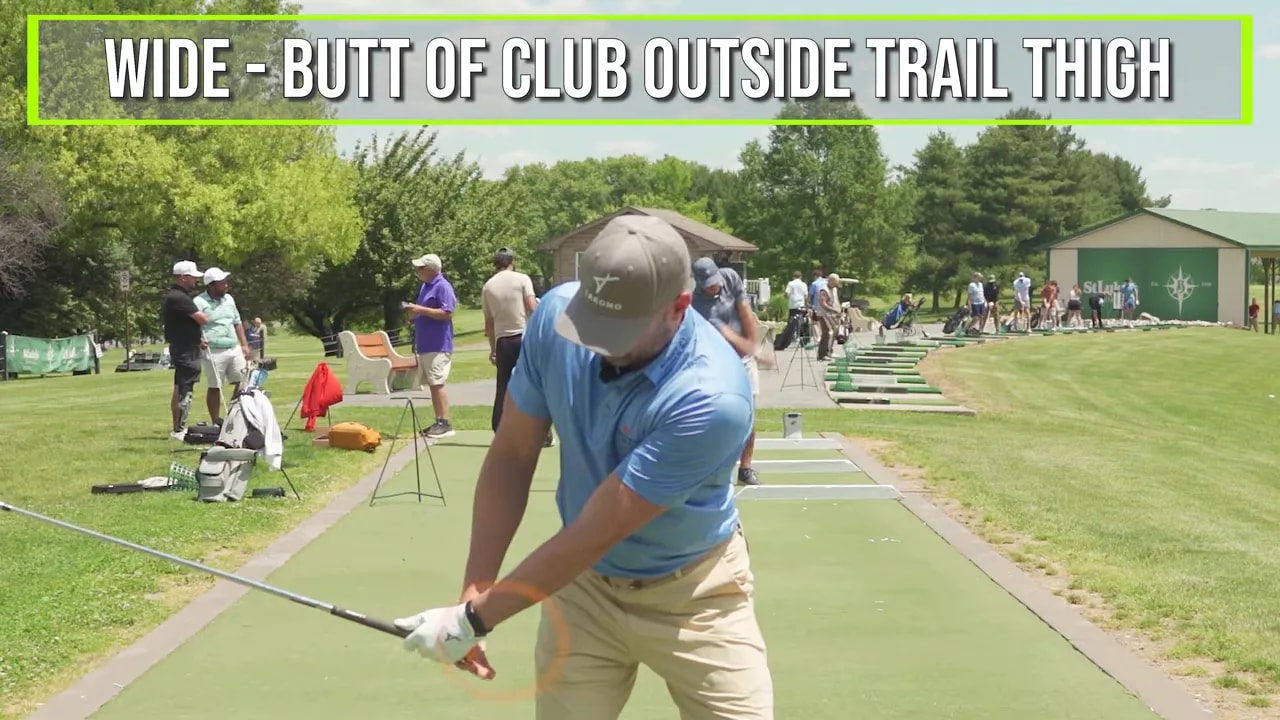
Wide takeaway checkpoint
Pause your swing when the shaft is about parallel to the ground. Check whether the butt end of the club is outside your trail thigh. If it is trapped behind the leg, your takeaway is likely too narrow and too inside.
This one checkpoint gives you a clear alternative to the vague command to keep the club low and slow.
Step 4: Get the Clubhead Up While Your Hands Stay Below Hip Height
The second half of the wide and up golf swing takeaway is the clubhead position. When your hands are just below hip height, the clubhead should be above your hip.
That is the “up” part of the movement. It does not mean lifting your arms vertically or picking the club up with your wrists. Instead, as the hands and arms move with width, the clubhead starts to rise naturally. This early rise helps create useful hinge and puts the club in a better position to travel back down.
The simple golf principle is that a club that gets up can come down. When the clubhead rises appropriately in the takeaway, it is easier to deliver the club to the ground, take a divot, and compress an iron shot.
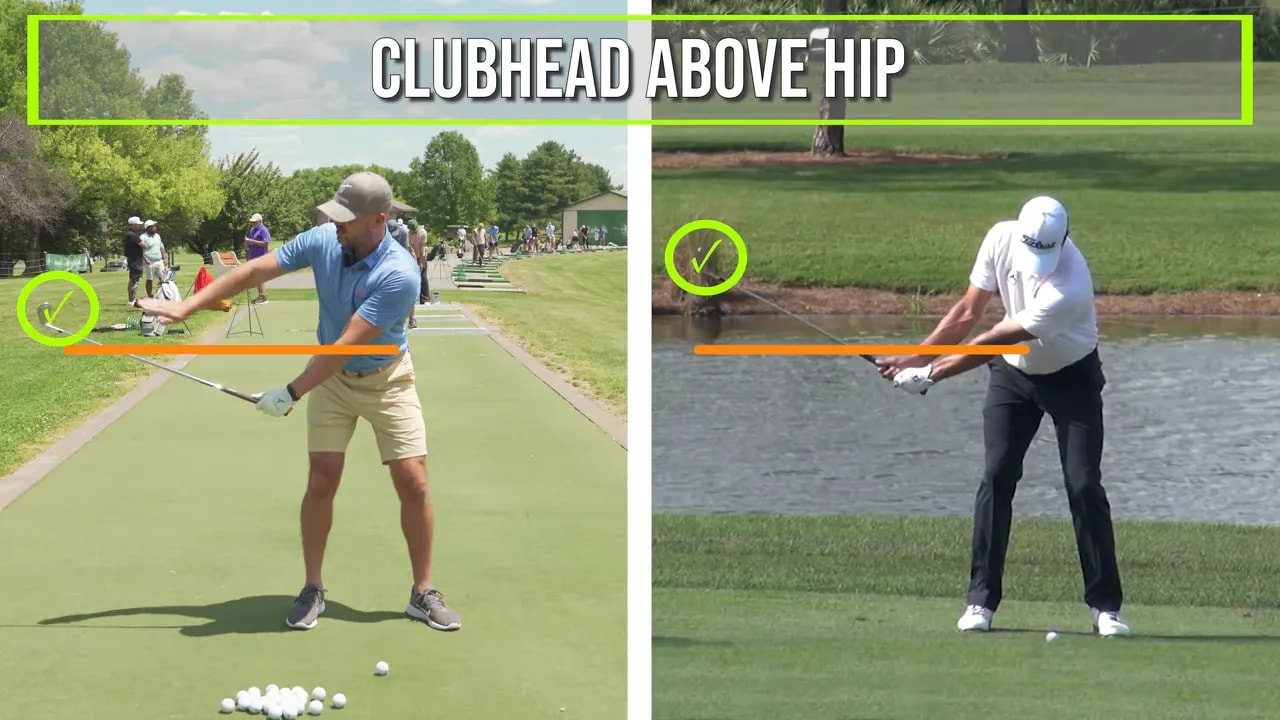
Upward clubhead checkpoint
- Your hands are just below hip height.
- Your clubhead is above hip height.
- Your club handle remains outside the trail thigh.
- The club is working up around the setup shaft plane rather than far under it.
Elite players such as Adam Scott and Nelly Korda demonstrate this blend of width and early clubhead rise. Their takeaway positions are not identical in every detail, but the shared pattern is clear: the arms and hands have width, and the clubhead is already moving upward instead of being dragged low behind the body.
Step 5: Keep Your Body Centered and Turned
Club position is only part of a successful golf swing takeaway. Your body motion has to support it. The companion phrase for your body is centered and turned.
Centered means your head and upper body remain relatively stable rather than drifting noticeably away from the target. You do not need to freeze your head in place, but avoid allowing the first movement of your backswing to become a sway.
Turned means your chest, core, and lead shoulder rotate away from the target. Your lead shoulder should work down and in under your chin as you turn. This gives your arms room to move wide without forcing them away from your body.
Without a turn, creating true width is nearly impossible. If your chest stays facing the ball while you try to move the club wide, you will likely reach with your arms or shift your body off the ball. A centered turn lets you create width while maintaining your posture and balance.
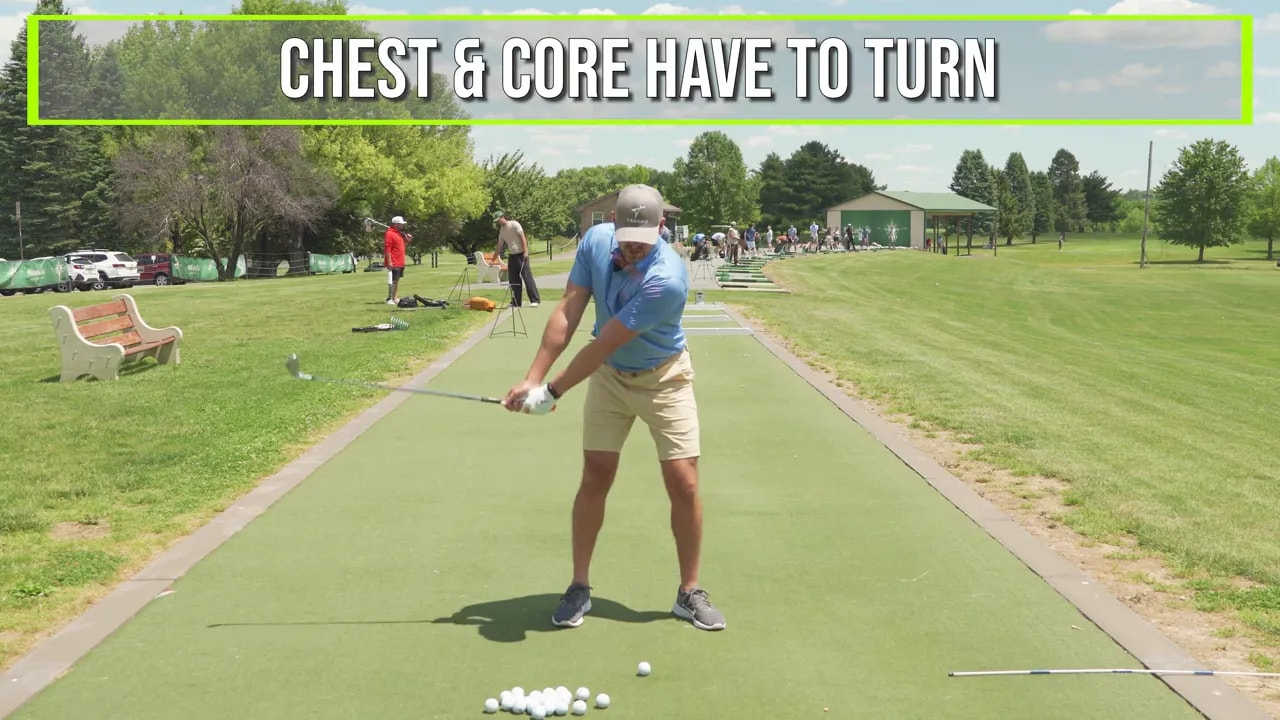
Body-motion checklist
As you begin the backswing, feel these movements working together:
- Your head stays near its starting location.
- Your chest turns away from the target.
- Your lead shoulder moves back, down, and under your chin.
- Your core turns while your lower body remains balanced.
- Your hands and arms move wide as the clubhead moves up.
For more help with this relationship, use the golf swing takeaway checklist near the end of this guide during every practice session.
Step 6: Use the Lead-Hand-Only Drill to Learn Width and Turn
The lead-hand-only drill is an excellent starting point because it makes you organize the takeaway with your body instead of relying on a quick roll of the wrists.
For a right-handed golfer, use only your left hand. For a left-handed golfer, use only your right hand.
How to do the lead-hand-only drill
- Set up normally with a club, holding it only with your lead hand.
- Start the club back slowly enough to feel your body motion.
- Move your hands slightly beyond your trail thigh, creating width.
- Allow the clubhead to rise above hip height while your hands remain below hip height.
- Keep your head centered while turning your chest away from the target.
- Feel your lead shoulder move back and down underneath your chin.
- Make one or two rehearsals, then return both hands to the club and hit a shot.
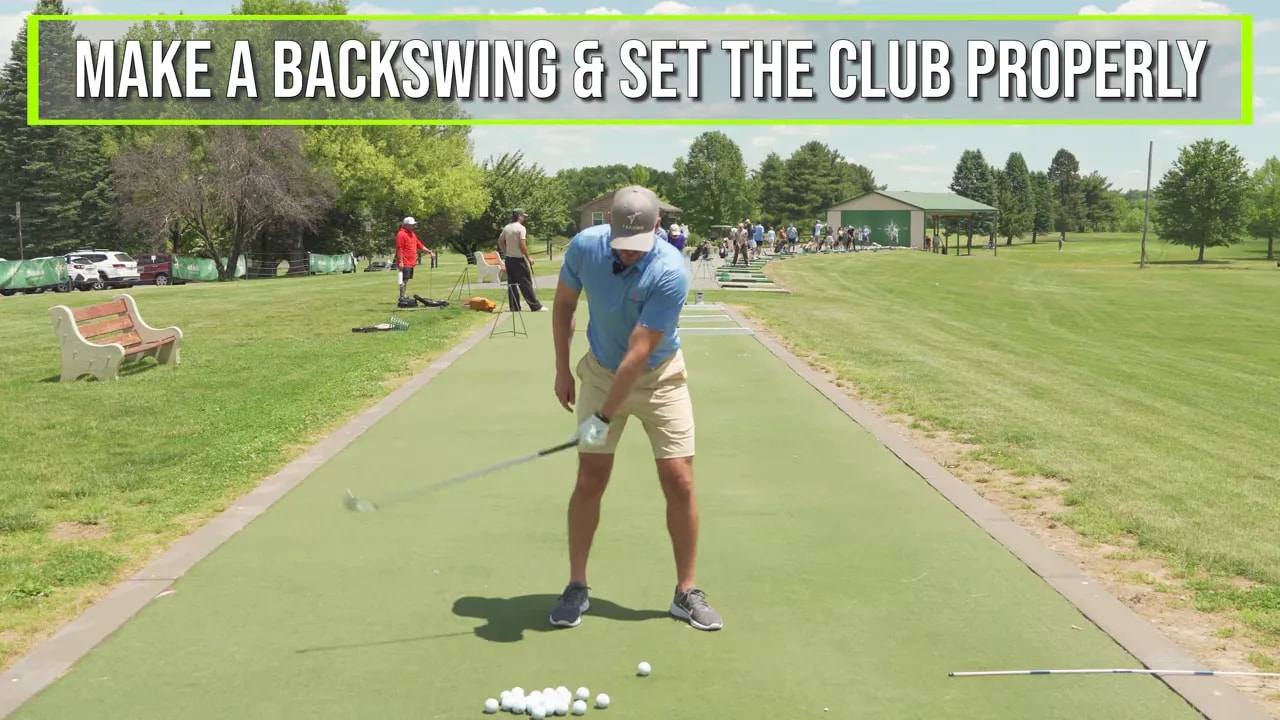
The purpose is not to hit full-speed shots with one hand. Use it as a rehearsal that teaches the correct shape. After a few rehearsals, add your trail hand and try to preserve the feeling of wide hands, an up clubhead, and a turning chest.
A useful internal feel is that your hands are moving along your toe line while your lead shoulder and chest turn away from the target. This helps you avoid pulling the club sharply behind you.
Step 7: Use the Trail-Hand-Only Drill to Exaggerate Width
If you still take the club too far inside, the trail-hand-only drill gives you a stronger exaggeration. The drill is intentionally bigger than your final golf swing takeaway position. Its job is to help you feel the amount of width and torso turn you may be missing.
How to do the trail-hand-only drill
- Set up with only your trail hand on the club.
- Keep the slight bend you had in your trail arm at address. Do not lock it straight.
- Move the club back with exaggerated width, allowing the trail arm and club to extend roughly a foot outside the trail thigh.
- Feel as though you do not add any extra bend to the trail arm during this short move.
- Keep your head centered rather than allowing your body to sway away from the target.
- Turn your chest so your lead hand could reach the club without a body drift.
- Add the lead hand back on the club and recreate a less exaggerated version of the position.
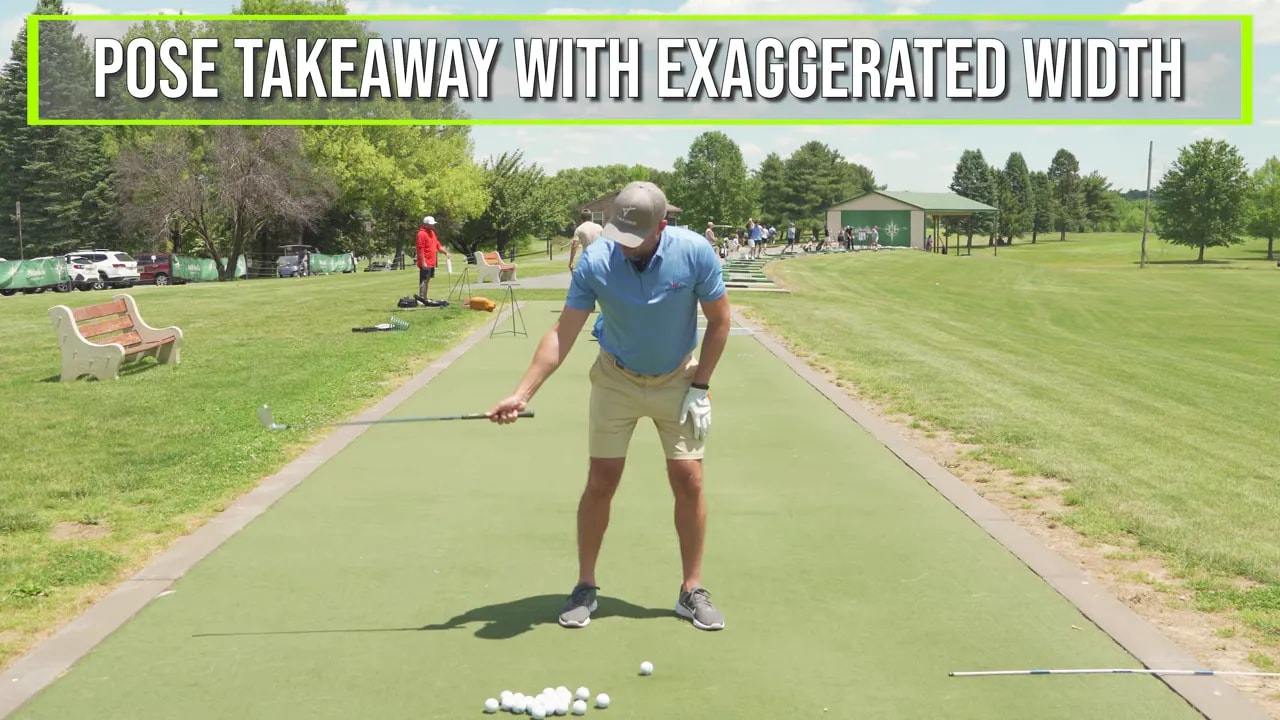
The trail-hand drill makes one important point very clear: if the club is wider, your body has to turn. You cannot reach the lead hand to the club in this wider position unless your lead shoulder and chest have moved properly.
That is exactly why the two mantras belong together. You need wide and up with the club, but you need centered and turned with the body.
Step 8: Blend the Drills Into a Full Golf Swing Takeaway
After rehearsing both drills, blend them into your normal pre-shot routine. You do not need a lengthy practice swing. One or two purposeful rehearsals are enough.
- Make a lead-hand-only rehearsal to find centered turn, width, and early clubhead rise.
- Make a trail-hand-only rehearsal if you need more width.
- Put both hands on the club.
- Repeat the same takeaway feeling with a normal swing.
- Evaluate the first few feet of the motion rather than trying to fix everything at once.
A good swing beginning makes the downswing less complicated. With the club on a better plane, your transition has less work to do. You are more likely to return the clubhead to the ball with solid contact instead of trying to recover from an overly inside takeaway.
Step 9: Check Your Golf Swing Takeaway From Two Camera Angles
Video feedback can make these checkpoints much easier to understand. Record a few swings from down the line and face on. You do not need a perfect camera setup to get useful information, but keep the phone stable and capture your full motion.
Down-the-line check
From down the line, look at the club during the first part of the backswing. The club should work generally up along the setup shaft line. If it immediately disappears under that line, it is likely moving too low and too far inside.
Face-on check
From face on, check whether your head remains centered as your chest turns. You should see rotation, not a pronounced drift away from the target. At the takeaway checkpoint, verify that the handle is outside your trail thigh and the clubhead is above hip height while the hands are still below it.
Apps that provide swing-plane overlays can give you an additional visual reference, but the key is to use them for a few simple measurements. Avoid chasing dozens of positions. Start by improving the first move away from the ball.
Step 10: Use This Golf Swing Takeaway Checklist on the Range
Use this short routine to keep your golf swing takeaway practice simple and repeatable.
- Thought 1: Wide and up with the arms, hands, and clubhead.
- Thought 2: Centered and turned with the body.
- Checkpoint 1: The butt of the club is outside the trail thigh.
- Checkpoint 2: The clubhead is above hip height when the hands are below hip height.
- Checkpoint 3: The head stays centered as the chest turns.
- Drill 1: Make one or two lead-hand-only rehearsals.
- Drill 2: Add a trail-hand-only exaggerated-width rehearsal if the club still works inside.
Start with short swings and slow rehearsals. Once the takeaway feels more natural, hit normal shots while retaining only one clear swing thought. Trying to force every checkpoint during a full-speed swing can create tension. Use the drills to build the motion, then trust the simpler feel on the course.
FAQ
Is low and slow always bad in the golf swing takeaway?
No. The original intent, starting the club back smoothly, is useful. The problem arises when low and slow causes the club to travel too far inside and under plane or causes your upper body to drift away from the target.
What does wide and up mean in a golf swing takeaway?
Wide means the hands and club handle move far enough from your body that the butt of the club is outside your trail thigh. Up means the clubhead rises above hip height while your hands are still just below hip height.
Should my head stay completely still during the backswing?
No. The goal is not to freeze your head. Keep it relatively centered rather than allowing a noticeable sway away from the target. Your chest and core still need to turn during the takeaway.
Why does my golf club go too far inside on the takeaway?
This often happens when you drag the clubhead low behind you, roll the club inward with your hands, or move your upper body away from the target instead of turning. The wide and up and centered and turned feels directly address those tendencies.
How often should I practice the lead-hand-only drill?
Use one or two rehearsals before hitting balls during a range session. It is a quick way to remind your body how to create width, clubhead rise, and a centered turn without overloading your full swing.
Does this golf swing takeaway advice work for every handicap?
These are useful checkpoints for golfers of different ability levels because they focus on the early fundamentals of club path, width, and body turn. Keep the rehearsal simple and choose the feel that best corrects your own takeaway tendency.
0 Comments