
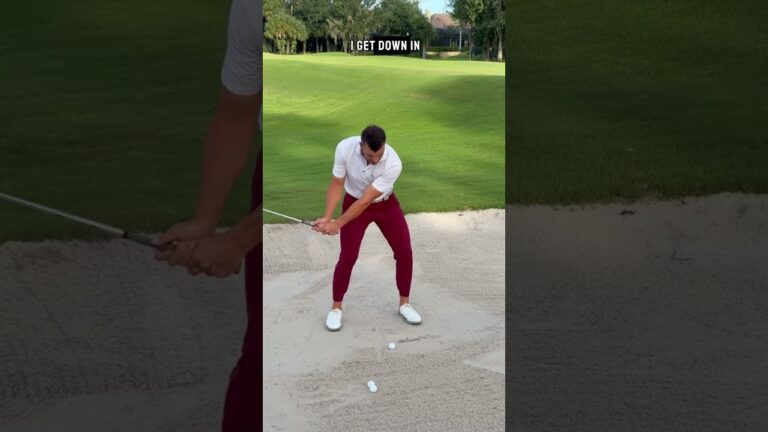

Chunked and thin bunker shots are among the most frustrating mistakes in golf. The good news is that both problems often come from the same source: using the wedge’s bounce incorrectly. When you understand how the sole of your wedge should interact with sand, bunker play becomes far more predictable.
This step-by-step golf guide explains how to set the clubface, manage shaft lean, choose an entry point, and practice a repeatable splash shot. The objective is not to strike the ball first. Your wedge should enter the sand behind the ball, glide through it, and let the sand lift the ball out.
Table of Contents
- Step 1: Understand Why Golf Bunker Shots Get Chunked or Thinned
- Step 2: Open the Clubface to Activate Bounce in Golf Bunkers
- Step 3: Use a Small Amount of Forward Shaft Lean
- Step 4: Choose the Right Sand Entry Point
- Step 5: Make a Through-the-Sand Golf Swing
- Step 6: Match Your Expectations to Your Wedge Design
- Step 7: Diagnose Your Most Common Golf Bunker Mistake
- Step 8: Use a Focused Golf Bunker Practice Drill
- Step 9: Take This Golf Bunker Checklist to the Course
Step 1: Understand Why Golf Bunker Shots Get Chunked or Thinned
A standard golf bunker shot is a sand-first shot. The wedge moves into the sand behind the ball, and the displaced sand carries the ball upward and forward. If the club digs too deeply, it can stay buried in the sand and produce a chunked shot that barely escapes. If the sole skips into the ball or the leading edge sits too high, the result can be a thin shot that races across the green.
The key part of the wedge is its bounce. Bounce is the portion of the sole that sits below the leading edge. It is designed to resist digging and help the clubhead slide through sand.
For bunker play, the goal is balance:
- Too little bounce exposure: the leading edge wants to cut downward and dig.
- Too much bounce exposure: the club may strike the sand too far behind the ball or skim into the ball.
- Useful bounce exposure: the sole enters the sand, glides, and throws enough sand to move the ball.
Many golfers try to add loft by completely removing forward shaft lean. That may expose more bounce, but it also lifts the leading edge farther from the sand. Your margin for error then becomes very small, which can create both heavy and thin golf bunker shots.
Step 2: Open the Clubface to Activate Bounce in Golf Bunkers
Start by opening the wedge face approximately 15 degrees. An open face exposes more of the sole and helps prevent the leading edge from immediately burrowing into the sand. It also adds loft, which helps the ball come out higher.

Opening the face does not mean that you should simply lay the club flat and hope the bounce does all the work. The more you open the face, the more the leading edge rises. This can be helpful for loft, but it also requires more precision with where the club enters the sand.
Use the open face as a starting point rather than a reason to make a radically different swing. A practical golf bunker setup should allow the wedge to use its sole while still arriving with enough forward lean to control the bottom of the swing.
What happens with a square clubface?
With a square face, the leading edge is more likely to enter the sand first. In soft sand, that can cause the clubhead to dig abruptly. If you often take a deep trench and leave the ball in the bunker, a slightly more open face can help the club glide instead of burying.
Step 3: Use a Small Amount of Forward Shaft Lean
The most important detail in this golf bunker technique is modest forward shaft lean. A useful target is approximately 5 degrees of forward shaft lean through impact.
That is enough forward lean to give you a dependable entry point without driving the leading edge sharply into the sand. It preserves the wedge’s bounce while making contact more repeatable.
For a right-handed golfer, at the point where the wedge enters the sand, the shaft should point roughly toward the inside portion of the left thigh or left pocket area. If the shaft points back toward the center of your body, there may be too little forward lean. If the handle is pushed well ahead toward the middle of the left thigh, you are likely adding too much lean and encouraging the leading edge to dig.

This is a small adjustment, not a handle drag. In golf, players often hear that hands should lead at impact. That principle can be useful, but an exaggerated version is a common bunker mistake. Excessively dragging the handle forward reduces the help you get from the bounce.
A simple impact checkpoint
Make slow practice motions without hitting a ball. Stop where the club would enter the sand and check the shaft direction. Your hands should be slightly ahead, not dramatically ahead. This small amount of forward lean is the middle ground between digging the leading edge and exposing so much bounce that the club skips.
Step 4: Choose the Right Sand Entry Point
For a standard greenside golf bunker shot, aim to enter the sand about 3 inches behind the ball. This is a reliable starting point for building consistent contact.
The club is not trying to scoop the ball cleanly from the sand. It should strike sand first, continue through the strike, and move the sand toward the target. If you consistently enter much farther behind the ball with a conventional wedge, the bounce may hit the sand first and leave the clubhead too high or too far from the ball.

A closer entry point may be appropriate when you are trying to create a shot with more spin, but it demands more precise contact. Begin with 3 inches behind the ball before experimenting.
Use this simple practice reference:
- Place a ball in the sand.
- Identify a spot roughly 3 inches behind it.
- Make practice swings that brush the sand at that point.
- Check whether the wedge continues through the sand rather than stopping in a deep divot.
Your entry point matters more than trying to help the ball into the air. A properly delivered wedge and a shallow splash of sand produce the height.
Step 5: Make a Through-the-Sand Golf Swing
Once the face is open and the shaft is set with modest forward lean, make a committed swing through the sand. The clubhead should not quit at the entry point. A hesitant motion often leaves the wedge trapped in the sand and causes a chunk.
Focus on returning the club to the intended impact position. Feel the wedge entering the sand behind the ball with the shaft directed through your left pocket area, then allow the sole to move through the sand. The ball should come out as a result of the sand being moved, not because you tried to pick it cleanly.

Good bunker contact generally produces a visible burst of sand that travels forward. If the club cuts deeply and produces a heavy crater, review your shaft lean and clubface position. If the club barely touches the sand and the ball comes out thin, check whether the face is excessively open or whether you are entering too far behind the ball.
Keep the task simple
Do not overload your golf swing with several competing thoughts. Use one clear intention: open face, slight forward lean, enter the sand 3 inches behind the ball, and swing through. This gives you a practical sequence for most standard bunker lies.
Step 6: Match Your Expectations to Your Wedge Design
Not every wedge has the same amount of bounce or sole width. A wedge with more bounce and a wider sole can be more forgiving in sand because it is better able to resist digging. A wedge with less bounce may require greater precision in how you deliver the sole.
For example, the BX-1 wedge referenced in the source material has a wide sole and 25 degrees of bounce. That design can allow contact farther behind the ball, around 3 to 6 inches, while still helping the club glide through the sand rather than dig.
That does not mean you need a specialized wedge to improve at golf bunker shots. You can practice the same core skill with the wedge already in your bag. Learn where its sole contacts the sand when the face is open and the shaft is slightly forward. The more accurately you understand that interaction, the better you can judge your entry point.
A useful rule is to avoid copying a larger entry distance unless your wedge’s bounce and sole design can support it. With a typical wedge, beginning around 3 inches behind the ball gives you a clearer contact reference.
Step 7: Diagnose Your Most Common Golf Bunker Mistake
Use the result of the shot to identify what to adjust. Change one variable at a time so you can learn what the sand and wedge are telling you.
If you chunk the ball
- Check for too much forward shaft lean and excessive handle drag.
- Make sure the clubface is not left square when the sand is soft.
- Confirm that you are swinging through rather than stopping the club in the sand.
- Practice letting the bounce contact the sand instead of trying to drive the leading edge downward.
If you thin the ball
- Check whether the clubface is opened so much that the leading edge sits too high.
- Make sure the club is not entering the sand too far behind the ball.
- Return to the 3-inch reference point behind the ball.
- Keep slight forward shaft lean so the club does not simply skip into the ball.
If contact changes from shot to shot
- Use the 5-degree forward-shaft-lean checkpoint in slow rehearsals.
- Practice striking a consistent point in the sand before adding speed.
- Keep the face opening and entry point consistent from shot to shot.
- Judge success by predictable sand contact first, then by where the ball finishes.
Consistency in golf bunker play comes from a repeatable bottom of the swing. Once you know where the wedge contacts the sand and how its bounce reacts, you can begin to adjust distance and trajectory with confidence.
Step 8: Use a Focused Golf Bunker Practice Drill
Practice without trying to hole every shot. This drill trains the contact pattern that helps eliminate chunks and thins.
- Draw or identify a small mark in the sand.
- Set the clubface slightly open, around 15 degrees.
- Rehearse impact with a small amount of forward shaft lean, about 5 degrees.
- Make practice swings that enter at the mark and glide through the sand.
- Add a ball approximately 3 inches ahead of your intended entry point.
- Evaluate the sand pattern, not just the ball flight.
When the wedge enters the sand at a predictable spot and exits without digging severely, you have the foundation for solid golf bunker shots. Repeat that pattern until it feels natural, then use the same setup for routine greenside sand shots.
Step 9: Take This Golf Bunker Checklist to the Course
Before playing a standard bunker shot, run through this short checklist:
- Clubface: slightly open, about 15 degrees.
- Shaft: slightly forward, about 5 degrees rather than extreme handle drag.
- Entry point: start about 3 inches behind the ball.
- Strike: sand first, then continue through.
- Intent: let the bounce glide through the sand.
The takeaway for better golf bunker shots is simple. Do not try to force the wedge’s leading edge into the sand, and do not remove all forward shaft lean in an effort to add loft. Use an open face, a small amount of forward lean, and a consistent sand entry point. That combination gives the bounce room to work while maintaining a much larger margin for error.
Step 10: Golf Bunker Shot FAQ
How far behind the ball should you hit in a golf bunker?
For a standard greenside bunker shot, begin by entering the sand about 3 inches behind the ball. This gives the sand enough space to lift the ball while keeping the strike close enough for consistent contact.
Should you open the clubface for a golf bunker shot?
Yes. Opening the clubface by roughly 15 degrees exposes more bounce, adds loft, and helps the wedge glide through sand instead of allowing the leading edge to dig immediately.
Should your hands be forward in a bunker shot?
Your hands should be only slightly forward. About 5 degrees of forward shaft lean provides a useful balance between controlling the entry point and allowing the wedge bounce to work.
Why do I keep thinning golf bunker shots?
Thin shots can occur when the face is opened too much, lifting the leading edge high off the sand, or when the wedge enters too far behind the ball and skips forward. Return to a slightly open face, modest shaft lean, and an entry point around 3 inches behind the ball.
0 Comments