
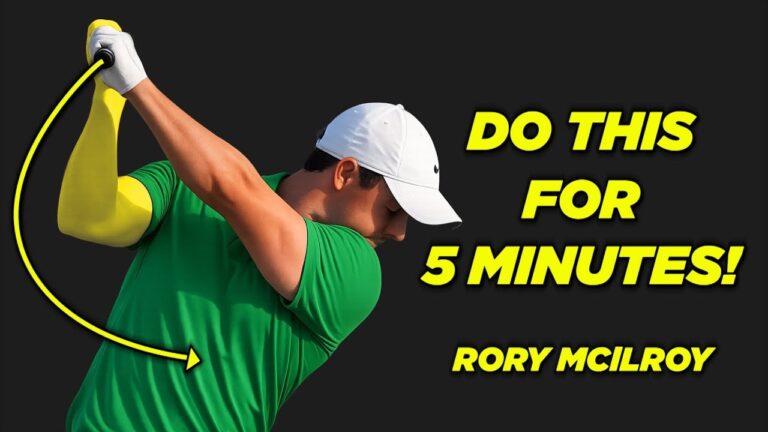

If you want to improve your golf swing quickly, there are two ideas here that can make an immediate difference. The first is a backswing move that creates more space, more depth, and an easier path into the ball. The second is a downswing move that helps you shallow the club, tilt correctly, and strike the ball from the inside.
These are not complicated positions built on endless mechanical thoughts. They are simple feels you can take straight into your golf practice. When you combine them, your golf swing becomes more compact, more powerful, and often much more repeatable.
The big theme is this: turn early going back, then lower the right side correctly coming down.
Table of Contents
- Step 1: Build a better golf backswing by turning early
- Step 2: Create the “corridor” that makes golf ball striking easier
- Step 3: Use a wall drill to train depth in your golf swing
- Step 4: Take the early-turn feel from practice to the golf course
- Step 5: Learn what elite golf drivers do at the top
- Step 6: Use Rory’s golf backswing and transition keys
- Step 7: Add the “magic move” to improve your golf downswing
- Step 8: Rehearse the right-eye feel to shallow the club in golf
- Step 9: Understand the golf difference between Rory’s driver and iron swing
- Step 10: Use one finishing cue to improve your golf sequence
- Step 11: Check your golf positions without becoming overly mechanical
- Step 12: Build a simple golf practice plan around these moves
- Frequently Asked Questions
- Final thoughts on using this move to improve your golf
Step 1: Build a better golf backswing by turning early
One of the fastest ways to improve your golf ball striking is to get your trail shoulder out of the way early in the backswing. That early turn creates room for your hands to move deeper behind you instead of lifting too much or getting trapped out in front.
When your trail shoulder stays in place too long, your arms run out of space. That usually leads to a steep, awkward transition. But when you turn early, several good things happen at once:
Your hands move deeper.
Your arms stay more connected to your body.
You create a better route to attack the ball from the inside.
You increase the amount of travel in the swing, which can help clubhead speed.
This deeper hand position at the top is especially useful for amateur golf players. It places the trail elbow in a more functional spot and makes the start of the downswing simpler. Instead of forcing the club down into position, your arms can fall more naturally into the slot.
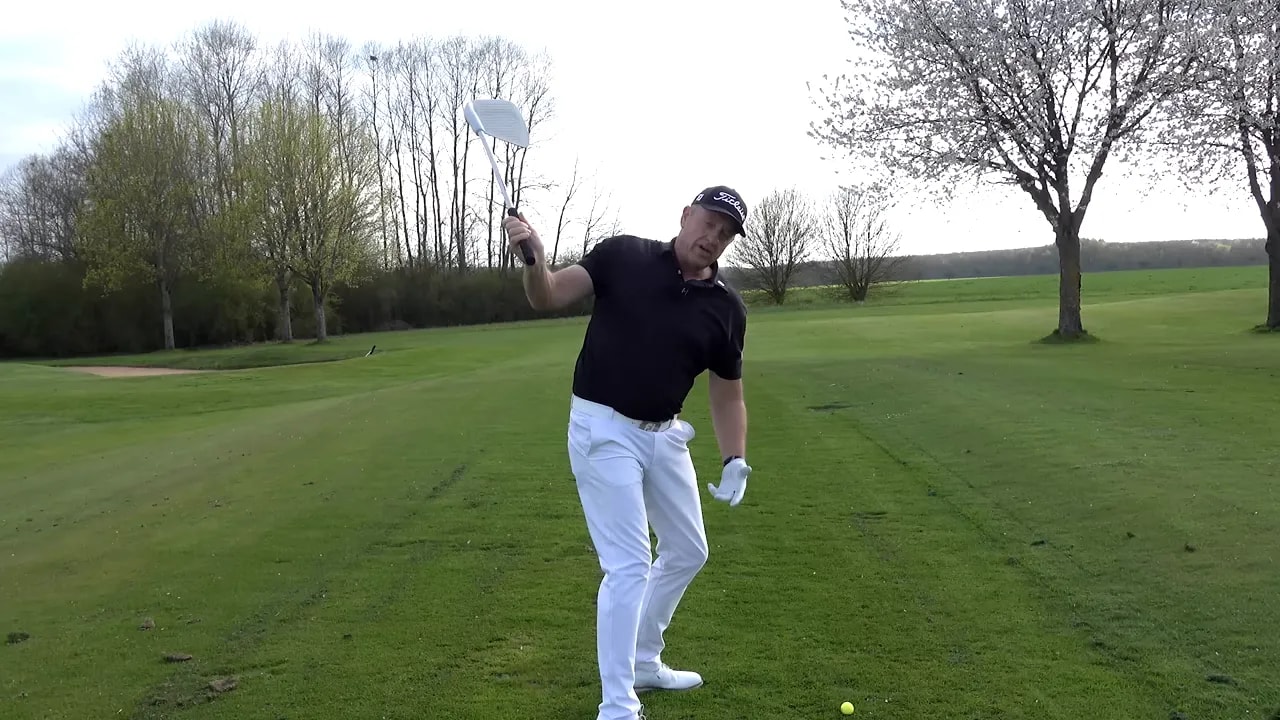
That is one reason this move tends to help so many players immediately. It does not require elite timing. It helps organize the swing before the hard part even begins.
Step 2: Create the “corridor” that makes golf ball striking easier
A useful way to think about the top of the swing is as a corridor or pocket. If your hands and arms reach that corridor, you are much better placed to deliver the club efficiently.
The key checkpoint is simple. When your lead arm is roughly parallel to the ground in the backswing, your trail shoulder should already be working behind you. That early turn helps place your hands deeper rather than higher and narrower.
This matters because a deep hand position often gives you:
A shallower delivery into the ball
A more powerful sequence
A shorter-feeling swing that still produces speed
More consistency with less compensation
For many golfers, especially aging players, this is a major advantage. You do not need a long, loose, highly flexible swing to hit solid shots. Winding up better can actually allow for a shorter-looking swing while producing more reliable contact and speed.
Step 3: Use a wall drill to train depth in your golf swing
One of the simplest drills in this lesson uses a wall or any object behind you. It gives immediate feedback on whether you are turning early enough to create depth.
Here is how to do it:
Stand about six inches away from a wall.
Take your address posture.
Place your lead hand on the outside of your lead leg or into your pocket.
Make a backswing rehearsal with your trail arm and shoulder.
Feel the trail shoulder turn behind you early.
Allow your hands to move back into the pocket or corridor.
If you do not turn early, you will feel blocked. Your hands will struggle to move back without colliding with the wall space behind you. If you turn the trail shoulder behind the ball early, the space appears instantly.
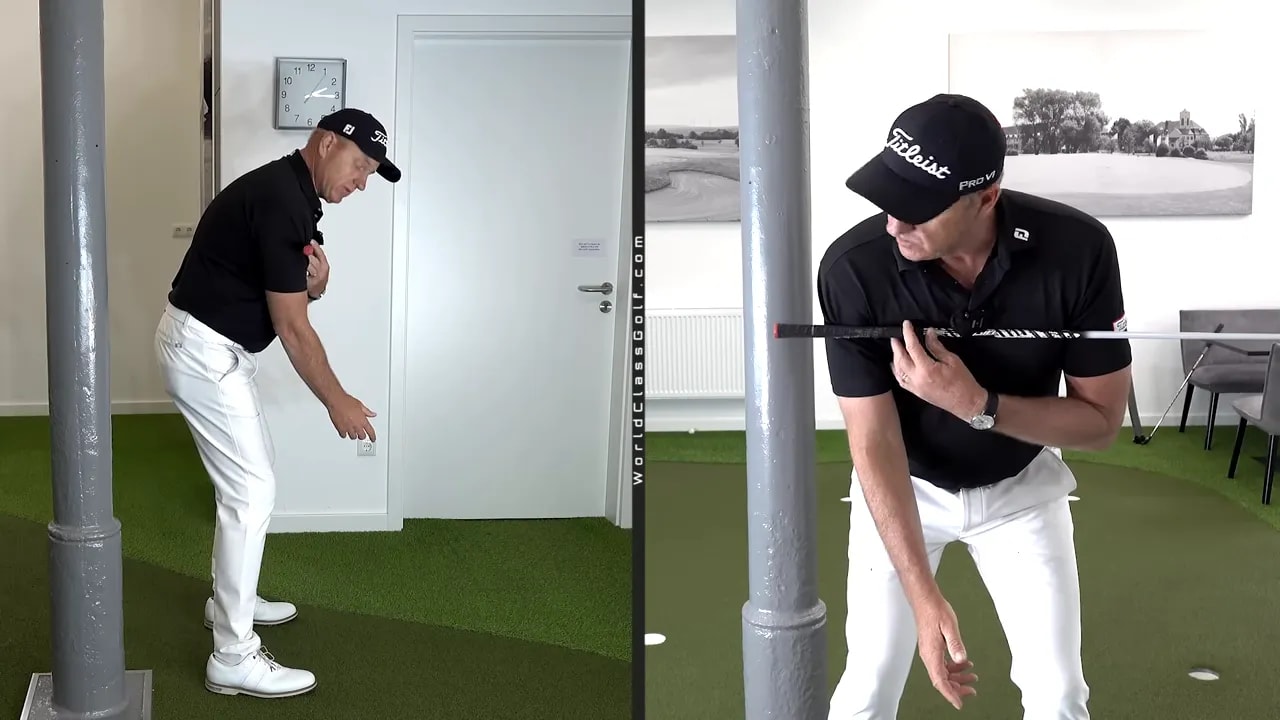
This drill is valuable because it changes the swing through feel, not just theory. You can sense why early turn matters. In golf, that kind of direct feedback is often much more useful than trying to memorize a list of positions.
Step 4: Take the early-turn feel from practice to the golf course
A move only matters if you can actually use it when you play golf. A simple rehearsal can help you transfer the feeling from the practice area into real swings.
At address, place your lead hand on top of the club briefly and make a few mini rehearsals. Feel the trail shoulder turning behind the ball. Sense where your hands move as they work deeper. Then return both hands to the club and hit the shot while that feeling is still fresh.
The goal is not to freeze yourself into a position. The goal is to build a clear sensation of where the backswing should go. Once you know the route, the actual swing becomes much easier to trust.
This kind of rehearsal can be especially effective before tee shots and long approach shots where width, rhythm, and a better inside path matter most.
Step 5: Learn what elite golf drivers do at the top
A striking point from the lesson is the similarity between world-class drivers of the ball. At the top and into delivery, there are common patterns that show up repeatedly.
One of the measurable checkpoints mentioned is the lead arm in the slot area at around 41 degrees. The exact number is less important than the pattern itself. Great drivers tend to organize the club and arms in ways that make a powerful, efficient downswing possible.
That is why getting closer to these positions can help your own golf driving right away. You may not copy a tour swing exactly, but you can move toward the same functional ideas:
More width going back
More depth at the top
A better loading pattern into the trail side
A cleaner, more athletic transition into the lead side
Step 6: Use Rory’s golf backswing and transition keys
Rory McIlroy’s explanation is useful because it is built on feel rather than over-analysis. His main backswing thought is width. He describes taking the club back in one piece and creating a wide move without reaching.
“I just think of width on the way back… really taking this back in one piece there and getting this really wide.”
That width creates a stretch across the back and lats, while still allowing him to load into the trail side. He also keeps the trail leg flexed while loading into it, which helps him stay athletic and ready to move.
Then comes the key transition idea. His first move down is a shift or press into the lead side before anything major happens with the upper body.
“My first move on the way down is that shift onto the left side before anything happens up here.”
This is a major point for your golf swing. Many amateurs start down by throwing the arms or shoulders first. Rory’s feel is the opposite. Pressure moves into the lead side, then the rest of the motion can organize around that shift.
His sequence can be simplified like this:
Create width going back.
Load into the trail side with structure.
Press into the lead side to start down.
Then extend upward through impact.
That sequence is one reason his driver swing produces so much speed without looking forced.
Step 7: Add the “magic move” to improve your golf downswing
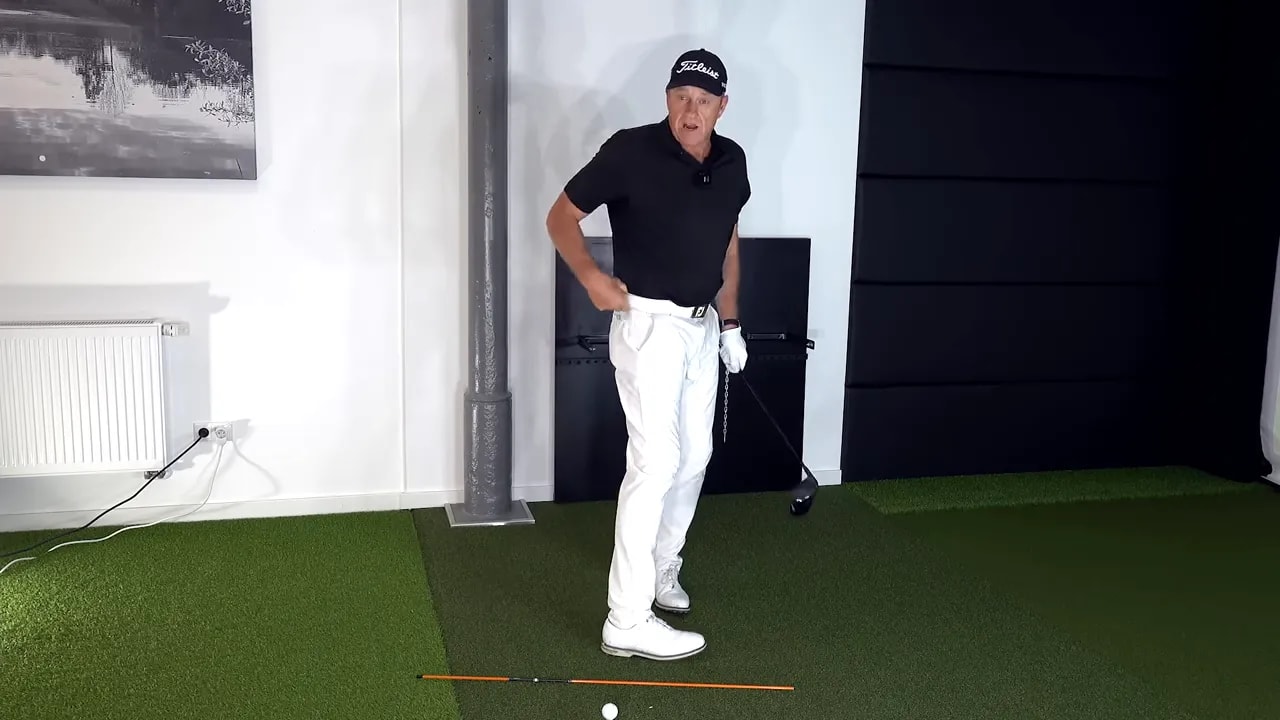
The second major piece is what the lesson calls the magic move in the downswing: the lowering of the right eye and the shortening of the right side.
This is a feel that helps you create correct body tilt while the club shallows and approaches from the inside. Instead of spinning level or standing up too early, you let the trail side work down as the body turns.
The idea is straightforward:
From the top of the swing, your right side gets smaller.
Your right eye feels slightly lower.
Your body gains the tilt needed to approach impact efficiently.
Your chest is freed up to turn through the shot.
There is also an important physical reference here. On average, tour players have the trail hip about three inches lower from address to impact. That means the body is not staying level. It is reorganizing dynamically in transition.
For the driver, this matters even more. You want to hit up on the ball, not crash into the ground behind it. The right-side lowering move helps create the proper tilt so you can turn and launch the ball effectively.
Step 8: Rehearse the right-eye feel to shallow the club in golf
This downswing feel is meant to be practical. You can rehearse it without overcomplicating your swing.
Try this:
Make a backswing to the top.
Pause briefly.
Feel the right side lower and shorten.
Feel the right eye tilt slightly down toward the ball.
Let the club fall as your body begins to turn.
You may even feel the shaft “lay down” or shallow on its own. That is often a sign you are organizing the transition better. The club is no longer being thrown out over the top. Instead, it has room to approach from a stronger path.
Another feel mentioned is pressure in the base knuckle of the trail index finger as the club falls into the slot. That can help you sense the clubhead and avoid snatching the handle outward.
When this move is blended correctly, your downswing can feel more natural and less forced. You are not trying to manually manipulate everything. You are creating the body conditions that allow the club to behave better.
Step 9: Understand the golf difference between Rory’s driver and iron swing
One of the most interesting comparisons in the lesson is how different Rory McIlroy’s driver swing looks from his iron swing. Many golfers assume one swing should look exactly the same with every club, but that is not always how elite golf works.
With the iron, you see a more classic L-shaped wrist set earlier in the backswing. With the driver, the swing appears wider, the right arm stays extended longer, and the wrist set happens a little later.
That wider driver action helps create speed and space. At the top, there is tremendous turn, and then in transition the right side shortens as he moves down and through. The motion into impact is athletic, dynamic, and strongly connected to ground pressure.
There is also a notable recentering move into the lead side, followed by powerful extension through impact. The lead foot action and the way the body unwinds show how aggressively energy is being transferred from the ground up.
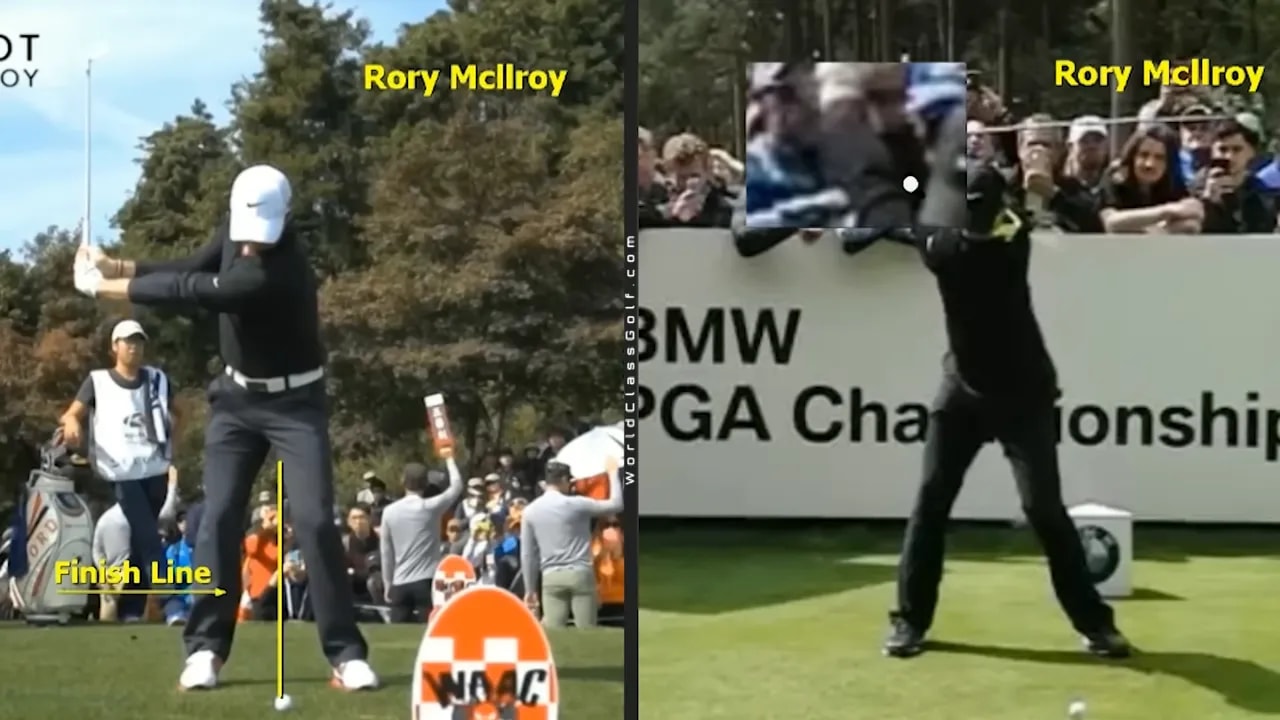
For your own golf game, the takeaway is not that you need to copy every exact shape. It is that different clubs can call for different feels. Driver often benefits from more width and a launch-friendly tilt. Irons often call for a more controlled structure that supports strike and compression.
Step 10: Use one finishing cue to improve your golf sequence
There is one more detail that can help many amateur golfers sequence the through-swing better: get the trail knee to the finish line before the hands do.
That is a useful image because it encourages your lower body to keep moving through impact. Instead of stopping and flipping the club, you continue rotating and posting up into the finish.
This can improve:
Balance
Rotation through impact
Pressure shift into the lead side
A more complete finish position
If your hands outrun everything and your body stalls, contact often suffers. If your body continues moving properly, the club can release with much less manipulation.
Step 11: Check your golf positions without becoming overly mechanical
The lesson also points out that useful measurement does not have to make your golf swing robotic. There is value in comparing your motion to broad tour averages, especially at impact.
For example, shoulder tilt with the driver around impact is often in the range of 30 to 35 degrees among PGA Tour players. You can use a phone-based swing analysis app to compare your own motion and see whether your body is anywhere close to that pattern.
The point is not to obsess over every degree. The point is to confirm whether your feels are producing realistic positions. In golf, feel and real are often very different. A simple check can keep your practice pointed in the right direction.
Step 12: Build a simple golf practice plan around these moves
If you want to put this into your own practice, keep it simple. Work on one backswing feel and one downswing feel.
Backswing feel: turn the trail shoulder behind the ball early so the hands move deep into the corridor.
Downswing feel: lower the right side and the right eye slightly so the body tilts and the club shallows from the top.
A good practice progression looks like this:
Do the wall drill slowly for depth.
Make rehearsal backswings with the lead hand off the club.
Hit short shots while keeping the same early-turn feel.
Add a pause at the top and rehearse the right-side lowering move.
Blend both feels into fuller swings.
Finish with driver swings using width back and pressure left in transition.
If you stay with those priorities, your golf swing can start to feel more organized very quickly.
Frequently Asked Questions
Why does turning early help my golf swing?
Turning early moves the trail shoulder out of the way, creates hand depth, and gives your arms space to work. That makes it easier to approach the ball from the inside and often improves both consistency and speed.
What does “deeper hands” mean in golf?
Deeper hands means your hands move more behind you during the backswing rather than lifting too vertically. This usually helps place the club in a better position at the top and makes the downswing easier to sequence.
What is the right-eye move in the golf downswing?
It is the feel of lowering the right eye slightly as the right side shortens in transition. This helps create body tilt, frees the chest to turn, and encourages the club to shallow into the slot.
Should my driver swing and iron swing look exactly the same in golf?
Not necessarily. The lesson highlights that Rory McIlroy’s driver swing is wider with a later wrist set, while his iron swing is more classic and structured. Different clubs can call for slightly different feels and shapes.
How can I practice these golf moves without overthinking?
Use one rehearsal for the backswing and one rehearsal for the downswing. Focus on early trail-shoulder turn going back and right-side lowering coming down. Keep your practice centered on simple feels instead of too many technical checkpoints.
Can older golfers benefit from this golf approach?
Yes. A better wind-up can create a shorter-feeling swing that still produces speed and consistency. That can be especially helpful for golfers who do not want to rely on a long, highly flexible motion.
Final thoughts on using this move to improve your golf
The reason this approach helps so many golfers is that it simplifies two of the hardest parts of the swing. The early turn gives you space and structure. The right-side lowering move gives you tilt and delivery.
Put those together and your golf swing has a much better chance to become shallow, connected, and powerful without feeling complicated.
If you are struggling with contact, path, or driver consistency, start with these two changes:
Backswing: turn early and get your hands deep.
Downswing: lower the right side and shift pressure left.
Those are the kinds of moves that can instantly improve your golf because they do not just fix one symptom. They improve the structure of the entire motion.
0 Comments