

If you keep pulling golf iron shots left of the target, the problem is often not your aim. In many cases, your downswing is getting too steep, your trail shoulder is moving out too early, and your trail elbow is separating from your body. That combination can send the club over the top and across the ball.
The good news is that this golf issue can often improve with a simple feel and a straightforward drill. By keeping your trail arm more connected and learning how to shallow the club, you can approach the ball more from the inside and improve start line and face delivery.
This guide explains how to stop pulling golf iron shots step by step, what causes the miss, and how to practice the move without overcomplicating your swing.
Table of Contents
- Step 1: Understand why you pull golf iron shots
- Step 2: Learn the feel of connection in your trail arm
- Step 3: Recognize the move that makes golf iron shots go left
- Step 4: Use the glove drill to stop pulling golf iron shots
- Step 5: Shallow the club in transition
- Step 6: Add a directional checkpoint to your golf practice
- Step 7: Practice the motion with half swings before full golf shots
- Step 8: Avoid the most common golf mistakes with this fix
- Step 9: Build a simple golf practice routine for pulled irons
- Step 10: Know what success looks like on the range
- Step 11: Use this golf feel on the course without getting mechanical
- FAQ
- Final takeaway
Step 1: Understand why you pull golf iron shots
A pulled iron shot in golf usually starts left of the target for a right-handed player. One common pattern behind that miss is an over-the-top downswing. When the club gets steep and moves outside the ideal path, the club can cut across the ball instead of approaching from the inside.
Several body motions often contribute to this:
- Your trail elbow flies away from your side
- Your trail shoulder moves out toward the ball too early
- The clubshaft steepens in transition
- You deliver the club with a path that works left through impact
For many golfers, the pull is not a random miss. It is the result of a chain reaction. Once the elbow and shoulder move outward, the club tends to get thrown on top of the swing plane. From there, solid contact and straight ball flight become much harder to produce.
Step 2: Learn the feel of connection in your trail arm
If you want to stop pulling golf iron shots, one of the most useful feelings is keeping your trail arm connected to your side during the transition and early downswing.
For a right-handed golfer, that means feeling as if the right shoulder, right upper arm, and right elbow stay tucked more into the right side of the body. This does not mean squeezing rigidly or locking the arm in place. It means staying compact enough that the arm does not fly out.
Why this matters in golf:
- It helps the club drop into a shallower position
- It reduces the urge to throw the club from the top
- It gives you more room to rotate through the shot
- It encourages an inside approach into the ball
When that connection improves, the club has a better chance of approaching the ball on a more efficient path. That is a big step toward eliminating pulls in golf.
Step 3: Recognize the move that makes golf iron shots go left
Many golfers who pull irons are doing one specific motion without realizing it. From the top of the backswing, the trail shoulder moves outward and forward too early. At the same time, the trail elbow separates from the body. The club then steepens and comes down across the target line.
This is the classic over-the-top move in golf.
Here is a simple way to recognize it:
- If your divots point left of the target, your path may be moving left
- If your ball starts left and stays left, the face and path may both be left
- If your ball starts left and curves farther left, you may be combining a left path with an open face to that path
You do not have to diagnose every launch detail during practice. A simpler checkpoint is to watch whether your trail shoulder and elbow are immediately moving away from your body in transition. In golf, that outward move often leads directly to the pull.
Step 4: Use the glove drill to stop pulling golf iron shots
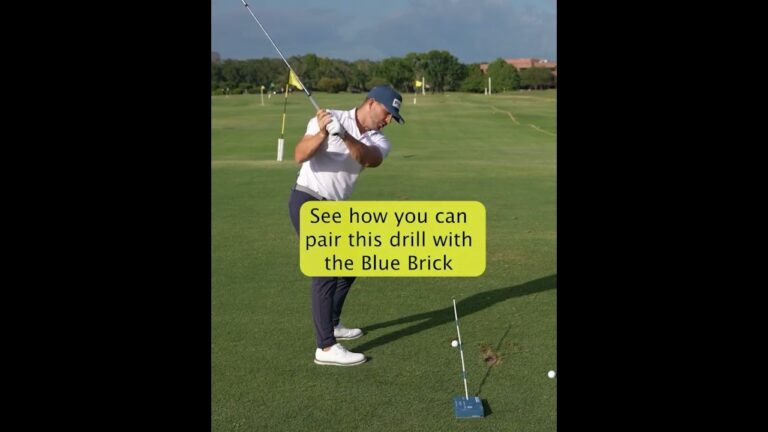
A simple glove drill can help you build the connected feel you need in golf. Place a glove under your trail armpit and make practice swings while keeping it in place as long as possible through the early downswing.
For a right-handed golfer:
- Place a glove under your right armpit
- Take your normal setup with an iron
- Make a backswing to about halfway or to the top
- Start down while keeping the right upper arm connected
- Feel the right shoulder work under and back, not out and over
- Rotate through the shot without throwing the elbow away from your side
If the glove drops immediately, your trail arm is likely disconnecting too soon. That usually means your elbow is flying out and the club is getting steeper.
This is a valuable golf drill because it gives you instant feedback. You do not need to guess whether the arm stayed connected. The glove tells you.
What the glove drill should feel like
You should feel compact, not cramped. The club should seem to fall into place rather than being forced from the top. Many golfers describe it as feeling more inside, more shallow, and more connected.
If the move is correct, you can then rotate aggressively through the strike without sending the club outside the plane.
Step 5: Shallow the club in transition
One of the main goals of this golf fix is to shallow the shaft. A shallow shaft does not mean flat for the sake of flat. It means the club is not standing up too steeply in transition.
When your trail elbow stays closer to your side and your trail shoulder does not move out early, the shaft tends to lower naturally into a better delivery position.
That matters because a shallower approach in golf can help you:
- Approach the ball from the inside
- Avoid glancing across impact
- Improve face control
- Start the ball closer to your intended line
Golfers often try to shallow the club by manipulating the hands. That can make the swing more confusing. A better place to start is with body and arm structure. If your trail arm stays connected and your trail shoulder stays from jumping out, the club often shallows as a result.
Step 6: Add a directional checkpoint to your golf practice
Once you have the connected arm feel, add a directional checkpoint. The goal is to feel the swing moving more out toward the right side of the target in the through-swing for a right-handed golfer. That inside-out feel is often helpful for players who pull golf iron shots.
A simple training aid or alignment stick outside the ball can help. If your trail shoulder moves out and you come over the top, you will tend to crash into that barrier or swing across it. If your motion is better, the club can work from the inside and through the strike more cleanly.
This kind of feedback is useful in golf because it turns a vague thought into a measurable task. Instead of merely trying not to pull the ball, you are training the club to approach the ball on a better path.
Important note
The goal is not to exaggerate into a huge push or hook. It is simply to neutralize the leftward path that creates the pull. In golf practice, a slight inside-out feel is often exactly what an over-the-top player needs.
Step 7: Practice the motion with half swings before full golf shots
If you immediately try this move at full speed, you may lose the feel. Start with smaller swings.
Use this progression:
- Rehearsal without a ball
Go to the top or halfway back and slowly feel the trail arm stay connected while the trail shoulder stays from moving out. - Half swings
Hit short iron shots with reduced effort and focus only on connection and path. - Three-quarter swings
Add more rotation while keeping the same shallowing feel. - Full swings
Only move to full speed when the ball starts on a better line consistently.
This step matters because golf swing changes are easier to keep when you build them gradually. Most players who pull irons are better off training the movement pattern first and then adding speed.
Step 8: Avoid the most common golf mistakes with this fix
Even a good drill can create problems if you apply it incorrectly. Here are the most common mistakes golfers make when trying to stop pulling iron shots.
Squeezing the arm too tightly
Connection is not tension. If you clamp your trail arm hard against your body, your swing can become restricted and uncomfortable. The goal in golf is supportive structure, not stiffness.
Sliding instead of rotating
Keeping the trail shoulder back does not mean hanging on the back foot forever. You still need to rotate through the shot. The difference is that the shoulder should not jump out and over in transition.
Trying to force an exaggerated inside path
If you overdo the inside-out move in golf, you may trade pulls for pushes or hooks. Start with a small correction, not a dramatic reroute.
Only thinking about the club
Many golfers focus only on where the club is. The real source of the issue is often the body motion that steepens the shaft. Fix the trail elbow and shoulder pattern first.
Going too fast too soon
This change is easiest to learn in slow motion and with short swings. Speed can come later.
Step 9: Build a simple golf practice routine for pulled irons
If you want this change to hold up on the course, use a repeatable practice routine. Here is a simple 10 to 15 minute golf session:
- 2 minutes of slow rehearsals
No ball. Trail arm connected. Trail shoulder staying under and back. - 3 minutes with the glove drill
Make small swings and keep the glove secure through transition. - 3 minutes of half shots
Hit easy shots and watch the start line. - 3 minutes with a path checkpoint
Use an external barrier or alignment reference to stop the over-the-top move. - 2 to 4 minutes of random targets
Switch targets and clubs to make the golf motion more realistic.
This routine gives you both feel and feedback. In golf improvement, that combination is often what makes a swing change stick.
Step 10: Know what success looks like on the range
When this golf change starts working, you may notice:
- The ball starts closer to your intended target line
- Your contact feels more centered
- Your divots look less leftward
- Your downswing feels less steep and rushed
- Your swing feels more connected through impact
Do not expect perfection right away. In golf, a pull pattern that has been repeated for years may take time to change. Early success often shows up as fewer severe pulls and more manageable misses.
Step 11: Use this golf feel on the course without getting mechanical
On the course, avoid stacking too many swing thoughts. Pick one simple cue.
Good on-course cues for this golf issue include:
- Keep the trail arm connected
- Trail shoulder stays back
- Swing from the inside
Choose the one that gives you the best ball flight in practice. Then trust it. Golf becomes harder when you try to monitor every body part over the ball.
FAQ
Why do I pull my golf iron shots left?
A common reason is an over-the-top downswing. In golf, that often happens when the trail elbow flies away from the body and the trail shoulder moves out too early, which steepens the club and sends the path left.
Can a glove drill really help my golf swing?
Yes. A glove under the trail armpit gives immediate feedback about arm connection. If it falls out early, your trail arm is likely disconnecting and contributing to a steep, across-the-ball motion in golf.
What does shallowing the club mean in golf?
Shallowing means the shaft moves into a less steep position during transition. In golf, that usually helps the club approach the ball more from the inside instead of cutting across it.
Should I try to keep the glove under my arm all the way through the swing?
No. The glove is mainly a training aid for connection in the backswing and early downswing. In golf, the arm can naturally separate later as the club releases and the body rotates through impact.
Will this golf fix work if I also slice my irons?
It may help if your slice comes from an over-the-top path. A more connected trail arm and a shallower downswing can improve path. But ball flight in golf also depends on clubface control, so you may need to check both path and face.
How long does it take to stop pulling golf iron shots?
That depends on how ingrained the move is. Many golfers feel improvement quickly with the right drill, but lasting change usually requires repeated practice with slow rehearsals, half swings, and clear feedback.
Final takeaway
To stop pulling your iron shots in golf, focus on the move that causes the miss. If your trail elbow flies out and your trail shoulder moves over the top, the club will usually get steep and cut across the ball. A connected trail arm, a shoulder that works under instead of out, and a shallower transition can help the club approach from the inside.
Start simple. Use a glove under your trail arm, rehearse the motion slowly, and build up from half swings to full golf shots. When the motion improves, the ball flight usually follows.
0 Comments