
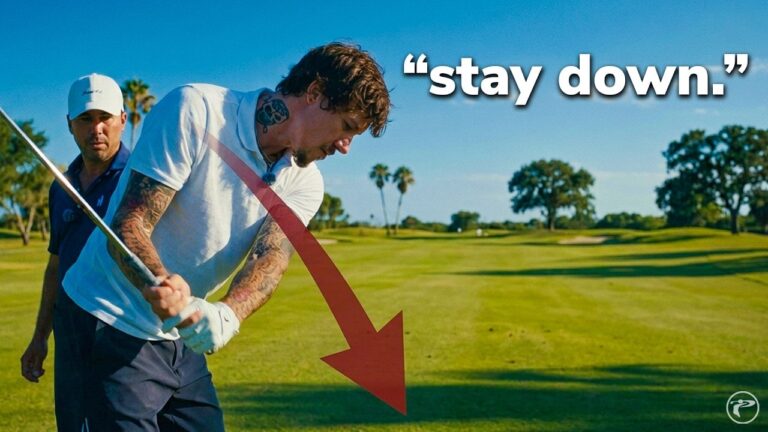

Standing up through impact is one of the most frustrating swing issues in golf. You may feel as though you are trying to stay in your posture, yet your chest rises, your hips move toward the ball, and solid contact disappears at the worst possible moment.
This move is commonly called early extension. It can lead to thin shots, inconsistent low points, poor compression, and lost distance. But the urge to stand up is usually not the original fault. It is often your body’s athletic solution to problems that began earlier in the swing.
The productive way to fix standing up through impact is to work backward through the chain: build a balanced setup, create a more organized takeaway and backswing, then give your hips room to rotate through the strike.
Table of Contents
- Step 1: Understand Why You Are Standing Up Through Impact
- Step 2: Build a Setup That Makes Good Impact Possible
- Step 3: Keep the Club in Front of You During the Takeaway
- Step 4: Train a Connected Trail Elbow
- Step 5: Rotate the Lead Hip Back Through Impact
- Step 6: Let Your Arms Extend Through the Ball
- Step 7: Practice the Standing Up Through Impact Fix in the Right Order
- Step 8: Avoid the Most Common Early Extension Mistakes
- Step 9: Use a Quick On-Course Cue
- Takeaway: Fix the Cause, Not Just the Posture
Step 1: Understand Why You Are Standing Up Through Impact
Standing up through impact happens when your pelvis moves closer to the golf ball and your chest rises out of its original inclination. From a face on perspective, you may notice less of your lead hip at impact than expected. From down the line, your rear end may appear to leave its original position as it moves toward the ball.
The important point is that early extension is often a reaction, not an isolated posture problem. If the club gets too far behind you, too long at the top, or disconnected from your body, it becomes difficult to deliver the club to the ball from an effective position. Your body then creates space by standing up.
This is why the common instruction to simply “stay down” frequently fails. Trying to force your chest downward without improving the motions that caused the problem can make your swing feel restricted, stuck, or overly steep.
Instead, think of the pattern as a cause and effect chain:
- An unbalanced setup can put your center too far behind your feet.
- A takeaway that pulls the club too far inside can place the club behind your body.
- A loose, long backswing can make the club harder to return in front of you.
- Limited hip rotation in the downswing can remove the space your arms and club need.
- Your body responds by moving upward toward the ball.
Fix the earlier links in the chain and standing up through impact becomes far less necessary.
Step 2: Build a Setup That Makes Good Impact Possible
A reliable strike begins before the club moves. If you set up with your weight too far back toward your heels, your body may be forced to make compensations before impact.
Start by standing tall with the club held across your waist. From there, hinge forward from your hips so your sternum points toward the ball. Allow your knees to soften naturally. The goal is not to squat deeply. It is to create an athletic address position where your hips are more balanced over your ankles and your pressure is centered under your feet.
A useful address feel is that you are looking at the ball “from your waist,” rather than merely dropping your eyes toward it. Your head remains in a natural position, but the forward tilt comes from your hips.
Check your foot pressure
For many golfers who stand up through impact, the pressure begins too far on the heels. That makes it harder to keep the club in front of your body and can encourage a steep, rescuing move during the transition.
Use this simple balance check:
- Take your normal address position.
- Feel pressure through the middle of both feet, with enough pressure toward the balls of your feet to stay athletic.
- Without rocking onto your toes, see whether you could lightly lift your heels.
- If you cannot do this without tipping backward or forward, reset your balance.
You can also stand with a narrow object under the middle of each foot during rehearsals. This creates a clear physical reference for centered pressure. The objective is not to force all of your weight into the toes. It is to avoid sitting too far back on your heels.
Setup checkpoint: Your knees should have some flex, your hips should be balanced over your ankles, your chest should tilt toward the ball from the hips, and your pressure should feel athletic rather than heel-heavy.
Step 3: Keep the Club in Front of You During the Takeaway
The next piece of the standing up through impact fix is the takeaway. When the clubhead disappears too far inside too early, the club can become trapped behind your torso. From there, you may need to steepen the club, throw your arms outward, or stand up to find the ball.
A better early-swing picture is a club that stays more in front of your chest. As the club moves back, it should work closer to the line of your trail forearm rather than falling well underneath it.
At roughly halfway back, the shaft should appear organized and relatively close to the ball line, or slightly inside it. This puts the club in a position that is easier to return to the ball with forward shaft lean and compression.
Use sharper structure instead of a loose backswing
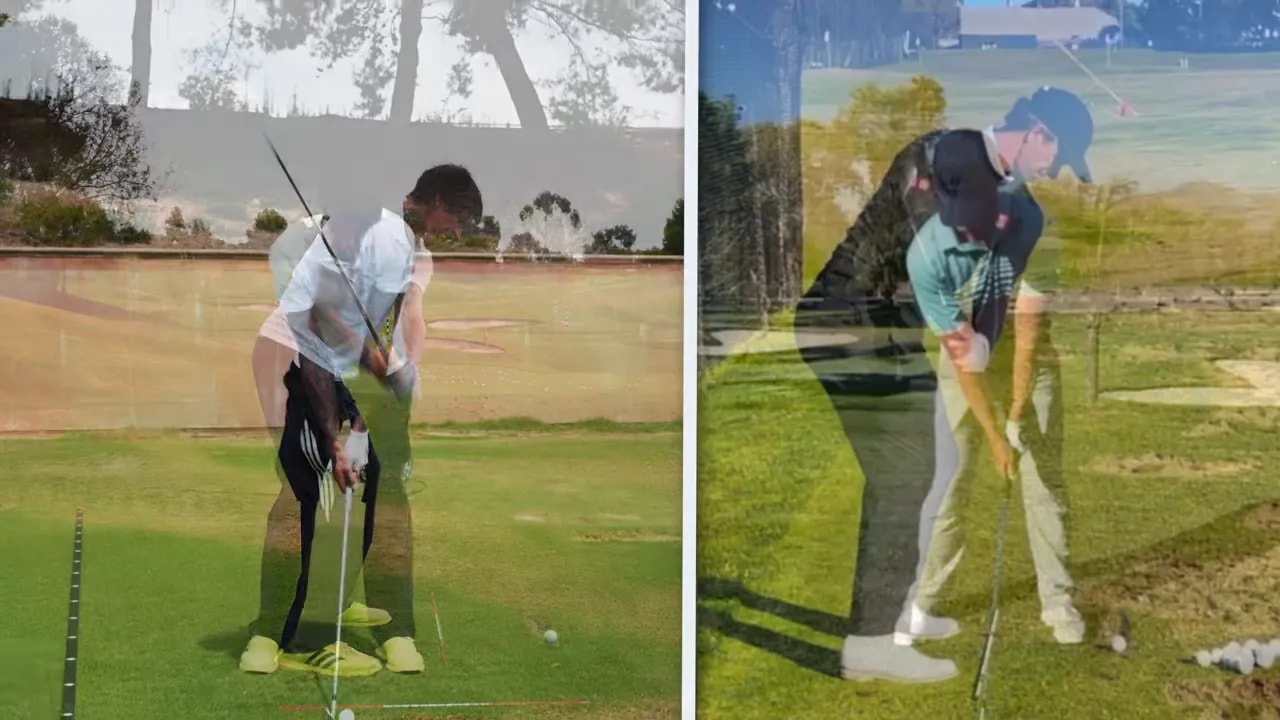
Many golfers who early extend feel “long” or loose at the top. Their arms may keep traveling after the body has turned, causing the club to wrap behind them. This creates a late recovery problem in the downswing.
Your goal is a more connected, structured top position. That does not mean stiff arms or a forced short swing. It means that your arms stay in front of your torso as your shoulders turn.
For a right-handed golfer, a useful rehearsal is to feel the club setting more upright while the trail elbow works in a controlled position rather than flying far behind you. The sensation may feel as if the butt end of the club points back toward your lead shoe. It will probably feel more vertical than it actually is.
Golfers often need an exaggerated feel because the old movement is deeply familiar. Use slow rehearsals first. When the position becomes repeatable, gradually add speed.
Step 4: Train a Connected Trail Elbow
Your trail elbow has a major influence on whether the club stays in front of you or gets thrown behind your body. If the trail elbow works too far outward and behind you during the backswing, the arms can become disconnected from the torso. This can make standing up through impact feel unavoidable.
Rather than pulling the trail elbow backward as if starting a lawn mower, rehearse bringing your arms up in front of your chest while you turn. If you can place your trail arm in front of your body while standing still, you can maintain a similar relationship as you rotate.
The arms do not need to race behind the turn. They should move with the turn and remain connected enough that the club can return from in front of your torso.
Trail elbow rehearsal drill
- Set up without a ball or use a short iron.
- Make a slow backswing to about halfway back.
- Pause and check that the trail elbow has not drifted excessively behind your rib cage.
- Feel the hands and arms in front of your chest as your shoulders rotate.
- Return to address, then repeat before hitting a shot.
This drill is best used as a rehearsal, not as a rigid position you must hold for the entire swing. Your full motion should still be athletic and flowing.
Step 5: Rotate the Lead Hip Back Through Impact
Once the club is organized, you need to create room to deliver it. This is the step that directly changes the feeling of standing up through impact.
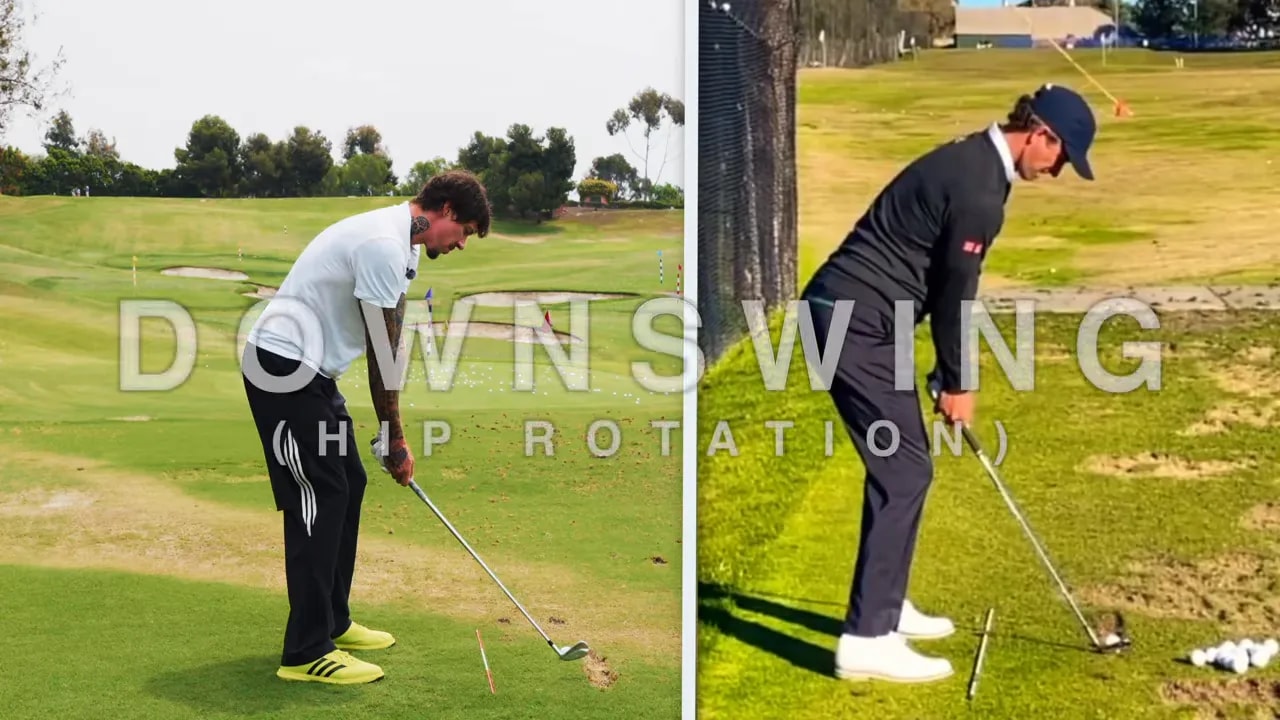
Your lead hip should rotate back and around as you move through the downswing. If your hips drive forward toward the ball and target line, your chest is likely to rise. The club then loses the space it needs, and your body’s easiest option is to stand up.
When your lead hip works back around your belt line, your pelvis stays farther from the ball. That gives your arms room to come down and through while your chest can remain inclined toward the strike.
Feel the difference between forward and back
Imagine an alignment stick, chair, or wall just behind your hips at address. As you begin the downswing, feel your lead hip moving back toward that reference while it opens. You are not trying to slide your entire body backward. You are allowing the lead side of your pelvis to clear behind you.
A helpful sensation is that your rear end remains back while your lead hip rotates away from the ball. This supports your spine angle and gives the club room to approach from the correct side of the ball.
Do not confuse rotation with spinning out. The goal is not to rotate your hips as fast as possible before your arms can reach the ball. The goal is a coordinated move in which the hips open and clear while the hands and arms continue through impact.
Step 6: Let Your Arms Extend Through the Ball
Hip rotation alone is not enough. Your arms must also travel through the strike. When the hips stop and the club’s momentum continues, the club can be forced outward. When the arms pull across your chest too early, you may fold them and lose the space needed for solid contact.
As you rotate through impact, allow your arms to work down and through. This combines a clear lead hip with an extending club delivery. The result is a more compressed strike, with the low point occurring ahead of the ball for an iron shot.
A well-struck iron often leaves a divot on the target side of the ball. The exact size and shape vary, but the key idea is that the club continues downward through the ball before it reaches its low point. If your divot is consistently behind the ball, your low point is likely too far back.
Simple impact rehearsal
Make a slow, waist-high rehearsal swing without a ball. As your hands move down, feel these three actions together:
- Your chest remains inclined rather than popping upward.
- Your lead hip rotates back and open.
- Your arms extend through the intended strike area.
Then make a smooth shot at partial speed. Do not try to manufacture a deep squat or force your head down. Focus on creating room with the lead hip and delivering the club through that space.
Step 7: Practice the Standing Up Through Impact Fix in the Right Order
Trying to repair every swing piece at once can create more confusion. Use a progression that respects the cause and effect sequence.
Your range practice plan
- Rehearse your address: Check hip hinge, soft knees, and centered foot pressure.
- Make takeaway rehearsals: Keep the club in front of your torso rather than rolling it sharply inside.
- Rehearse the top: Feel a compact, more vertical set rather than a long, loose arm swing.
- Add the lead hip movement: Feel the lead hip clearing back as the club starts down.
- Hit half shots: Use a short iron and prioritize centered contact over distance.
- Build to full swings: Retain the same sequence as speed increases.
Use a realistic motion during practice. A drill should resemble the movement you intend to use when hitting a golf ball. Extreme static poses can be useful briefly, but your long-term goal is a repeatable swing that works at normal tempo.
Step 8: Avoid the Most Common Early Extension Mistakes
Early extension can be stubborn because golfers often attack the visible symptom. Avoid these common errors while working on your swing.
Trying to keep your head down
Keeping your head down does not necessarily keep your pelvis back. You can hold your head relatively still while your hips move toward the ball. Focus on hip rotation and space instead.
Forcing a squat in the downswing
More knee bend is not automatically better. Excessive squatting can limit rotation and make the swing feel trapped. Begin with athletic flex at address and preserve your ability to rotate.
Pulling the club too far inside
An overly inside takeaway may feel shallow, but it can create the opposite problem later. Keep the club organized in front of your body early so you do not need a last-second correction.
Over-rotating without delivering the arms
Your hips should clear, but the arms must still swing through. If your body opens while your arms lag too far behind, you may trade one compensation for another.
Expecting the new move to feel natural immediately
The improved motion may initially feel exaggerated or uncomfortable. That is normal when replacing a familiar pattern. Judge progress by contact quality, balance, and repeatability, not by whether the change feels normal on the first few swings.
Step 9: Use a Quick On-Course Cue
On the course, too many technical thoughts can make it difficult to swing freely. Once you have practiced the full sequence, use one short cue that matches your biggest need.
- If your setup is the issue: “Athletic over the ankles.”
- If your takeaway gets trapped: “Club in front.”
- If you stand up through impact: “Lead hip back.”
- If you lose structure at the top: “Arms in front of chest.”
Pick only one. A clear cue gives you a better chance of making an athletic swing than trying to consciously control every body part.
Takeaway: Fix the Cause, Not Just the Posture
Standing up through impact is rarely solved by telling yourself to stay down. Your body may be rising because it is trying to recover from a poor setup, a club that has moved too far behind you, or hips that have not cleared space through the strike.
Build your solution in order: establish centered pressure and hip hinge at address, keep the club and trail elbow more connected in the backswing, then rotate your lead hip back as your arms travel through impact. This sequence gives you a better chance to maintain posture, compress the ball, and strike your irons more consistently.
Frequently Asked Questions About Standing Up Through Impact
What is standing up through impact in golf?
Standing up through impact, often called early extension, is a swing pattern in which your hips move toward the ball and your chest rises during the downswing and strike. It can make consistent contact and compression more difficult.
Why do I stand up through impact with my irons?
You may stand up as a reaction to an earlier swing issue, such as pressure too far on your heels, a takeaway that gets too far inside, a loose backswing with the club behind you, or hips that do not rotate back through impact.
Should I try to stay down through impact?
Do not force your chest down as the only fix. Instead, create room by rotating your lead hip back and keeping the club in front of your body. Better structure and rotation make it easier to maintain your inclination naturally.
How do I stop my hips from moving toward the ball?
Rehearse your lead hip rotating back and around your body in the downswing. A chair, wall, or similar reference behind your hips can help you feel that your pelvis is clearing rather than moving toward the ball.
Can a takeaway that is too inside cause early extension?
Yes. When the club moves too far inside and behind your body early in the backswing, it can be harder to return the club to the ball from an organized position. Standing up may become a compensation to create space.
0 Comments