
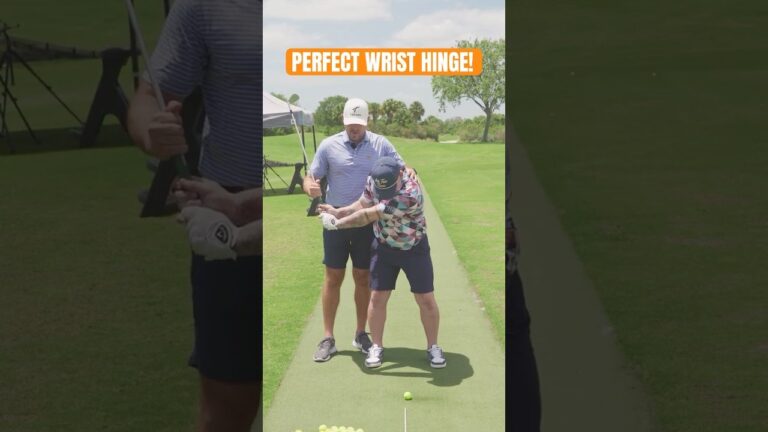

If you are a high handicap golfer struggling with thin iron shots, weak contact, or that frustrating feeling of never quite compressing the golf ball, the fix may not be where you think it is. A lot of golfers chase impact, but the real problem often starts much earlier.
The key move here is early wrist hinge in the takeaway. When your club gets too low and too far inside during the first part of the backswing, the swing can quickly fall under plane. That usually leads to poor ground contact, inconsistent low point, and weak iron strikes.
This simple adjustment can help you clean up your takeaway, improve your swing plane, and make it much easier to hit down on the ball properly.
Table of Contents
- Step 1: Understand why early wrist hinge in the takeaway matters
- Step 2: Use the first checkpoint to fix your takeaway path
- Step 3: Add the right amount of early wrist hinge in the takeaway
- Step 4: Match feel versus real with a 90 degree hinge rehearsal
- Step 5: Make early wrist hinge in the takeaway lead to better turf contact
- Step 6: Practice the two rehearsals plus thud-the-mat drill
- Step 7: Accept that the correct move may feel exaggerated
- Step 8: Connect the takeaway fix to compression and better iron contact
- Step 9: Build this into your normal practice routine
- Step 10: Know the signs that the drill is working
- FAQ
Step 1: Understand why early wrist hinge in the takeaway matters
The focus keyphrase here is early wrist hinge in the takeaway, and for good reason. This move changes the structure of your swing almost immediately.
Many golfers who struggle with iron contact move the club back with very little hinge at all. The hands drift inward, the clubhead stays too low, and the shaft works behind the body too early. It can feel wide and powerful, but in reality it often puts you in a position that makes solid contact much harder.
When you add hinge sooner, the club starts traveling on a better plane. That gives you a more functional backswing and a much easier route into the ball.
For iron shots, that matters because good compression depends on predictable contact with the turf. If the club is trapped too far behind you from the beginning, you often get:
- Thin strikes
- Little or no divot
- Inconsistent low point
- Weak compression
- Trouble returning the club on plane
Early wrist hinge in the takeaway is not about making a fancy move with your hands. It is about putting the club in a better position early enough that the rest of the swing has a chance to work.
Step 2: Use the first checkpoint to fix your takeaway path
The first important checkpoint happens very early in the backswing.
As the club moves away from the ball, pay attention to the point when the butt end of the club reaches just outside your trail thigh. Around that moment, the shaft should already be approaching parallel to the ground.
That tells you something important. The club is not simply dragging back low and inside. It is beginning to set up correctly.
A useful visual is this:
- The shaft is about parallel to the ground
- The club is roughly in line with your toe line
- The clubhead is not buried far behind your heels
- The toe of the club is around the area just forward of your heel line
If the club is a touch inside, that is usually not a disaster. The bigger issue is when it gets dramatically sucked inward with no hinge.
For golfers who have always been too wide and too low early in the swing, the correction can feel exaggerated. That is normal. In many cases, the move that feels extreme is simply bringing you back to neutral.
Step 3: Add the right amount of early wrist hinge in the takeaway
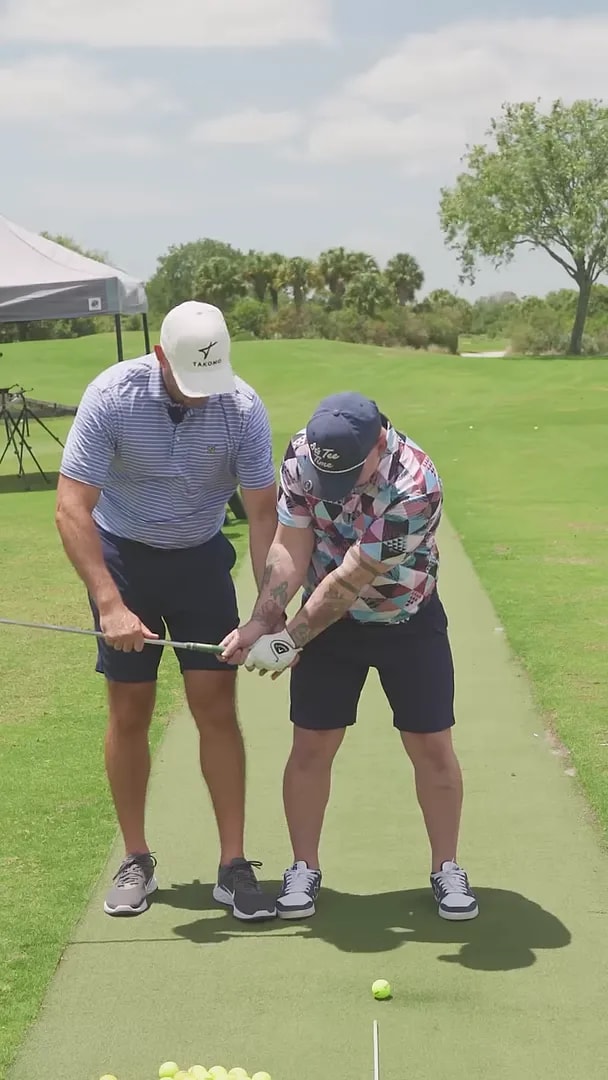
Once you reach that early checkpoint, the next feel is to let the butt of the club work more downward while the clubhead works upward through hinge.
This is the part that often surprises golfers. If you are used to a flat, wide takeaway, proper hinge can feel like a lot. But on camera or in a mirror, it usually looks very normal.
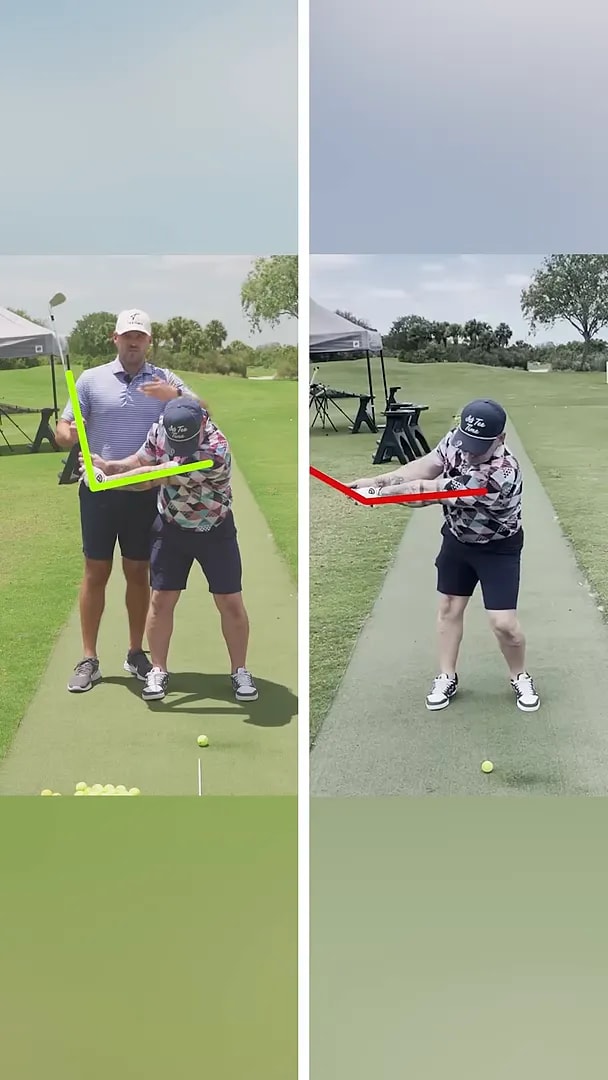
The target feel is roughly a 90 degree wrist hinge.
That does not mean you should tense your forearms or snatch the club upward. It means that by the time you reach your rehearsal position, the relationship between your lead arm and the shaft should resemble a right angle.
Why is that so helpful?
- It gets the shaft more vertical sooner
- It helps keep the club from running too far behind you
- It gives you a better chance to return the club to the ball with proper shaft lean
- It makes downward strike and turf interaction much easier
If you have been fighting thin iron shots, this one change can be a game changer.
A good mental cue is simple: start hinging right away. Not late. Not halfway back. Right from the beginning of the takeaway.
Step 4: Match feel versus real with a 90 degree hinge rehearsal
One reason golfers struggle to improve is that their feels are unreliable. What feels huge may actually be correct. What feels normal may still be the same old mistake.
That is why rehearsals matter.
Your first job is not to hit a ball. Your first job is to build the correct motion.
Use this rehearsal sequence:
- Set up to the ball as normal.
- Move the club back to the early takeaway checkpoint.
- Add wrist hinge until the shaft and lead arm form about a 90 degree angle.
- Pause and confirm the position.
- Return to setup and repeat.
Do this twice before every practice swing or shot while you are learning the move.
This type of repetition is especially useful if you have always taken the club away too far inside. You are trying to retrain a pattern, not just understand a concept. Rehearsing the correct position gives your body a clear map.
Step 5: Make early wrist hinge in the takeaway lead to better turf contact
There is an important reason this fix works so well for ball striking. It makes hitting the ground in the right place much easier.
If your takeaway is too low and too inside, the club often approaches the ball from a poor delivery position. That can cause you to shallow too early, miss the turf, or bottom out before or at the ball without compressing it.
With better early wrist hinge in the takeaway, the club is set in a position that supports a more natural strike into the mat or turf after the ball.
That is where the next training rule comes in: you must make the clubhead thud the mat.
This is a practical drill, not just a swing thought.
The point is to train proper ground interaction. If the club is organized correctly from the takeaway, getting the clubhead to strike the mat becomes far easier. If the club is stuck behind you, that task is much harder.
For many golfers, this is the missing link between a prettier backswing and actual better iron contact. Better positions only matter if they lead to better impact conditions. The thud gives you immediate feedback.
Step 6: Practice the two rehearsals plus thud-the-mat drill
Here is the full drill sequence to use on the range.
- Address the ball normally.
- Make one slow rehearsal to the 90 degree hinge position.
- Reset.
- Make a second slow rehearsal to the same 90 degree hinge position.
- On the third motion, repeat the hinge and then swing through with the goal of thudding the mat.
This sequence is simple, but it teaches several things at once:
- Correct takeaway structure
- Proper early wrist hinge
- A better swing plane
- Improved ground contact
If you are working on how to compress the golf ball, this drill is especially useful because it connects the backswing pattern directly to the strike.
Do not rush this.
The rehearsals should be deliberate. You are trying to build awareness of where the club is when the shaft reaches parallel and how much hinge you need to create that 90 degree angle. Then you carry that feel into a through swing that produces a clear strike on the mat.
Step 7: Accept that the correct move may feel exaggerated
This is one of the most important ideas for any golfer making a swing change.
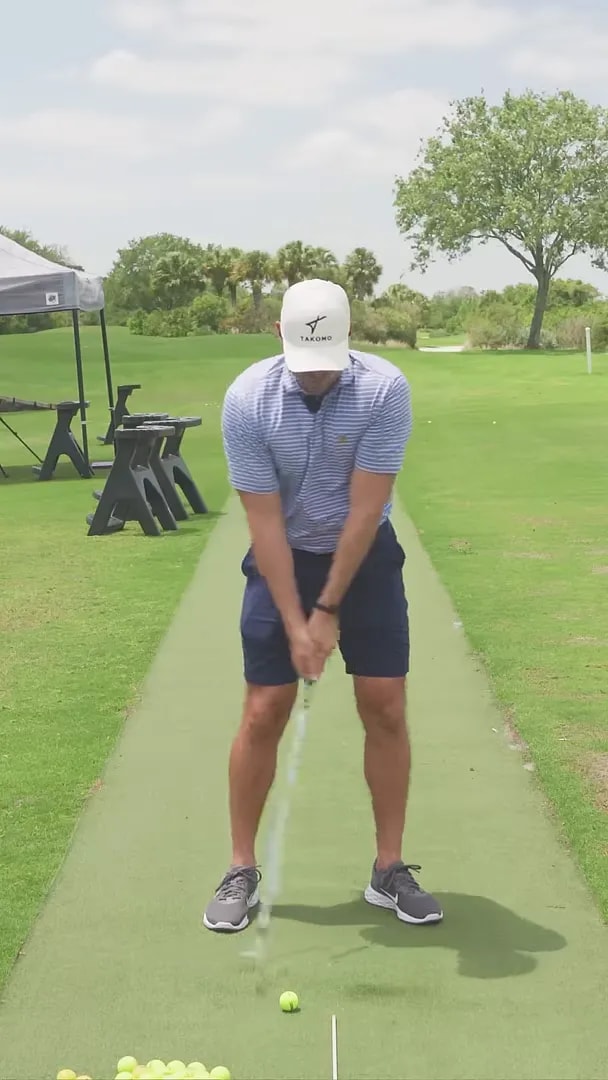
If your pattern has been under plane for a long time, neutral can feel extreme. The proper amount of hinge may seem like too much. The club may feel steeper than you are used to. You may even feel as if the butt end of the club is working sharply downward.
That is often exactly what needs to happen.
Golf improvement gets stalled when you judge a move only by feel. A golfer who has spent years with a low, inside takeaway cannot rely on old sensations to decide what is correct.
Instead, use objective checkpoints:
- Shaft about parallel when the handle gets just outside the thigh
- Club roughly along the toe line
- Noticeable early hinge
- About 90 degrees at the rehearsal point
- Ability to strike the mat crisply
When those pieces show up, your swing is usually moving in the right direction even if it feels unusual.
Step 8: Connect the takeaway fix to compression and better iron contact
It is easy to think of takeaway work as technical detail, but this change has a direct effect on results.
When your early wrist hinge in the takeaway is improved, you often get:
- Cleaner contact first
- Better compression second
- More predictable divots third
- Improved strike consistency overall
That order matters. Compression is usually a byproduct of better delivery and better low point control, not a magic move at impact.
If you are trying to stop hitting thin iron shots, your goal is not just to hinge for the sake of hinging. Your goal is to put the club in a position where it can return to the ball with better geometry and better intent into the ground.
This is why takeaway work can instantly improve ball striking. It addresses the source of the problem instead of the symptom.
Step 9: Build this into your normal practice routine
To make the change stick, give it structure.
A strong range routine might look like this:
- Hit 10 to 15 half speed shots using the two rehearsals plus thud-the-mat drill.
- Hit 10 more shots at moderate speed while keeping the same early hinge feel.
- Alternate between one rehearsal swing and one real shot.
- Finish with a few normal swings where your only focus is clean ball then turf contact.
As you improve, you should notice that the rehearsal can become shorter. At first, it may need to be very deliberate. Later, it can be a simple reminder before you pull the trigger.
If you use video or a swing analysis app, this is a great area to monitor. Many golfers think they are hinging early when they still are not. A quick check can save a lot of guesswork.
Step 10: Know the signs that the drill is working
You do not need launch monitor numbers to know whether this takeaway fix is helping.
Look for these signs:
- Your divot starts showing up more consistently
- You hear a more solid strike
- Thin shots begin to disappear
- The club no longer feels stuck behind you
- Your contact feels heavier and more compressed
At first, the ball flight may not be perfect every time. That is okay. The first win is usually better strike quality. Once contact improves, direction and distance control tend to improve much faster.
For a high handicap golfer, that is a huge leap forward.
FAQ
How much wrist hinge should you feel in the takeaway?
You should feel more hinge than you probably expect, especially if your current takeaway is low and inside. A good target is about a 90 degree angle between the lead arm and shaft during the rehearsal position. It may feel exaggerated, but it often looks normal.
Can early wrist hinge in the takeaway help thin iron shots?
Yes. Early wrist hinge in the takeaway can help stop thin iron shots because it improves the club’s position early in the swing. That gives you a better chance to return the club to the ball with proper turf contact and better compression.
What is the main checkpoint for this golf takeaway drill?
When the butt end of the club reaches just outside your thigh, the shaft should be about parallel to the ground. From there, the club should be close to the toe line rather than sucked far inside behind you.
Why does the correct move feel so extreme?
If you are used to taking the club back too wide and too flat, a neutral move can feel dramatic. That is common in golf swing changes. The key is to trust the checkpoint and the strike quality rather than old feel.
What is the thud-the-mat drill?
It is a practice rule where you rehearse the correct 90 degree hinge twice, then make a third motion that swings through and strikes the mat with purpose. The thud helps train proper ground interaction and reinforces that the improved takeaway should lead to better impact.
Should you use this drill with every club?
This concept is especially helpful for irons because of the need for crisp ball then turf contact. The same idea can influence other clubs too, but the biggest benefit described here is better iron contact and compression.
If your iron contact has been inconsistent, do not assume the answer is a last-second fix at impact. Start at the beginning. A better takeaway with earlier wrist hinge can clean up your swing plane, improve turf contact, and make compression much easier to produce.
For many golfers, that single adjustment is the difference between brushing at the ball and truly striking it.
0 Comments