
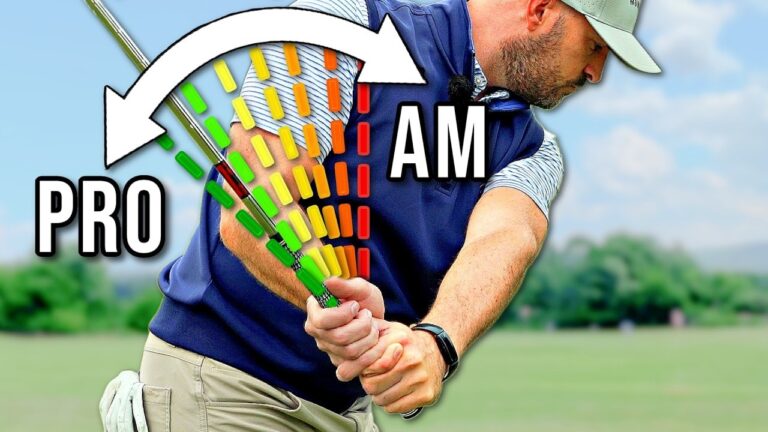

A reliable golf swing plane is one of the clearest differences between inconsistent contact and the solid, repeatable strikes every golfer wants. Great players can have very different backswings, but from hip high in the downswing through hip high after impact, their clubs tend to work through remarkably similar positions.
The key is not trying to copy every part of another golfer’s motion. It is learning where the club should be during delivery, identifying whether your normal swing is too steep or too shallow, and then practicing a feel that deliberately moves you toward neutral.
This guide gives you a simple on-plane downswing drill, practical checkpoints, and specific feels for fixing both a steep downswing and a shallow golf swing.
Table of Contents
- Step 1: Understand Why Golf Swing Plane Matters
- Step 2: Learn the Two Golf Swing Plane Checkpoints
- Step 3: Set Up the Toe Line Drill
- Step 4: Use Two Rehearsals, One Hit, Feedback
- Step 5: Identify Whether You Are Too Steep or Too Shallow
- Step 6: Fix a Steep Downswing by Feeling Low and Inside
- Step 7: Fix a Shallow Golf Swing by Feeling High and Outside
- Step 8: Use Feedback to Calibrate Your Feel
- Step 9: Build an Effortless Swing Through Better Practice
Step 1: Understand Why Golf Swing Plane Matters
Your golf swing plane is the path and angle the club travels on as it moves around your body. For this drill, use the shaft angle you create at address as your visual reference. Imagine drawing a line that extends upward from the shaft at setup, passing through the grip and roughly toward your belt line.
The goal is for the club to return to that reference line during the delivery portion of the downswing. This is the moment when your hands are around hip height and the club shaft is approximately parallel to the ground.
Getting the club back on plane at delivery supports several important parts of a good strike:
- Forward low point: It helps you bottom the club out in a position that promotes ball first contact with irons.
- More predictable start direction: A more organized delivery makes it easier to send the ball closer to your intended target line.
- Better launch and distance: Centered contact and a functional delivery can improve speed, launch, and carry.
- Greater consistency: You reduce the need for last second compensations with the hands and clubface.
There is no requirement for every backswing to look identical. The practical priority is how efficiently you deliver the club from hip high to impact. That is where the club needs to ride back down the intended plane line.
Step 2: Learn the Two Golf Swing Plane Checkpoints
Set a club on the ground along your toe line. This alignment club gives you a simple, visible reference for the delivery position. Use an eight iron or nine iron first, since a shorter club makes it easier to rehearse controlled swings.
When your club is parallel to the ground in the downswing, check these two positions:
- The shaft should point down your toe line. From a face on viewpoint, the shaft should appear to run directly along the club you placed at your toes. A shaft working inside that line is too shallow. A shaft working outside it is too steep.
- The clubhead should be even with your hands. The clubhead should not be dramatically behind your hands or far outside them. At this delivery checkpoint, it should line up approximately with the hands.
These references provide a usable definition of neutral. Your target is simple: club down the toe line, clubhead even with the hands.
Do not worry if this position feels unfamiliar at first. A feel is not necessarily the same as reality. Your own swing pattern determines how much you need to exaggerate a change to actually arrive at this neutral checkpoint.
Step 3: Set Up the Toe Line Drill
The toe line drill turns an abstract idea about golf swing plane into something you can rehearse. You need only an eight iron or nine iron, plus one alignment club placed on the ground along your toe line.
Set up normally, then make a three quarter backswing. From there, bring the club down slowly to delivery. Pause when the shaft is roughly parallel to the ground and confirm the two checkpoints:
- The shaft appears to run straight down the toe line.
- The clubhead is even with your hands.
If you practice at home, you can rehearse this without a ball. At the range, use the ball only after you can find the delivery checkpoint with enough control to recognize it.
The ground club is not an obstacle to hit. It is a visual guide. Keep your attention on where the shaft points during delivery rather than on forcing the club to trace a rigid line through the entire swing.
Step 4: Use Two Rehearsals, One Hit, Feedback
The practice structure is deliberately simple: two rehearsals, one hit, feedback. This keeps you from mindlessly hitting ball after ball while your normal pattern takes over.
- Make a controlled three quarter backswing.
- Rehearse the downswing to the delivery checkpoint, with the shaft down the toe line and the clubhead even with your hands.
- Reset and make the same rehearsal a second time.
- Hit one shot while trying to recreate that delivery feel.
- Assess the result before repeating the cycle.
The feedback can be a recorded swing from face on, a launch monitor, your ball flight, or a swing analysis tool that measures club delivery. The important point is to use feedback immediately. You need to know whether your feel actually changed the club’s position.
Do not assume a good practice swing will automatically transfer to a shot. Many golfers can make a reasonable rehearsal, then return immediately to their usual pattern as soon as a ball is present. The two rehearsal routine helps make the desired motion more available before each strike.
Step 5: Identify Whether You Are Too Steep or Too Shallow
Before choosing a correction, determine which side of neutral you normally occupy. Both steep and shallow swings miss the intended golf swing plane, but they require opposite practice feels.
Signs of a steep downswing
A steep delivery places the shaft too far outside the toe line, while the clubhead sits high and outside the hands. This is often associated with coming over the top.
Common tendencies include:
- Lower shots
- Inconsistent contact
- Pulls
- Fades or slices
At delivery, think of steep as high and outside. The shaft is outside the toe line and the clubhead has moved away from the hands.
Signs of a shallow golf swing
A shallow delivery puts the shaft too far inside the toe line, with the clubhead low and behind the hands. Excessive shallowing can create a club path that approaches too far from the inside.
Common tendencies include:
- Pushes
- Hooks
- Fat shots
- Thin shots
At delivery, think of excessively shallow as low and inside. While shallowing has become a popular swing concept, too much of it can be just as problematic as being too steep.
Step 6: Fix a Steep Downswing by Feeling Low and Inside
If your delivery is steep, merely trying to put the club on plane may not be enough. Your natural move is already high and outside, so a neutral position can feel deceptively shallow. To reach middle, practice the opposite sensation.
Your rehearsal feel is:
Clubhead low and inside. Shaft inside the toe line.
For a golfer who comes over the top, this may feel exaggerated. That is usually useful. A practice swing that feels noticeably low and inside may produce a delivery that is only slightly shallow or even neutral when a ball is introduced.
A concise swing cue makes this easier to remember:
Arms down, thumbs down, clubhead down.
- Arms down: Feel the arms working downward from the top rather than lifting outward toward the ball.
- Thumbs down: Feel the hands and thumbs working down through delivery instead of tipping upward.
- Clubhead down: Feel the clubhead lowering and moving inward rather than moving high and outside.
You can add a trail wrist sensation if needed. Imagine your trail hand is turning a doorknob clockwise, or to the right for a right handed golfer. This can help you feel the clubhead working lower and more inside. Maintain awareness of the clubface while using this feel, since excessive manipulation can leave the face too open or too closed.
The crucial distinction is between the feel and the result. You are not trying to become permanently shallow. You are using an opposite feel to move your actual delivery toward the toe line reference.
Step 7: Fix a Shallow Golf Swing by Feeling High and Outside
If your normal delivery is too low and inside, the correction is the opposite. You need to rehearse a higher, more outside delivery feel to bring the club back toward a neutral golf swing plane.
Your rehearsal feel is:
Clubhead high and outside. Shaft outside the toe line.
This can feel like you are swinging over the top, hitting down more sharply, or creating a pull cut. For a golfer whose club is excessively shallow, that sensation may be exactly what is needed to arrive at neutral during a full shot.
The principle remains the same: do the opposite of your normal pattern, then exaggerate enough to find middle.
A player whose normal motion is far inside may need to feel significantly more outside than expected. A slightly exaggerated feel often produces only a small measurable change. If your feedback still shows the club too shallow, increase the high and outside rehearsal gradually.
Do not judge this correction only by how dramatic it feels. Judge it by whether the shaft moves closer to the toe line and the clubhead moves closer to being even with your hands.
Step 8: Use Feedback to Calibrate Your Feel
The fastest way to improve your golf swing plane is to connect a specific feel with a visible or measurable outcome. A face on recording can show whether the shaft is inside, on, or outside the toe line. A swing analysis app can provide immediate delivery feedback and a scale indicating how far from neutral you are.
For example, if a steep player measures significantly outside the intended delivery position, a low and inside rehearsal might move the next swing close to neutral or slightly shallow. That is useful information. If the change is not enough, keep the same correction but exaggerate it slightly more.
Similarly, a shallow player may need to feel notably high and outside before the actual club delivery reaches the middle. The practice target is not “what looks correct in rehearsal.” It is what produces the desired position when you make a real swing with a ball.
Use this calibration process:
- Establish your current pattern with a recorded or measured swing.
- Choose the opposite feel: low and inside for steep, high and outside for shallow.
- Make two intentional rehearsals.
- Hit one shot.
- Check delivery and ball flight.
- Adjust the amount of exaggeration, not the entire plan.
A small draw or cut can be useful feedback when it represents an improvement over your normal shape. The aim is repeatable, solid contact and a delivery that no longer requires emergency corrections.
Step 9: Build an Effortless Swing Through Better Practice
An effortless golf swing does not mean you make no changes. It means you stop fighting the club during the split second before impact. When the club is consistently delivered on a functional plane, solid contact becomes less dependent on timing.
Keep your practice focused on the delivery window from hip high to hip high. Start with shorter iron swings, keep the speed manageable, and repeat the two rehearsals, one hit, feedback cycle.
Remember the full framework:
- Reference: Draw the shaft plane line from your setup position.
- Checkpoint one: Get the shaft down the toe line at delivery.
- Checkpoint two: Get the clubhead even with the hands.
- Diagnosis: Determine whether you are high and outside or low and inside.
- Correction: Feel the opposite of your normal miss.
- Practice: Use two rehearsals, one hit, and immediate feedback.
Stay patient with the unusual sensations. If you have spent years swinging one way, the correct change may initially feel wrong. Trust the checkpoints, use objective feedback, and allow the exaggerated rehearsal feel to guide your actual golf swing plane back toward neutral.
Frequently Asked Questions About Golf Swing Plane
What does on plane mean in the golf downswing?
For this drill, on plane means that at delivery, when the shaft is roughly parallel to the ground, the shaft points down your toe line and the clubhead is approximately even with your hands. This helps the club return along a functional path into impact.
How do you fix a steep downswing?
Practice the opposite feel. Rehearse the clubhead moving low and inside, with the shaft feeling inside the toe line. Use the cue arms down, thumbs down, clubhead down, then check whether your actual delivery moves closer to neutral.
How do you fix a golf swing that is too shallow?
Feel the clubhead working high and outside during delivery, with the shaft feeling outside the toe line. This may feel steep or over the top, but that exaggeration can move an excessively shallow delivery back toward a neutral golf swing plane.
What club should you use for the toe line drill?
Start with a nine iron or eight iron. The shorter length and controlled swing make it easier to rehearse the delivery checkpoint before progressing to longer clubs.
Why should you make two rehearsals before hitting a ball?
Two rehearsals help you feel and organize the intended delivery position before a shot. One hit followed by feedback then tells you whether that feel transferred to your actual swing rather than reverting to your usual pattern.
0 Comments