

Many golfers chase extra driver distance by trying to make the entire golf swing faster. The result is often the opposite of what you want: a rushed transition, an early release of the club, inconsistent contact, and a ball that does not travel as far as the effort suggests.
The key is not necessarily to swing slower overall. It is to delay when you apply your speed. A golf swing can feel smoother and less hurried at the top, yet still create more clubhead speed through impact. The useful sequence is simple: build it, store it, deliver it.
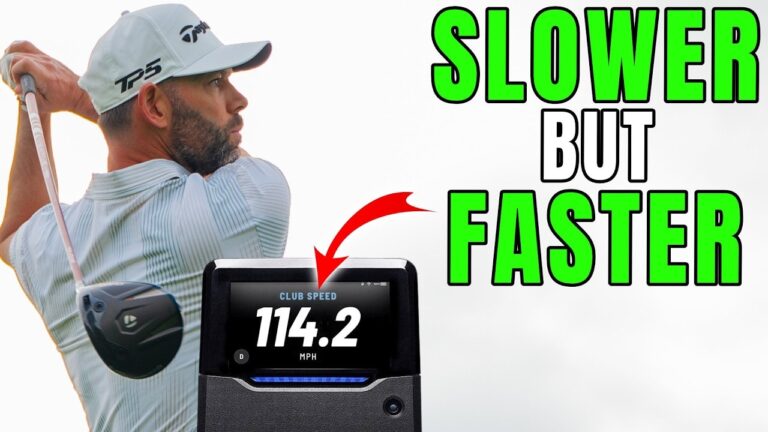
Two swings can look very different in tempo. The swing that finishes sooner may appear faster, but the smoother swing can produce more clubhead speed when it stores energy deeper into the downswing before releasing it. One comparison showed 105 mph from the visibly faster swing and 114 mph from the slower-looking one.
If your driver swing feels frantic, or if you regularly feel as though you swing hard without gaining distance, use the following two-step golf practice progression.
Table of Contents
- Step 1: Understand why a rushed golf swing loses speed
- Step 2: Use the extra-step drill to hear golf swing timing
- Step 3: Move your golf swing start line later
- Step 4: Avoid early casting in your golf downswing
- Step 5: Blend the slower-feeling transition into driver practice
- Step 6: Make build, store, deliver your on-course golf cue
Step 1: Understand why a rushed golf swing loses speed
At address, you have not yet created meaningful potential power in the club. You create that potential during the backswing as your body turns and your arms lift the club into position. By the top of the backswing, energy is available, but it still needs to be used at the right moment.
A common pattern is:
- Build: make a backswing and create potential power.
- Deliver: immediately try to use that power from the top.
This build-and-deliver approach is tempting because it feels aggressive. You reach the top, believe it is time to go as hard as possible, and throw the club toward the ball. However, the club can release too early. The action feels quick because the entire motion is completed in less time, but clubhead speed may be lower when it matters most.
A more effective golf sequence includes a middle phase:
- Build: create potential power in the backswing.
- Store: begin moving down without immediately throwing the clubhead.
- Deliver: release speed through the impact area.
The store phase is not a pause. It is an organized transition. Your body begins shifting and turning, while your arms work down, but you avoid immediately spending all of your speed from the top. This gives the club a chance to arrive in a stronger position before you accelerate it through the ball.
Step 2: Use the extra-step drill to hear golf swing timing
The first drill develops awareness. It is a concept drill designed to help you feel and hear the difference between releasing the club too early and releasing it later. Do this without a golf ball.
Set up the drill
Turn the club upside down so you are holding the shaft near the clubhead, while keeping a normal grip position with your hands. The grip end now points away from you and makes an audible swishing sound as it moves through the air.
Stand with your feet together, beginning approximately two to three feet behind where a golf ball would normally sit. You are going to make a backswing, step toward the target, and swing through.
Listen for the loudest part of the swish
Your aim is to make the strongest part of the sound occur just on the target side of the imagined ball position. Do not worry about locating it with complete precision. This is an estimate, and your ears provide the feedback.
Use this sequence:
- Start with your feet together, behind the imagined ball.
- Make a controlled backswing to build energy.
- Step toward the target as you begin down.
- Allow the club to move through so the swish peaks just after the imagined ball.
- Repeat until the sound clearly moves later in the swing.
When the swish happens well before the ball position, you have likely released the club too soon. This mirrors the rushed golf swing where the instinct is to hit from the top. The motion may feel fast, but the speed has been spent before impact.
When the swish occurs around or slightly beyond the imagined ball, you are beginning to experience the desired sequence. You built energy, stored it while moving into the downswing, and released it later.
Use the step as a timing tool, not a power move
The step is important because it makes your lower body move before you try to throw the clubhead. A poorly timed step often reveals the build-and-deliver pattern. You step or shift as the club is already being thrown, leaving no room to store speed.
A better step gives you time. The lower body begins moving toward the target, your body starts to turn, and the club is allowed to work down before the release. This is why the drill may initially feel unfamiliar. A later release can feel slower even though it gives you a better opportunity to create speed where it counts.
Do not expect one successful repetition to automatically transform your driver swing. This is level one practice. Its purpose is to establish a new feel and a new sound before you ask your full golf swing to reproduce it.
Step 3: Move your golf swing start line later
To transfer the drill into your driver swing, use the idea of a start line. Think about a race car at the start of a Formula One race. Once it reaches the start line and the signal changes, it uses maximum acceleration. The golf equivalent is the point where you allow yourself to apply your full speed.
The problem is that many golfers place this start line at the top of the backswing. As soon as the club reaches the top, they treat it as the signal to fire everything. That makes the early downswing rushed and can cause the club to cast.
Instead, your golf start line needs to move later into the downswing.
You still make a full backswing. You still create potential power. But from the top, you do not immediately try to smash the ball. First, you shift your body, begin turning, and allow your arms to work down. At that stage, you are storing energy rather than releasing it.
Only once the club has moved farther into the downswing do you reach your new start line. Then you can accelerate decisively through the ball.
Rehearse the new start line
For practice swings and shots, visually place an imaginary start line somewhere later in your downswing. The exact location is less important than the intention: it must be later than the top of your backswing.
Use this rehearsal:
- Make your usual backswing and feel that you have built power.
- From the top, begin your body shift and rotation without trying to throw the club.
- Let your arms start down as you store the energy.
- Recognize the later start line.
- From there, deliver the club through the ball with commitment.
This is not about becoming passive. You are still applying speed. You are simply applying it later, when the club can be accelerated through impact rather than thrown away from the top.
Step 4: Avoid early casting in your golf downswing
Early casting occurs when the angle between your lead arm and the club releases too soon in the downswing. In practical terms, the clubhead is being thrown outward early rather than retaining its speed potential until closer to impact.
When your mental start line is at the top, early casting becomes more likely. You react to the backswing by trying to create immediate speed, and the club releases before the impact area. This can feel incredibly fast because the motion is hurried, yet it gives the club less opportunity to build speed at the ball.
Feedback from motion tracking illustrates the difference. A rushed swing can be flagged for mid-downswing casting, while a swing with a later start line can register as being in range. The principle remains useful even without technology: if your downswing feels like an instant throw from the top, you are probably using the speed too early.
Common signs that you may be rushing include:
- Your driver swing feels hard but the clubhead speed or distance does not match the effort.
- You feel that the downswing is over almost immediately.
- You regularly lose the sensation of time between the top and impact.
- Your best attempts feel like you are hitting from the top of the backswing.
- Your practice swish occurs before the ball position rather than after it.
Rather than trying to consciously hold angles or force positions, return to the sequence: build, store, deliver. This keeps your focus on timing and motion instead of making the golf swing overly technical.
Step 5: Blend the slower-feeling transition into driver practice
The most important adjustment is often mental. You need to accept that a better driver swing may feel as though it gives you more time. That feeling does not mean you are losing speed. It can mean you are creating speed later and more efficiently.
Start with slow rehearsals, then progress gradually:
- Make several upside-down-club extra-step swings and move the swish beyond the imagined ball.
- Take normal practice swings with a driver, using a later start line.
- Hit shots at less than full effort while prioritizing the build-store-deliver sequence.
- Increase commitment only after the smoother transition is repeatable.
- Judge the change by strike quality, ball flight, and measured clubhead speed when available, not merely by how fast the swing feels.
A useful thought before each shot is: “I do not accelerate from the top. I accelerate from my start line.” This gives your golf swing a clear task without adding multiple swing thoughts.
In a successful version, the early downswing feels calmer. Your body begins moving, the club works down, and then speed is released through the hitting area. The final result can be a driver swing that looks and feels less rushed while producing more speed.
Step 6: Make build, store, deliver your on-course golf cue
Do not confuse a smooth transition with a slow swing. The goal is not to remove speed from your golf swing. The goal is to organize it.
You build power in the backswing. You store that power as your body begins the downswing. You then deliver the club with intent when it has reached the later start line. This sequence prevents the urge to rush from the top and gives you a more productive route to driver distance.
When you practice, focus on the sound of the first drill and the later start line of the second drill. These two checkpoints can help you replace an early, rushed release with a golf swing that feels more composed and has more speed available through impact.
Golf Swing Speed FAQ
Can a slower golf swing really hit the ball farther?
A smoother-looking golf swing can hit the ball farther when it releases speed later. The objective is not to move slowly throughout the swing. It is to avoid spending energy too early in the downswing.
What does build, store, deliver mean in golf?
Build refers to creating potential power in the backswing. Store means beginning the downswing with body movement and arm motion without immediately releasing the club. Deliver means accelerating the club through the impact area.
Why does my driver swing feel fast but not produce distance?
You may be rushing from the top of the backswing and releasing the club early. This can make the swing feel fast because it finishes quickly, but it can reduce clubhead speed at impact.
Where should the swish happen in the upside-down club drill?
The strongest swishing sound should occur around or just on the target side of the imagined ball position. A swish that peaks too early suggests that you are releasing speed before impact.
What is the golf swing start line?
The start line is an imaginary point in the downswing where you allow yourself to apply full acceleration. Moving it later than the top of the backswing encourages you to store energy before delivering the club.
0 Comments