
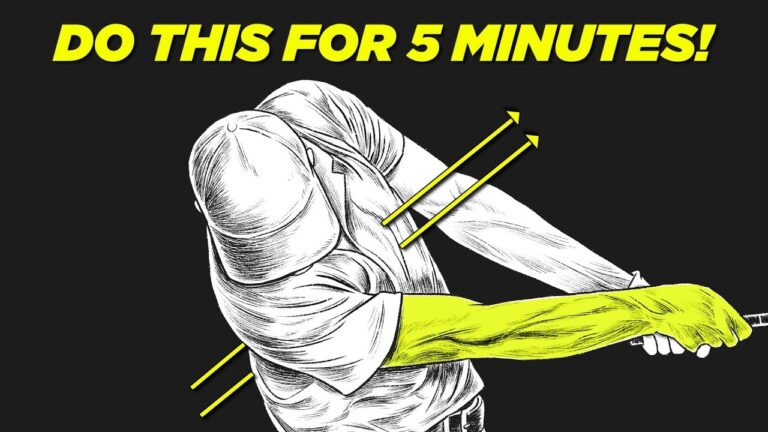

Unlock effortless power and consistency in your golf swing by mastering body movement and sequencing. Discover how closing the gap with your knees can transform your game.
If your golf ball striking often looks inconsistent, the issue might be your lower body isn’t finishing the move on time. When your knees and hips don’t close the ‘gap’ through the hitting zone, you’re prone to hitting fat shots, thin shots, and anything in between.
This golf improvement method focuses on a practical sequencing change: get your right knee to the finish line and learn how to turn and shift through impact more effectively. The result is more solid contact and a repeatable path without overthinking mechanics each swing.
Step 1: Identify the Knee and Turn Gap
Most amateur golfers struggle to ‘move through’ the ball effectively because they either don’t turn enough or they turn with shoulders that are too level. Instead of smooth rotation, many swings result in a pause, causing poor contact consistency.
Fixing this isn’t about swinging harder. It’s about coordinating your body to perform the correct move at the right time to turn smoothly and strike the ball with confidence.
Step 2: Feel the Motion with the Club-Under-Armpit Drill
This simple drill helps achieve the correct swing motion. Stand in your usual address position, extend a golf club roughly one foot in front of you, and reach down. Focus on what your body naturally does and aim for a setup that encourages better pressure release and a more effective trail-side finish.
Step 3: Close the Knee Gap
By focusing on getting your right knee to finish the movement, you’re likely to support rotation and allow the club to pass through the hitting zone fluidly, reducing fat or thin contact and promoting more consistent strikes.
Step 4: Avoid Turning Too Level
To prevent stalling or pauses during your swing, adjust your shoulders’ turn to not be so level. When turned correctly with knee alignment, movement becomes smooth and power more efficient.
Step 5: Incorporate Forward Rib Tilt
Optimize your swing for better impact by managing torso orientation. Shifting the ribcage forward with deliberate tilt helps maintain a strong impact position, preventing awkward club delivery.
Step 6: Implement the 55-Degree Rule
This simple rule-of-thumb involves keeping shoulder plane around 55 degrees on the downswing, ensuring you don’t stall at impact.
Step 7: Use the Arms Drop Drill
This drill helps integrate appropriate turn and tilt. Set arms at 45 degrees while turning to hone the correct body movement.
Step 8: Progress by Moving Through
Measure success not by swing force but by seamless movement through the hitting zone.
Step 9: Leverage Swing Analysis
Using tools like SwingUplap can help accelerate improvement by providing feedback on body mechanics.
Step 10: Focus on Separation
Separation between upper and lower body improves swing efficiency, leading to better impact performance.
FAQ
Why do I hit fat shots even when I feel like I’m swinging down?
Fat shots happen due to incorrect lower body movement that inhibits proper ball contact.
How long should I practice these drills before I expect better golf contact?
Focus on short, precise practice sessions. Consistency should improve as the feel sets in.
Do I need special equipment?
No specialized tools are necessary beyond a standard golf club for these drills.
What is the simplest cue if I forget everything during my swing?
Concentrate on getting your right knee to the finish line.
What if I turn through but still miss the ball?
Focus on tilt and avoiding a too-level turn to maintain consistent ball striking.
Quick Takeaway for Your Golf Game
Enhance your golf striking by focusing on proper sequencing and mechanics. Begin with knee finish, incorporate rib tilt, and practice integration with the arms drop drill to improve power effectiveness and contact reliability.
0 Comments