


Focus keyphrase: improve ball striking
If you want to improve ball striking with your irons, hybrids, and fairway woods, there is one skill that matters more than most golfers realize.
It is not a new swing thought. It is not another clever drill pulled from a random tip. It is not trying harder to keep your head still, hold your angle, or keep your hands ahead.
It is learning how to read the feedback from your strike.
That sounds simple, but it changes everything. Many golfers hit a poor shot, label it as “bad,” feel frustrated, and then go searching for a fix. The problem is that “bad shot” is not a diagnosis. It tells you nothing useful about what actually happened.
To make lasting progress, you need to become your own strike coach. You need to notice what the club did, where it interacted with the ground, and where the ball struck the face. Once you can identify the real problem, you can choose the right solution instead of guessing.
This approach can help you strike your irons better, make cleaner contact off the turf, and stop wasting time with tips that do not match your issue. Here is the step-by-step method.
Table of Contents
- Step 1: Stop calling every miss a “bad shot” if you want to improve ball striking
- Step 2: Learn the three strike variables that control contact
- Step 3: Use the turf to improve ball striking
- Step 4: Diagnose whether your main issue is low point or depth of arc
- Step 5: Improve ball striking by training awareness, not just mechanics
- Step 6: Use strike location to fix fairway woods and hybrids
- Step 7: Improve ball striking by learning face awareness
- Step 8: Let your body self-correct through better intention
- Step 9: Build a simple pre-shot and post-shot routine to improve ball striking
- Step 10: Use this framework before searching for another swing tip
- Step 11: Turn yourself into your own launch monitor
- Step 12: Make your next practice session about feedback
- FAQ
Step 1: Stop calling every miss a “bad shot” if you want to improve ball striking
The first change is mental, but it has a direct effect on your physical improvement.
When you hit a heavy iron, top a hybrid, or catch a fairway wood thin, the normal reaction is frustration. That is understandable. Golf is difficult, and poor contact is annoying. But frustration often shuts down the one thing that could help you most: awareness.
If you simply say, “That was terrible,” you skip over the evidence the shot gave you.
Instead, every poor strike should trigger a better question:
What exactly happened?
Did the club hit the ground too early or too late?
Was the swing arc too deep or too shallow?
Did the ball come off the center of the face or somewhere else?
This is the difference between random practice and productive practice. If you want to improve ball striking, you have to replace vague judgment with useful feedback.
Step 2: Learn the three strike variables that control contact
There are three key pieces of information behind solid contact from the ground.
If you can learn to notice these three, your ability to diagnose your own swing improves dramatically.
1. Where the club lands on the ground
This is your contact point with the turf relative to the ball.
For irons, you generally want the club to strike the ball first and then the turf. For fairway woods and hybrids, the bottom of the swing should be very near the ball, often around it or just after it, depending on the club and lie.
If your club is consistently interacting with the turf behind the ball, you will struggle with fat shots. If it is too far forward, you may catch the ball thin or top it.
2. The depth of the swing arc
This refers to how deep or shallow the club is traveling into the ground.
A golfer who digs too much often creates heavy contact. A golfer whose arc rides too high can struggle with topped shots or weak contact. Even if the club reaches roughly the right spot, poor control of depth can still ruin the strike.
3. Where you contact the ball on the clubface
Centered contact matters. Toe strikes, heel strikes, low-face strikes, and high-face strikes all produce different flight and feel.
This is especially important for golfers who shank chips, hit weak fairway woods, or feel like the strike is unpredictable. If you do not know where the ball is meeting the face, you are missing valuable information.
Those three variables are the foundation. Every clean strike depends on them.
Step 3: Use the turf to improve ball striking
One of the fastest ways to improve ball striking is to pay attention to how the club interacts with the ground.
Most golfers are so focused on body positions that they forget the club has to do a job. It has to arrive at the ball in the correct place, at the correct depth, and with reasonable face contact. The ground gives immediate feedback on whether that happened.
After each shot, notice:
Did you hit the ground before the ball?
Did you barely touch the ground?
Did the club dig too much?
Was the turf contact shallow and crisp?
This matters because your body can often self-organize more effectively when your attention is on the outcome of the motion rather than on a forced mechanical thought.
If you make a few swings and notice the club is going too deep, your body will often begin adjusting naturally to produce a shallower strike. That is a powerful training tool. You are not blindly copying positions. You are responding to real feedback.

Step 4: Diagnose whether your main issue is low point or depth of arc
Two golfers can both hit heavy shots, but for different reasons.
One might have a low point problem. The club bottoms out too far behind the ball.
Another might have a depth problem. The club reaches the correct area but goes too much into the ground.
Those are not the same issue, and they should not be treated the same way.
This is where many golfers get stuck. They search for a tip on “how to hit irons better,” but the tip may be aimed at the wrong fault. If your low point is poor, a drill for shallowing depth may not solve it. If your low point is fine but your arc is too steep, a low-point fix may not help enough.
So before trying to fix your contact, classify it:
Low point issue: The club is striking the ground in inconsistent places relative to the ball.
Depth issue: The club is entering the ground too much or not enough.
That distinction alone can save months of confusion.
Step 5: Improve ball striking by training awareness, not just mechanics
A useful example comes from a student working on wedge play. He believed his problem was failing to keep his hands ahead of the ball. So he kept trying that thought over and over.
The result was not better contact.
What changed things was a simpler question: How is the club interacting with the ground?
Once he began noticing whether the club barely brushed the ground or went too deep, he discovered the real issue was not his chosen swing thought. It was the depth of the arc.
From there, his practice swings became more intelligent. He sensed when the club was traveling too deep, allowed his body to adjust, and then produced a much cleaner strike.
This is one of the most important lessons in golf improvement:
Your preferred swing thought is not always your real problem.
If you want to improve ball striking, let the strike tell you what needs work.

Step 6: Use strike location to fix fairway woods and hybrids
Fairway woods off the ground can expose inconsistencies quickly. A small error in where the club bottoms out can produce a thin, heavy, or weak shot.
One golfer struggling with fairway woods discovered that his club was striking the ground in different places from swing to swing. Sometimes the turf contact was well behind the ball. Other times it was farther forward. That inconsistency explained why the strike felt so unreliable.
Once he focused on where the club was landing, his motion began to calm down. His body became more stable because stability supported the task. In other words, he did not need a dozen technical reminders. He needed a clearer intention.
For fairway woods and hybrids, ask yourself after each shot:
Where did the club brush or strike the ground?
Was that spot close to the ball?
Did the bottom of the swing move around from shot to shot?
That awareness can reveal whether your issue is centered around low point control. If it is, you can search for and apply drills that specifically train low point, rather than trying random swing changes.
Step 7: Improve ball striking by learning face awareness
Ground contact is only part of the picture. The clubface also tells a story.
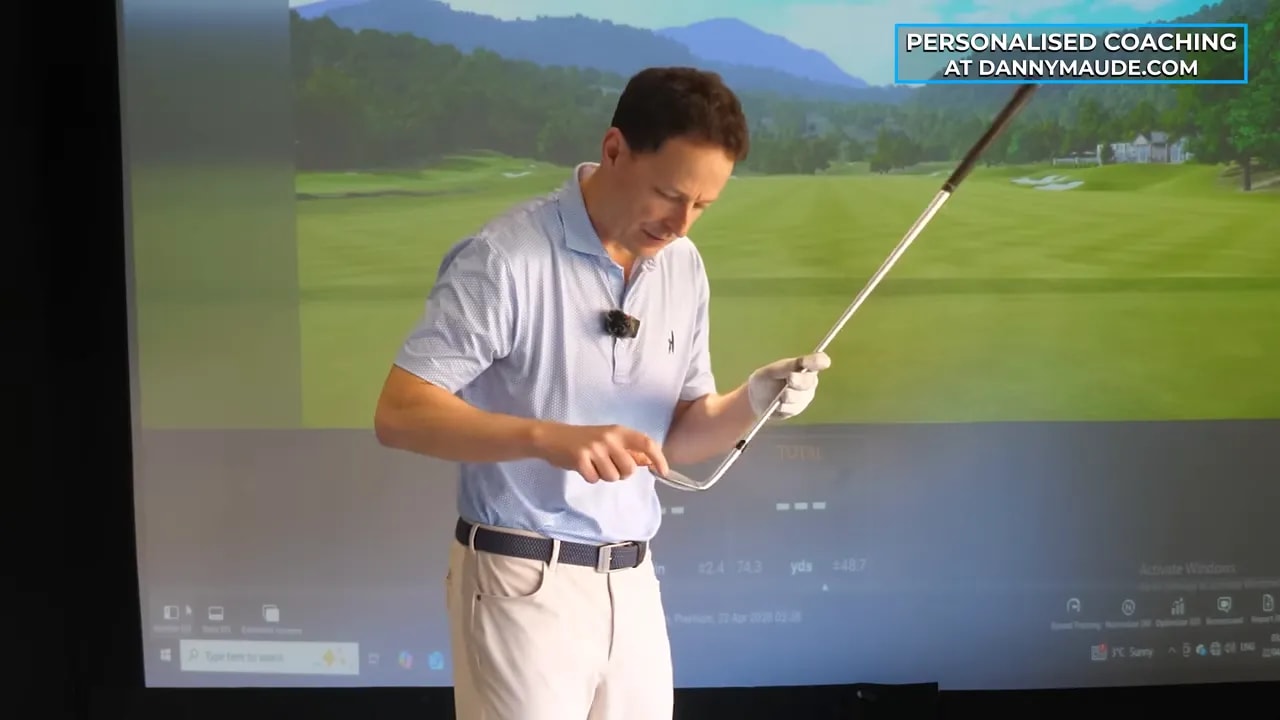
If you struggle with shanks, weak toe strikes, or shots that feel different from one swing to the next, start paying attention to where the ball is contacting the face.
This can be eye-opening.
A helpful comparison is tennis. A player learns to hit the center of the racket not by memorizing positions alone, but by reacting to feedback. If the ball catches the frame, the body learns. If the ball meets the sweet spot, the body learns that too.
Golf works the same way.
Try this simple exercise:
Hit a shot.
Immediately identify where on the face you believe contact occurred.
Point to the spot on the clubface if that helps.
Hit another shot with the sole intention of becoming more aware.
You are not trying to manipulate ten parts of the swing at once. You are building strike awareness.
For one golfer dealing with shanked chips, this shift alone changed the session. By noticing face contact and staying attentive to where the ball met the club, he stopped repeating the same miss. He even caught a pre-swing habit that was nudging the club toward the hosel before takeaway. Nobody had to tell him. Awareness revealed it.
Step 8: Let your body self-correct through better intention
There is a deeper lesson here about skill development.
When your intention is clear, your body often organizes the movement more effectively. If your intention is to strike the ground in the same place each time, your motion may become steadier. If your intention is to avoid digging too much, your body may begin to moderate the depth of the arc. If your intention is to find center-face contact, your setup and delivery may quietly improve.
This does not mean mechanics do not matter. They do. But mechanics become far more useful when they are connected to a clearly diagnosed issue.
That is why many golfers feel overwhelmed by online instruction. There are thousands of valid tips, but a valid tip is only useful when it matches the problem in front of you.
Better awareness gives you a filter.
Instead of asking, “What is the best golf tip?” ask, “Which of the three strike variables is costing me solid contact?”
Now your practice has direction.
Step 9: Build a simple pre-shot and post-shot routine to improve ball striking
If you want this to transfer from the range to the course, use a repeatable process.
Before the shot
Choose the target.
Set up as normal.
Pick one awareness cue based on your current pattern:
Where the club will meet the ground
How deep the club will travel
Where you want to strike the face
After the shot
Do not react first with emotion.
Identify the strike pattern.
Classify the miss using the three variables.
Make the next swing with better awareness.
This turns every shot into a source of information.
Even on poor days, you are still learning. That is how you begin to strike your irons better and gain more consistency with hybrids and fairway woods.
Step 10: Use this framework before searching for another swing tip
Online golf instruction can be helpful, but only if you know what you are looking for.
Before searching for another fix, ask yourself:
Is my issue mainly where the club lands?
Is it mainly how deep the club goes?
Is it mainly where I strike the face?
Once you know that, you can choose a relevant drill or lesson. That is far better than bouncing from one idea to another and hoping something sticks.
The real breakthrough is not a secret move. It is learning how to identify your actual pattern.

Step 11: Turn yourself into your own launch monitor
Launch monitors and high-end coaching tools are valuable because they reveal what is happening at impact.
But you can build part of that skill yourself by becoming more aware of strike feedback.
You may not measure everything with the precision of a device, but you can absolutely learn to detect patterns in:
Turf interaction
Low point location
Depth of arc
Clubface strike location
That awareness makes you a much smarter golfer.
Instead of saying, “I am terrible with irons,” you can say, “My low point is drifting behind the ball,” or “My contact is too much off the heel,” or “My arc is getting too deep.”
That level of clarity is what leads to real improvement.
Step 12: Make your next practice session about feedback
The next time you practice, resist the urge to chase a perfect-looking swing.
Instead, make the session about information.
Notice the turf.
Notice the strike on the face.
Notice whether your low point is consistent.
Notice whether your depth changes from swing to swing.
If your contact improves, great.
If it does not improve immediately, that is still useful. You are gathering the evidence needed to apply the right fix. That is a much better long-term strategy than guessing.
Golfers often spend years searching for a missing tip. In many cases, what is actually missing is a better conversation with the strike itself.
FAQ
What is the fastest way to improve ball striking with irons?
The fastest way to improve ball striking is to stop labeling every miss as a generic bad shot and start identifying the actual cause. Focus on three things: where the club strikes the ground, how deep the arc travels, and where the ball contacts the face. That gives you a clear diagnosis and a better path to improvement.
Why do I keep hitting fat and thin shots?
Fat and thin shots usually come from poor control of low point or depth of arc. If the club bottoms out too far behind the ball, heavy contact often follows. If the arc rides too high or the bottom of the swing moves around too much, thin contact and topped shots become more likely.
How can I strike my irons better without overthinking my swing?
Use external feedback instead of stacking technical thoughts. Pay attention to the turf and the strike on the clubface. Often your body will self-correct more effectively when your focus is on the task, such as brushing the ground in the right place or finding center-face contact.
What should I focus on with fairway woods off the ground?
With fairway woods, focus on where the club is interacting with the ground relative to the ball. If that spot changes from swing to swing, solid contact becomes difficult. Awareness of low point can help you become much more consistent.
How do I stop shanking chip shots?
Start by paying attention to where the ball is hitting on the face. If the strike is repeatedly near the hosel, that is valuable information. By becoming aware of the contact pattern, you may also spot a setup or takeaway habit that is moving the club toward the heel.
Should I still use golf tips and drills from YouTube or lessons online?
Yes, but only after identifying your actual strike issue. Online tips are far more effective when matched to a specific problem such as low point control, depth of arc, or face contact. Random tips can waste time if they do not address the pattern you have.
If you want to improve ball striking, the first move is not changing everything in your swing. It is learning to notice what your strike is already telling you.
Every shot gives feedback. The turf tells you where and how the club arrived. The face tells you where contact occurred. Your job is to pay attention.
Once you do that, your practice becomes smarter, your fixes become more specific, and your progress becomes more predictable.
That is the kind of change that can save years of frustration and lead to better irons, cleaner hybrids, and more reliable fairway woods from the turf.
0 Comments