
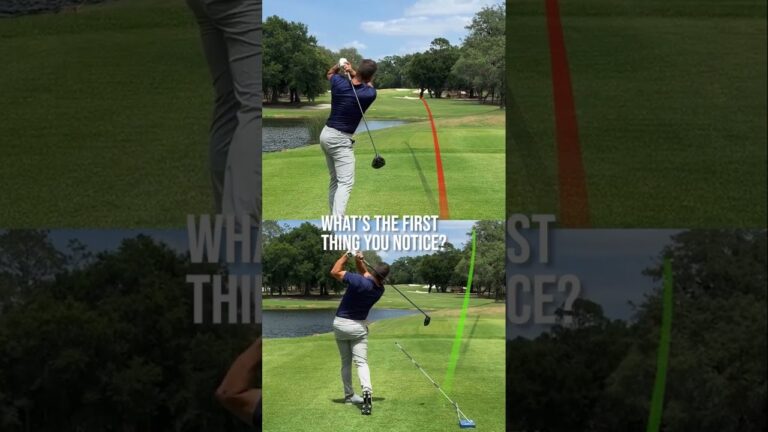

If your golf downswing feels disconnected, steep, or hard to time, your body sequence may be the real issue. A common pattern in golf is letting the arms take over while the body stalls. That can lead to pushes, hooks, chunks, and weak contact.
The fix is not just “turn your hips more.” In golf, better downswing motion comes from syncing your hips, chest, arms, and right elbow so the club can shallow and approach the ball from a stronger position. When those pieces work together, your golf swing becomes easier to repeat.
This guide explains how to improve your golf downswing step by step, with a focus on hip rotation, right elbow position, and better body-driven motion through impact.
Table of Contents
- Step 1: Understand why hips in the downswing matter in golf
- Step 2: Start the golf downswing with the right elbow, not a throw from the top
- Step 3: Match hip rotation with the elbow tuck in your golf swing
- Step 4: Use the right golf checkpoint for a shallower club
- Step 5: Create space in your golf downswing with the daylight feel
- Step 6: Use the rope-pull image to improve golf body mechanics
- Step 7: Keep rotating through the golf shot instead of stalling
- Step 8: Protect your lag and strike quality in golf
- Step 9: Practice this golf move with a simple drill checklist
- Step 10: Know the common golf mistakes that ruin the downswing
- Step 11: Apply these golf feels on the course
- Step 12: Build a more repeatable golf downswing
- Golf FAQ
- Key takeaway for better golf downswing mechanics
Step 1: Understand why hips in the downswing matter in golf
In golf, the hips help create space for the arms and club to move into impact. When your lower body starts to open correctly in the downswing, the club has a better chance to shallow instead of getting thrown steeply over the top.
That matters because a steep downswing often causes several familiar golf misses:
Blocks out to the right
Hooks caused by late hand action
Chunked shots from poor low point control
Inconsistent contact from a disconnected motion
Your hips are not working alone. In a solid golf swing, they support the sequence by opening while the upper body and arms stay organized. If your hips stop rotating, your arms usually have to rescue the shot. That is where timing takes over, and timing is difficult to repeat under pressure.
Step 2: Start the golf downswing with the right elbow, not a throw from the top
One of the most important golf concepts here is the first move down. Instead of immediately throwing the club outward, focus on getting your right elbow tucked into your right side early in transition.
This move helps your golf downswing in three ways:
It shallows the club
It keeps your arms connected to your body
It sets up a more efficient strike with less reliance on perfect timing
A useful checkpoint in golf is this: when you are about halfway down, the club should be pointing at the ball or slightly outside it. That is a strong delivery position for many players because it gives you room to rotate and release through impact.
If your right elbow flies away from your side too early, the club tends to steepen. Once that happens, you often need a last-second hand save to square the face and make decent contact.
Step 3: Match hip rotation with the elbow tuck in your golf swing
This is where many golf players get confused. They hear that the right elbow should tuck, so they try to pin the arm in without moving the body. That usually creates tension and makes the swing even more stuck.
The better golf feel is to let the elbow tuck while your body keeps opening.
Think of it this way:
Your right elbow works inward
Your hips begin to open
Your chest continues rotating
The club drops into a better slot
In a good golf downswing, these motions are blended. The elbow does not replace hip rotation. Hip rotation gives the elbow and club somewhere to go.
If your hips stop, your arms will often race past your body too soon. If your hips spin without the arms organizing, you can get stuck behind the shot. The goal in golf is coordinated motion, not isolated motion.
Step 4: Use the right golf checkpoint for a shallower club
A practical golf checkpoint is to look at the club halfway down. If it is aimed at the ball or just a touch outside it, you are usually in a better delivery pattern.
That position suggests you have:
Started the downswing with better arm structure
Created a shallower club path
Maintained space for rotation through impact
If the club is cutting sharply across the line or working too far outside the ball early in the downswing, your golf motion is likely getting steep. That can make contact and face control much harder.
For many golf players, this simple visual checkpoint is easier to understand than abstract swing theory.
Step 5: Create space in your golf downswing with the daylight feel
Another helpful golf idea is the feeling of daylight between your left arm and right elbow as the downswing develops. This does not mean your arms should separate wildly. It means there is enough space and structure for the club to release naturally.
Why this matters in golf:
It prevents the arms from getting jammed too close to the body
It helps preserve room to swing through the ball
It supports a freer, more athletic release
Without that space, many golf swings become cramped through impact. The body stalls, the hands flip, and the strike becomes unreliable.
A good downswing is connected, but not squeezed. That is an important distinction in golf instruction.
Step 6: Use the rope-pull image to improve golf body mechanics
A strong golf downswing can feel a lot like pulling a heavy object with a rope. If you were trying to pull weight efficiently, you would not simply throw your hands out in front of you. You would organize your body to pull with leverage.
That same idea can improve your golf motion.
Try this feel:
Imagine your right elbow staying connected to your side
Feel as though your funny bone is tracing along the seam of your shirt
Keep turning your body as the club moves down
This is a useful golf swing image because it encourages connection, sequencing, and leverage all at once. It also discourages the common mistake of casting the club from the top.
Step 7: Keep rotating through the golf shot instead of stalling
One of the biggest golf mistakes in the downswing is stopping body rotation to try to force the arms in front. That may feel powerful for a moment, but it usually creates compensation.
When your body stalls in golf, several things can happen:
The club overtakes too early
The face becomes harder to control
Contact shifts behind the ball
You lose the ability to keep pressure moving forward
The better golf pattern is to continue opening through impact. Let your hips and chest guide the swing while the arms and club respond to that motion.
This is why the phrase “use your hips” can be misleading in golf. The goal is not a violent hip spin. The goal is steady rotation that keeps the whole system moving together.
Step 8: Protect your lag and strike quality in golf
When the downswing starts correctly, you have a better chance to maintain lag naturally. In golf, lag is not something you should force with tight wrists. It is often the result of proper sequencing.
A poor elbow position can cost you that advantage. If the right elbow gets out of alignment early, the club can steepen and unhinge too soon. That leads to weaker contact and more inconsistency.
Better golf players often preserve lag because:
Their transition is organized
Their right elbow works into a better spot
Their body keeps rotating instead of stopping
Solid golf contact is usually the result of these fundamentals working together, not one isolated hand move.
Step 9: Practice this golf move with a simple drill checklist
If you want to improve your golf downswing, keep practice simple. Use a short checklist rather than trying to fix everything at once.
Golf downswing rehearsal checklist
Make a backswing to the top.
Start down by feeling the right elbow move toward your right side.
Let your hips begin opening as that happens.
Check that the club is shallowing and approaching a position aimed at the ball or slightly outside it.
Keep rotating your chest and hips through the strike.
Finish balanced.
For golf practice sessions, begin with slow-motion rehearsals. Then move to half swings. Only add speed when the motion feels coordinated.
This is especially useful if your usual golf miss is a steep, glancing strike or a shot that curves unpredictably.
Step 10: Know the common golf mistakes that ruin the downswing
Even good golf players can fall into the wrong pattern if they focus on only one body part. Here are the main mistakes to avoid.
Golf mistake 1: Letting the right elbow fly out
This tends to steepen the club and disconnect the arms from the body.
Golf mistake 2: Stopping hip and chest rotation
This forces the arms and hands to rescue the golf shot, which makes timing much more difficult.
Golf mistake 3: Trying to spin the hips open too fast
Too much uncontrolled rotation can leave the arms behind. In golf, speed without sequence is still a problem.
Golf mistake 4: Forcing lag with tension
Lag is usually a byproduct of sound motion. In golf, trying to hold angles artificially often creates a worse release.
Golf mistake 5: Getting too narrow in transition
If there is no space or daylight in the downswing, the club can get trapped and the release becomes cramped.
Step 11: Apply these golf feels on the course
Range swings and on-course golf swings can feel very different. Under pressure, most players revert to whatever move feels simplest. That is why your downswing thought should stay basic.
A practical golf swing cue might be one of these:
Tuck the right elbow early
Open and keep turning
Pull the club through, do not throw it
Use only one cue at a time during a round of golf. Too many technical thoughts can freeze your athletic motion.
If your golf ball flight starts leaking right, curving too much left, or producing heavy contact, return to the same fundamentals:
Did the right elbow organize early?
Did the hips and chest keep rotating?
Did the club shallow or get steep?
Step 12: Build a more repeatable golf downswing
The best golf swings are not built on perfect hand timing. They are built on positions and motion that make impact easier to repeat.
If you want a more reliable golf downswing, focus on this sequence:
Tuck the right elbow early.
Allow the club to shallow.
Create enough space for release.
Keep the hips and chest rotating.
Let the club move through the ball with body support.
That combination can help you strike the ball more solidly and remove the disconnected feeling that hurts so many golf swings.
Golf FAQ
Should the hips start the downswing in golf?
Your hips should begin opening in the downswing, but not in isolation. In golf, the best move is a coordinated transition where the right elbow tucks, the club shallows, and the body keeps rotating. Spinning the hips without the arms organizing can create new problems.
What does the right elbow do in the golf downswing?
The right elbow works into your right side early in the downswing. This helps shallow the club, connect the arms to the body, and improve strike consistency in golf.
Why do I get steep in my golf downswing?
A steep golf downswing often happens when the right elbow moves out early, the club is thrown from the top, or the body stops rotating and forces the arms to take over.
How do I know if my golf club is shallowing correctly?
A useful golf checkpoint is halfway down. The club should be pointing at the ball or slightly outside it. That usually indicates a better delivery position than a steep over-the-top move.
Can better hip rotation fix chunked golf shots?
Better hip rotation can help, especially if chunked golf shots come from a stalled body and disconnected arms. But the full fix usually includes better elbow position, improved shallowing, and continued rotation through impact.
What is the easiest golf swing feel for the downswing?
Many golf players do well with a simple feel such as “tuck the right elbow and keep turning.” The rope-pull image can also help you avoid throwing the club from the top.
Key takeaway for better golf downswing mechanics
If your golf downswing feels out of sync, do not just try to swing harder or spin your hips faster. Start with better structure. Tuck the right elbow early, let the club shallow, create space, and keep your body rotating through the strike.
That is a practical way to make your golf swing feel more connected, more powerful, and far easier to repeat.
0 Comments