
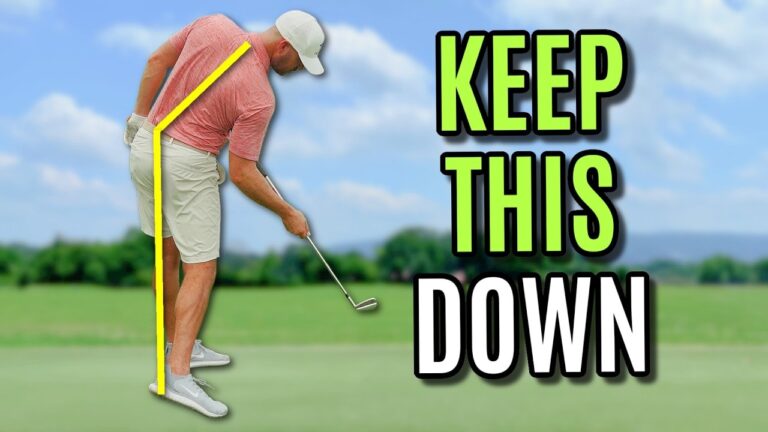

One of the most common ball-striking problems in golf is standing up through impact. You start in good posture, the club moves down, and then somewhere near the ball your body rises, your hips move in, and contact gets inconsistent. Thin shots, heel strikes, blocks, and weak contact often follow.
If you have been trying to stay down through the ball by keeping your chest pointed at the ground, that may be the exact reason the problem keeps coming back.
The better model is different. Strong ball strikers do not keep their chest down forever. Instead, they rotate the chest out toward the target while the trail side of the body stays down through the strike. That combination helps maintain posture, improve low point control, and create the look many golfers are trying to achieve.
This is the key idea to build around:
Chest out, trail side down, hips forward.
Once you understand what that means and how to practice it, staying down in the golf swing becomes much easier.
Table of Contents
- Step 1: Understand what “stay down through the ball” really means
- Step 2: Stop making the classic mistake of keeping your chest down
- Step 3: Learn the real move that helps you stay down through the ball
- Step 4: Use the sternum drill to feel chest out correctly
- Step 5: Understand how trail side down automatically improves your hips
- Step 6: Practice the rib cage drill to train trail side down
- Step 7: Blend rotation and side bend instead of trying to eliminate extension
- Step 8: Take this feel to real shots
- Step 9: Check the earlier parts of your swing if the problem persists
- Step 10: Build a repeatable practice routine around the feel
- FAQ: Staying down through the ball in the golf swing
- Final thought
Step 1: Understand what “stay down through the ball” really means
When golfers hear the phrase “stay down,” they often imagine one simple move: keep the chest bent over and keep the head down. It sounds logical, but it creates a bad picture.
At setup, your chest and sternum naturally point down toward the golf ball because you are in posture. But through impact and into the early follow-through, good players do not leave the chest pointing down at the turf. Their chest rotates outward toward the target.
What stays down is not the chest. It is the trail shoulder, trail pec, and trail rib cage.
That distinction matters because it explains why elite players can look tilted over through the ball without looking stuck, cramped, or frozen. Their upper body tilt is still there, but it is being maintained by the trail side lowering as the chest opens.
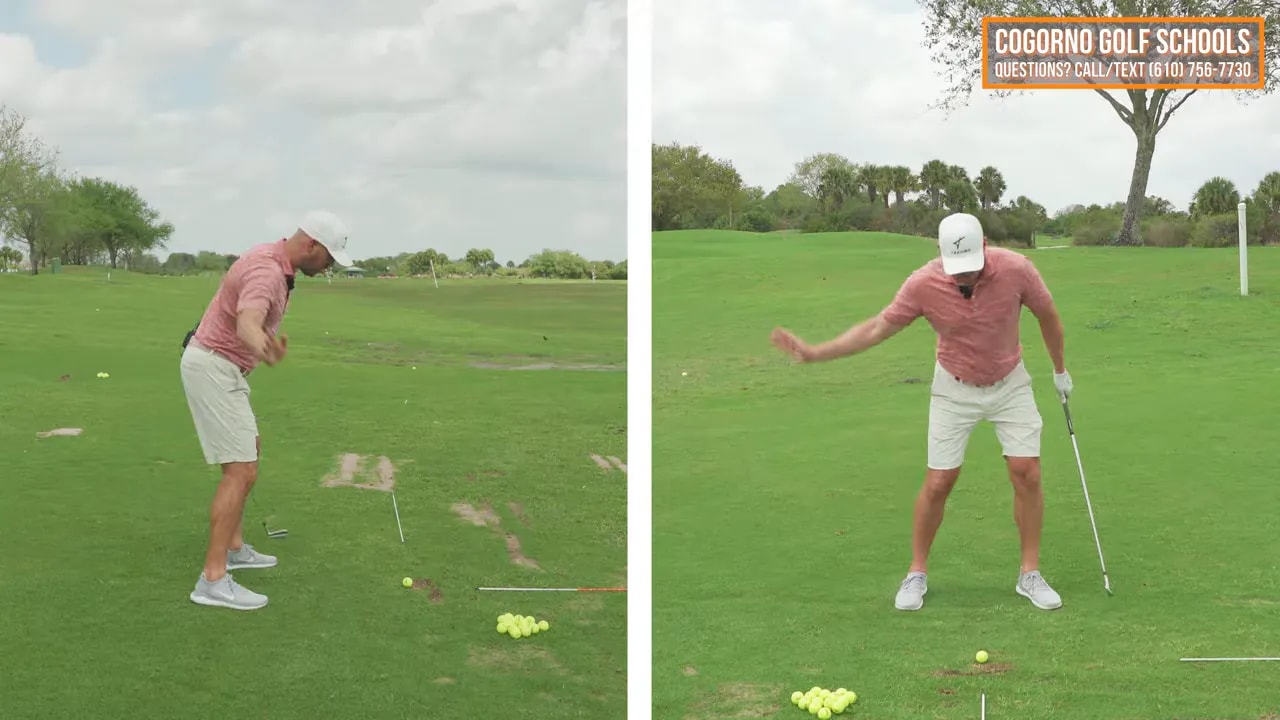
If you were to draw a line along a good player’s body angle at address, that angle can look very similar through the strike. The difference is how they preserve it. They do not lock the chest down. They rotate and side-bend correctly.
This is one of the biggest differences between golfers who hit the ball solidly and golfers who early extend.
Step 2: Stop making the classic mistake of keeping your chest down
Many golfers first try to solve early extension by forcing the chest to stay down through impact. It feels disciplined, but it usually leads to a poor through-swing shape.
Think about what happens if you keep your sternum pointed at the ground as the club moves past the ball:
- Your body rotation stalls
- Your arms can get trapped behind you
- Your release gets compromised
- Your finish looks stuck and restricted
- Your contact becomes less reliable
That is not how great ball strikers move. Through the strike, the chest is opening and moving out toward the target. By the time the arms are roughly parallel after impact, the chest is no longer pointing down at the ball. It is much more level to the ground and directed outward.
This is why trying to “keep your chest down” often creates the opposite of what you want. You may feel lower, but you are not moving correctly. Staying down in the golf swing is a motion pattern, not a frozen position.
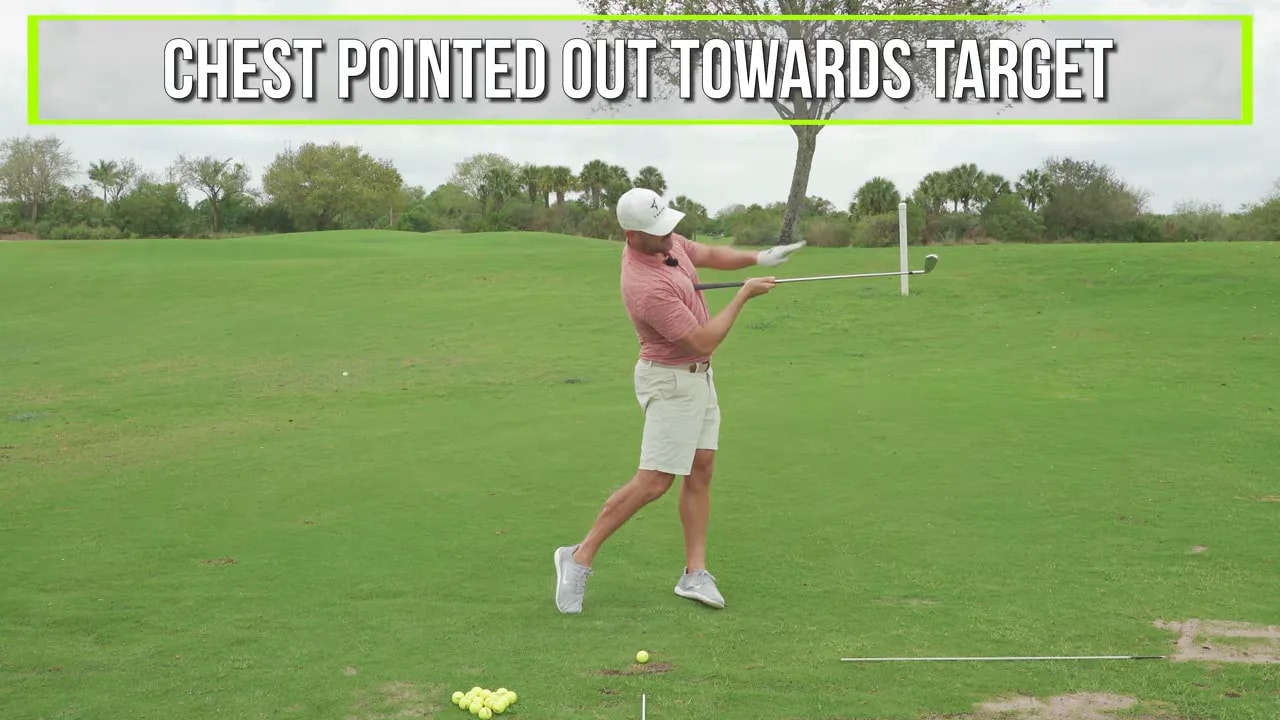
A useful checkpoint is your sternum direction:
- At setup: sternum points down toward the ball
- Through the ball: sternum rotates out toward the target
If you still try to point the chest down after impact, you will not match the movement pattern of strong players.
Step 3: Learn the real move that helps you stay down through the ball
The move you are missing is trail side down.
As your chest rotates out toward the target, your trail side works downward. For a right-handed golfer, that means the right shoulder, right pec, and right rib cage move down through the ball.
This is the piece that replaces the chest’s address position.
At address, your chest occupies the “downward” slot over the ball. Through impact, that space gets taken over by the trail side. That is why good players can open up and still appear to stay in posture.
Without this move, your chest opens and your body rises. With it, your chest opens and your posture is preserved.
The simplest way to remember it is:
Chest out, trail side down, hips forward.
Each part supports the others:
- Chest out gives you rotation instead of getting stuck
- Trail side down gives you side bend and helps you maintain body angles
- Hips forward keeps the pelvis moving properly instead of backing away from the target
This applies with all clubs, not just irons. The exact shape may vary slightly, but the pattern stays the same.
Step 4: Use the sternum drill to feel chest out correctly
If the idea of opening your chest while staying down feels confusing, start with a simple awareness drill.
Take a club and place it against your sternum, roughly along your shirt buttons.
Then make slow motion rehearsals.
- Get into your golf posture
- Notice that the club points down toward the ball at address
- Rotate through slowly
- Feel the club move so it points out toward the target
- Notice that your chest is now more level to the ground, not pointed straight down
This teaches a very important truth: if you want to stay down through the ball, your chest still has to open. Good rotation is not the enemy. It is part of the solution.
As you do this, do not force your head down or try to hold the chest at the ground. Let the chest rotate out naturally while keeping the trail side working downward.
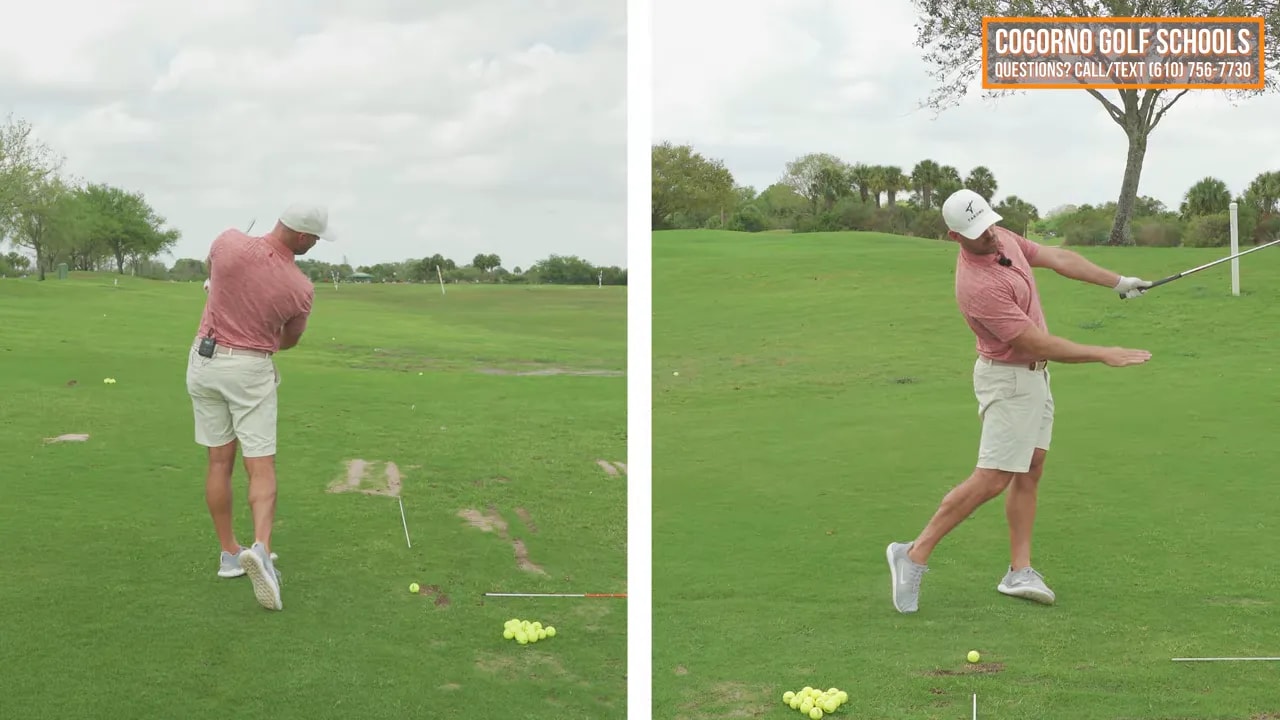
A helpful body sensation is a small trail-side oblique crunch. For a right-handed golfer, that means feeling the right side shorten slightly as the chest opens. It is not a violent move. It is a coordinated side bend that helps the upper body stay inclined while rotating.
Step 5: Understand how trail side down automatically improves your hips
Many golfers try to fix standing up by shoving the hips back or keeping the rear end on an imaginary wall. That can be a useful checkpoint, but it often becomes too mechanical when used by itself.
There is a better way to think about it.
When your trail side works up, your lead hip tends to move toward the ball. That is the pattern associated with early extension. The pelvis moves in, space disappears, and the club has to find a new path.
When your trail side works down, your lead hip tends to move back. In other words, proper side bend helps create the hip depth many golfers are desperately trying to force.
This is why the mantra includes hips forward.
You are not trying to keep your hips back forever. You are trying to move pressure and rotation toward the target while allowing the lead hip to deepen properly from the down-the-line view.
That is a very different feel from this common mistake:
- Chest down
- Hips back
- Body stuck behind the ball
The better pattern is:
- Chest out
- Trail side down
- Hips forward
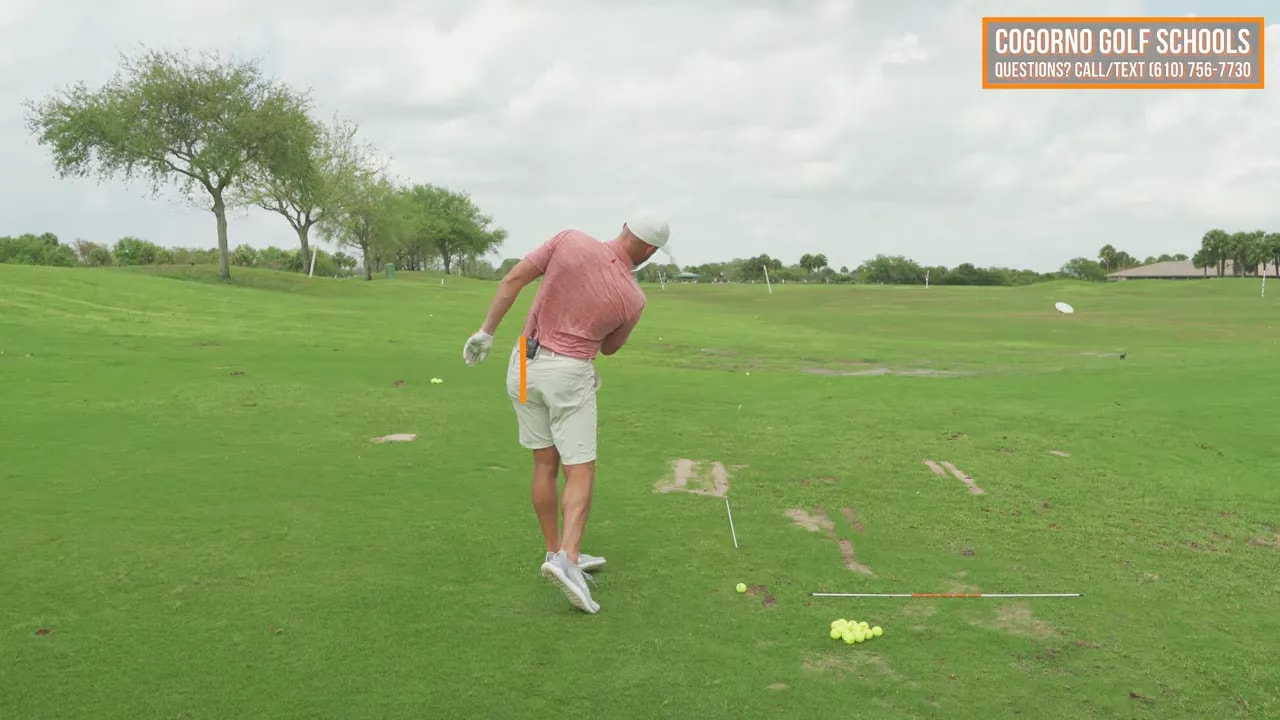
Once you feel this, the motion becomes more athletic and less forced. You are no longer trying to manufacture posture with separate parts. You are creating it through correct motion.
Step 6: Practice the rib cage drill to train trail side down
If you want a more direct drill for learning how to stay down through the ball, the rib cage drill is one of the best ways to build the feeling.
Here is how to do it.
Set up the drill
- Take a golf club and place the butt end into the middle of your trail rib cage
- Grip the shaft with your trail hand about halfway to three-quarters down
- Get into your normal golf posture
- Keep the club roughly parallel to the ground at the start
The point of the drill is not arm position. The point is to feel your trail rib cage move correctly.
Make the motion
From there, slowly rehearse your through-swing while keeping the butt end of the club connected to your rib cage.
Your goal is to:
- Turn your chest out toward the target
- Move the trail rib cage down toward the ball
- Let the hips move forward
If done correctly, the shaft should point slightly outside the golf ball line when you look down.
The key is that the club stays “glued” to your rib cage. Do not push it with your hand independently. The body motion must move the club.
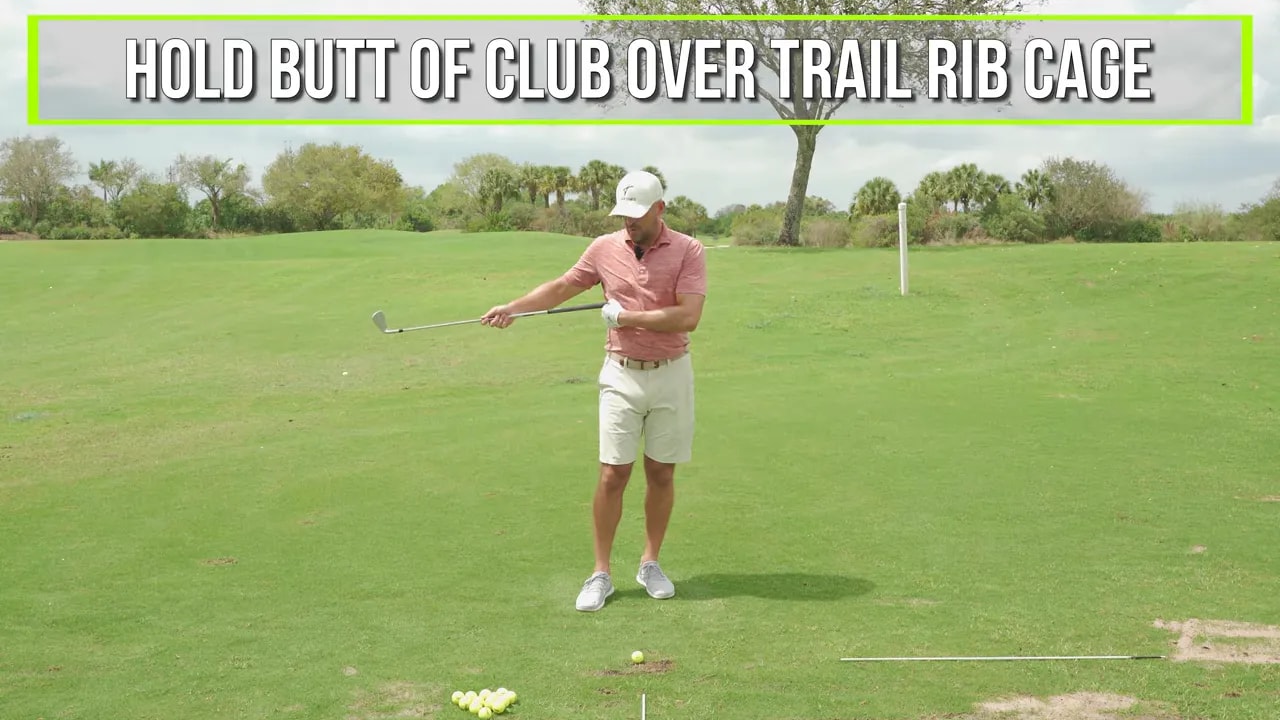
This drill gives instant feedback. If your trail side lifts, the club will not point correctly. If your chest stays down and the hips back up, the movement will feel cramped and wrong. If your chest opens while your trail side bends down, the motion becomes organized.
Make a few slow rehearsals before hitting shots. That bridge between rehearsal and execution is important.
What you should feel
As you practice, look for these sensations:
- A small crunch in the trail side oblique
- The chest opening toward the target
- The lead hip working deeper
- The body staying tilted instead of popping up
Those are strong signs that you are learning to stay down in the golf swing the right way.
Step 7: Blend rotation and side bend instead of trying to eliminate extension
Another important concept is that you are not trying to remove extension from the swing entirely.
Your body will extend through the strike. The issue is where and when that extension happens.
If your hips move toward the ball and your torso rises too early, extension happens in a way that destroys posture. But if your chest moves out toward the target while the trail side works down, your body can extend more naturally after the strike and in the correct direction.
This matters because some golfers attack early extension as if any upward movement is bad. That usually creates a stiff, trapped motion. A better approach is to organize the movement so extension occurs out toward the target rather than toward the ball.
That is why this issue is really a combination problem:
- Rotation of the chest
- Side bend of the trail side
If you rotate without side bend, you stand up. If you side bend without rotation, you get stuck. You need both.
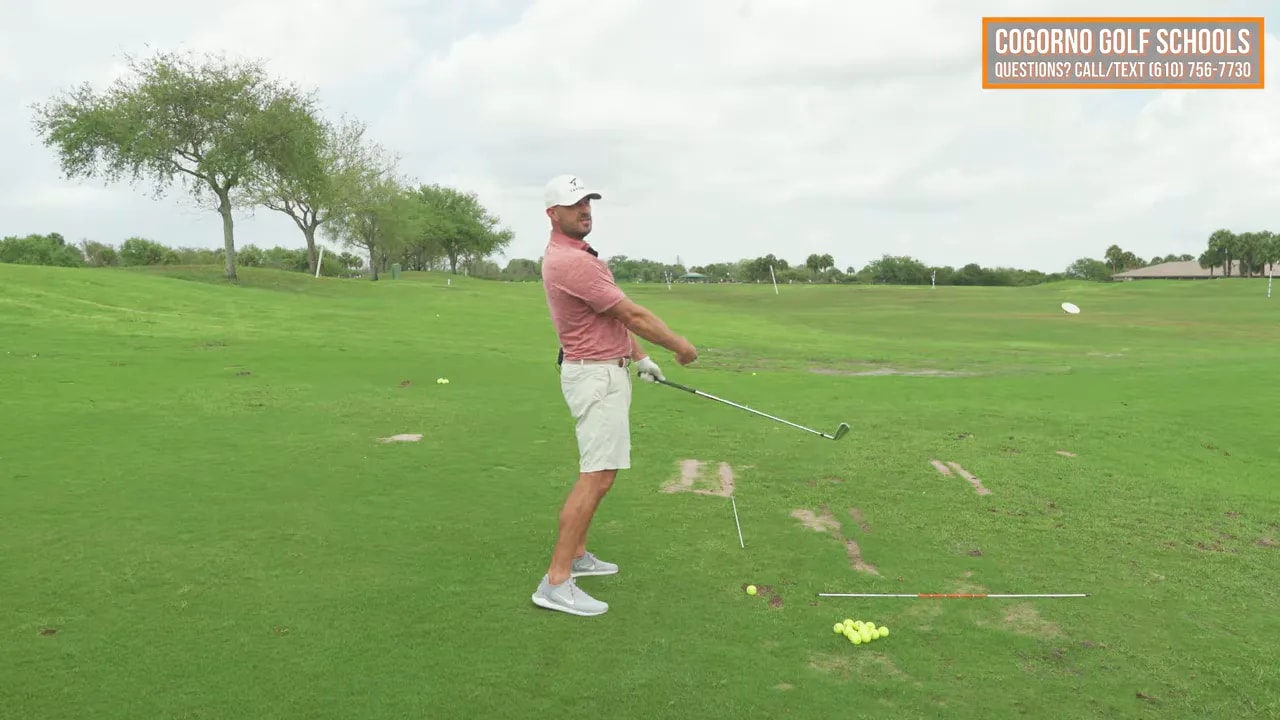
This is one reason the phrase stay down through the ball can be misleading. It sounds static. In reality, the correct action is dynamic and coordinated.
Step 8: Take this feel to real shots
Once the drills make sense, begin hitting easy shots while repeating the same swing thought:
Chest out, trail side down, hips forward.
Start with short or medium iron swings. A 7-iron is a great place to begin because it gives enough loft and feedback without requiring full speed.
As you hit shots, keep your focus simple. Do not overload yourself with too many technical pieces. Pick one cue and let it organize the others.
For many golfers, the best cue is simply:
Trail side down through the ball.
If you are someone who tends to get stuck and under-rotate, use:
Chest out, then trail side down.
If you are someone who backs up and hangs behind the strike, add:
Hips forward.
The right cue depends on your pattern, but the full model remains the same.
As you practice, check whether contact becomes more centered and more solid. Better mechanics should produce better strike quality, not just prettier positions.
Step 9: Check the earlier parts of your swing if the problem persists
Standing up through impact is often a through-swing issue, but it can also be made worse by earlier swing errors.
If the club gets badly off plane or the face is dramatically out of position in the backswing or downswing, your body may stand up as a compensation to make contact. In other words, posture loss is sometimes the symptom, not the original cause.
That means you should also evaluate:
- Your club path earlier in the motion
- Your clubface position
- Your overall balance and setup
If those pieces are badly off, fixing only the impact feel may not fully solve the issue. But for many golfers, the missing move is still the one covered here: opening the chest while keeping the trail side down.
Step 10: Build a repeatable practice routine around the feel
To make this change stick, keep your practice simple and repeatable.
Suggested session structure
- Make 5 slow sternum-club rehearsals
- Make 5 rib cage drill rehearsals
- Hit 5 half-swings with a short or mid iron
- Pause after each shot and evaluate whether you felt chest out, trail side down, hips forward
- Repeat for 2 to 3 rounds
You can also rehearse this at home without a ball. The movement is mostly about body awareness, and that makes it easy to train indoors.
When done regularly, these rehearsals can improve:
- Low point control
- Contact quality
- Posture through impact
- Body rotation through the strike
The biggest win is that your swing starts to feel less like a collection of fixes and more like one connected motion.
FAQ: Staying down through the ball in the golf swing
Should you keep your chest down through impact?
No. At setup, your chest points down because you are in posture. Through impact, your chest should rotate out toward the target. What stays down is the trail side of the body, especially the trail shoulder, trail pec, and trail rib cage.
What does “trail side down” mean?
It means the trail side of your upper body works downward through the strike as your chest opens. For a right-handed golfer, that is the right shoulder, right pec, and right rib cage moving down. This helps you maintain posture and avoid standing up early.
Why do I stand up through the ball in my golf swing?
A common reason is rotating without the proper side bend. If your chest opens but your trail side lifts, your body rises and your hips move toward the ball. You can also stand up because of earlier swing issues such as an off-plane club or poor face position.
What is the best swing thought to stay down through the ball?
A simple and effective swing thought is: chest out, trail side down, hips forward. It captures the rotation, side bend, and lower-body motion needed to maintain posture through impact.
Will this help with iron contact?
Yes. Learning how to stay down through the ball properly can improve low point control and centered contact, which are major factors in solid iron play.
Can I use this with every club?
Yes. The pattern applies with all clubs. The exact shape and intensity may vary, but the core concept remains the same: chest opening out, trail side staying down, and hips moving forward.
Final thought
If you have been trying to stay down through the ball by forcing your chest toward the ground, you are working against the motion used by strong ball strikers. The solution is not to stay frozen over the ball. The solution is to move better through it.
Remember the pattern:
- Chest out
- Trail side down
- Hips forward
That combination lets you open up without standing up. It gives your swing the structure needed for more consistent impact. And it turns “stay down” from a frustrating command into a motion you can actually train.
If this concept has never clicked before, start with the rib cage drill and rehearse it slowly. The feeling may be different from what you expected, but for many golfers, it is the missing move that finally makes solid contact more repeatable.
0 Comments