
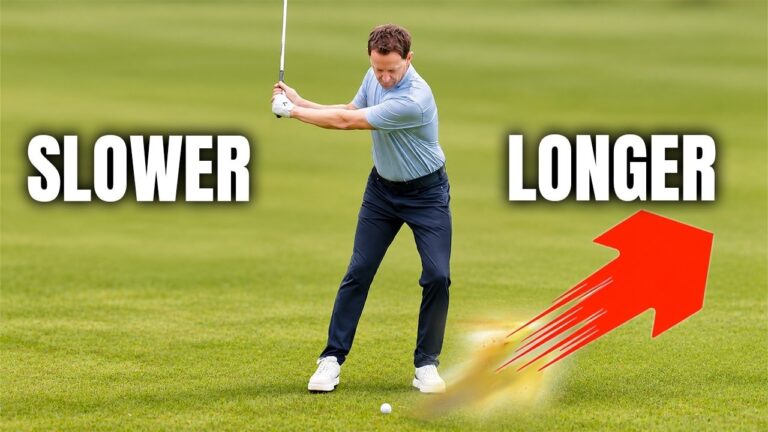

If your iron shots stay inconsistent no matter how hard you try, adding more effort may not be the answer. You can work so hard to control your arms, wrists, and club that you lose the sensation that makes a golf swing flow: the weight of the clubhead.
An effortless golf swing starts with a different task. Instead of forcing the club through a series of positions, you learn to feel its weight, allow it to swing, and respond to its movement.
That change made a clear difference during Leo’s lesson. As a beginner who plays around once a month, he struggled with inconsistent iron contact and could not find extra distance by trying harder. Once his attention shifted toward the swinging clubhead, his movement became more rhythmical, his release improved, and extra distance followed.
You can explore the same concept through a simple progression: understand the release, practice the effortless golf swing drill, transfer the feeling to golf balls, and then build speed without sacrificing your strike.
Table of Contents
- Step 1: Understand Why Trying Harder Can Hurt Your Strike
- Step 2: Start Your Effortless Golf Swing Drill With One Hand
- Step 3: Let the Club Fall Instead of Forcing the Downswing
- Step 4: Transfer the Feeling to Iron Shots
- Step 5: Check Whether You Can Feel the Clubhead Throughout the Swing
- Step 6: Build an Effortless Golf Swing by Giving Up Excess Control
- Step 7: Use the Drill to Recover Feel When You Lose It
- Step 8: Add Clubhead Speed Without Losing Your Strike
Step 1: Understand Why Trying Harder Can Hurt Your Strike
When you want a better shot, it is tempting to take tighter control. You might steer the club down, push your hands toward the ball, or try to keep every part of your swing in its correct place.
The trouble is that a controlled-looking movement does not necessarily produce a well-timed release.
In Leo’s initial swing, the club was releasing too early. Rather than trailing for longer during the downswing, the clubhead was being pushed outward prematurely. The goal was not to stop the club from releasing. It was to improve when that release happened.
For your iron shots, you want the swing’s low point to be beyond the ball, toward the target. If the club reaches its fully extended feeling too soon, controlling that low point becomes more difficult.
This is where the idea of lag can become confusing. You may recognize the appearance of a trailing clubhead in a good downswing and decide you need to hold that position. But holding an angle is a different task from allowing a club to trail naturally.
Your aim is a swinging release, not a frozen wrist position. The club needs freedom to accelerate through the shot. Trying to preserve lag rigidly can take that freedom away.
Step 2: Start Your Effortless Golf Swing Drill With One Hand
Before you hit balls, remove the pressure of producing a result. Move the ball aside and use a one-handed rehearsal to discover what the clubhead feels like when you stop managing every inch of its journey.
Follow this sequence:
- Hold the club in one hand. Let it sit in your fingers with enough freedom to move, while maintaining a secure hold.
- Swing it back gently. Allow your arm to bend so the club can fall behind your shoulder and upper back.
- Notice its weight. Feel the clubhead hanging behind you rather than trying to place it precisely.
- Let the club swing down. Allow its weight to fall and guide the movement through.
- Repeat without a ball. Keep your attention on the swinging head, not on producing a perfect-looking motion.
A useful image is an arrow dropping into a quiver on your back. The club settles behind you, giving you a clear sensation of its weight. From there, you allow it to move out and swing through.
This is an exaggerated feel exercise. You are not trying to copy every detail of this rehearsal into your normal swing. Bending your arm and allowing the club to drop behind you simply makes its weight easier to recognize.
You can explore either hand. During the lesson, Leo mentioned being left-hand dominant, so he also tried the movement with his left hand. Use the version that helps you sense the club most clearly, rather than assuming one hand must provide the answer.
Step 3: Let the Club Fall Instead of Forcing the Downswing
Once you can feel the clubhead behind you, pay particular attention to the change of direction.
Rather than immediately pulling the handle or throwing the club toward the ball, allow yourself to sense the weight falling. Your task is to guide and respond to the club, not force it into a predetermined position.
Think of gravity as a helpful sensation in this drill, rather than a complete explanation of how you generate a golf swing. You still move with the club. The difference is that you are no longer trying to manufacture the entire motion through conscious control.
As you rehearse, ask yourself:
- Can you feel the clubhead at the top?
- Can you sense its weight beginning to drop?
- Can you stay aware of that weight as the club swings through?
When Leo first experienced this, the movement felt more powerful despite requiring less deliberate effort. He was reacting to the club rather than attempting to arrange his body around a checklist.
Less interference does not mean less involvement. You remain connected to the club, but your attention is on what it is doing. That gives your body something useful to respond to.
Now add your second hand and explore the same sensation. Keep the rehearsal easy enough that you can still recognize the weight. If adding both hands immediately makes the motion stiff, return to one hand and rebuild the feel.
Step 4: Transfer the Feeling to Iron Shots
The next challenge is keeping the same task when a ball returns. Without a ball, you may swing freely. With one in front of you, the urge to hit a good shot can quickly take over.
Start by making your rehearsal, then step in and hit an iron shot with the same intention: feel the clubhead dropping and swinging.
At this stage, prioritize contact over direction. That does not mean direction is unimportant. It means you are working on one part of the task first, rather than asking a new sensation to solve everything at once.
During the early shots in Leo’s lesson, the focus stayed on ball striking and low point. When the desired release was not quite appearing, the response was to exaggerate the dropping sensation in the rehearsal, then try again.
You can use the same approach:
- Rehearse the one-handed drop until the weight feels clear.
- Put both hands on the club and retain that awareness.
- Hit a ball without adding a new technical instruction.
- Notice your contact and whether you could still feel the clubhead.
- Return to the rehearsal if the sensation disappears.
One encouraging feature of Leo’s improvement was that better swing positions began appearing without him deliberately chasing them. The club started trailing more naturally, and the feedback showed a better-timed release.
Treat those positions as feedback, not as a new set of shapes to hold. The drill’s value lies in helping you produce a flowing movement that leads to better contact.
Step 5: Check Whether You Can Feel the Clubhead Throughout the Swing
A good rehearsal does not guarantee that you will retain the sensation during the shot. You might feel the head at the top, then lose awareness as you rush down toward the ball.
That happened during the lesson. After one less successful attempt, Leo recognized that he had pulled the club through instead of reacting to it. The useful discovery was not simply that the shot was imperfect. It was that he could identify when the connection disappeared.
Use a simple question after each swing: Could you feel the head, or did you start forcing the club?
This gives you a more useful practice focus than judging every attempt only by where the ball finishes. A poor result can still teach you something if you recognize that you rushed, pulled, or lost the sensation.
Equally, do not assume every imperfect shot requires a mechanical rebuild. First, return to the basic exercise and check whether you can regain awareness of the swinging weight.
As your relationship with the clubhead improves, rhythm becomes easier to recognize. You begin to sense when your movement matches the swinging club and when you are getting ahead of it.
Rather than imposing a tempo while separately controlling your arms, you are allowing the club’s movement to help shape the rhythm of the swing.
Step 6: Build an Effortless Golf Swing by Giving Up Excess Control
There is an apparent contradiction here: giving up some deliberate control can help you develop better practical control.
If you try to manage your arms and wrists tightly, your swing may feel organized because you are restricting movement. Yet it can also feel wooden, with little freedom for the club to release.
When you allow the club to swing, you may initially feel less in charge. But you gain clearer information about its weight and movement. In Leo’s experience, less restriction made the clubhead easier to feel, which made the motion feel more controllable overall.
You can think of the distinction this way:
- Forced control: You attempt to put each body part and the club into the right place.
- Responsive control: You feel the club moving and guide your swing around that sensation.
The second approach is not permission to become careless. It asks you to pay close attention, but to a different thing.
Instead of checking your wrist angle during the downswing, stay interested in the clubhead. Instead of trying to recreate a photograph of a good impact position, experience the swinging motion that leads you through impact.
This is also why chasing the previous good shot can be unhelpful. You cannot replay it by remembering every detail. You can, however, give yourself the same simple task on the next attempt.
Step 7: Use the Drill to Recover Feel When You Lose It
After a few solid shots, it is natural to wonder exactly how you produced them. You may start searching for the movement that must be repeated: a certain arm position, a particular turn, or a perfectly timed wrist action.
That search can pull your attention away from the very sensation that helped.
Rather than asking how to reconstruct the whole swing, return to the exercise that created your awareness:
- Hold the club in one hand.
- Allow it to settle behind your shoulder.
- Feel its weight.
- Let it swing down and through.
- Reconnect that sensation to your next shot.
Your feel does not have to be identical every time. You may notice the weight behind you on one rehearsal and the swinging release more clearly on another. The purpose is to restore awareness, not memorize one exact sensation.
If you want additional feedback, the Swing Coach app used in the lesson analyzes your swing and provides feedback on areas such as release timing and shaft lean. The lesson also used feedback about low point to check progress.
Use that information to assess whether your experiment is helping. Avoid turning each measurement into another instruction to force during the swing.
Step 8: Add Clubhead Speed Without Losing Your Strike
Once your contact becomes more dependable, you can explore extra speed. The key is to keep the same connection to the clubhead rather than switching back to a harder, more forceful hit.
During the lesson, the discussion moved from shots around 138 yards toward the possibility of greater distance. The next task was to swing the club faster while continuing to feel its head. Making the club’s swishing sound louder provided another way to explore that speed.
A later shot reached approximately 147 yards. Leo reported that he had stayed focused on the clubhead rather than deliberately trying to smash the ball.
That result is an example from one lesson, not a guaranteed distance gain. Your priority remains the same: build speed without giving away consistent contact.
If extra speed makes you lose the head’s weight, rush the transition, or spoil the strike, return to the rehearsal. Reestablish the sensation before asking for more.
Your practice progression is straightforward: feel the weight, let the club swing, strike the ball, and then explore speed. Keep those priorities in that order.
An effortless golf swing does not require you to stop moving or stop caring about technique. It starts with replacing excessive manipulation with a clearer task. When you can feel the clubhead and respond to its movement, you give yourself a practical route toward freer rhythm, better iron contact, and distance that does not depend on trying harder.
0 Comments