

Inconsistent iron shots can make golf feel unnecessarily difficult. One swing produces a draw, the next turns into a hook, and then a pushed shot appears from nowhere. When you have no reliable pattern, it becomes hard to choose targets, commit to a shot, or trust your golf swing under pressure.
A common cause is not simply an out-to-the-right club path or a shallow approach angle. Those patterns are often connected symptoms of one movement issue. The practical solution is to make the club more manageable in the backswing and downswing, then train a new feel with clear visual references.
This step-by-step golf practice plan is designed for golfers who tend to draw, hook, block, or occasionally shank their irons. The aim is not to rebuild your swing around a dramatic fade. It is to reduce excessive movement, improve strike quality, and create a dependable stock shot.
Table of Contents
- Step 1: Identify Your Golf Miss Pattern Before Changing Anything
- Step 2: Understand Why an Out-to-the-Right Golf Path Creates Trouble
- Step 3: Find the Swing Position That Sends the Club Behind You
- Step 4: Change Your Golf Feel Before You Hit Full Shots
- Step 5: Use the Tee Drill to Improve Your Golf Backswing Reference
- Step 6: Use a Forward Ball Position to Change Your Golf Delivery
- Step 7: Train the New Golf Concept With a Controlled Through-Swing
- Step 8: Judge Your Golf Progress by Strike and Dispersion
Step 1: Identify Your Golf Miss Pattern Before Changing Anything
Start by honestly describing your usual iron misses. A three-way pattern is especially frustrating:
- Left miss: a draw that becomes too curved, flat, or hook-shaped.
- Right miss: a blocked shot that starts and stays well right of target.
- Occasional straight shot: a good result that feels difficult to repeat.
This mixture usually means you are relying heavily on timing. You may be able to find the correct timing repeatedly during a golf range session, when you can immediately recreate the same sensation. On the course, however, several minutes can pass between full swings. The feel fades, and the timing-based correction is much harder to reproduce.
Your goal is not perfection. A more realistic golf target is to narrow the range of outcomes. If your natural shot is a draw, retain a modest draw while reducing the hook and the block. That gives you a predictable ball flight to plan around.
Step 2: Understand Why an Out-to-the-Right Golf Path Creates Trouble
When the club travels significantly out to the right through impact, the lowest point of the swing often occurs too early. With an iron, that can create a shallow approach into the ball, weak contact, and little or no divot after impact.
An excessively shallow golf swing may create several results:
- Thin or “scruffy” strikes that do not feel compressed.
- Pushes when the clubface does not close enough relative to the path.
- Hooks when you try to save the shot by rapidly releasing the club.
- Shanks when the delivery becomes inconsistent and the hosel moves too close to the ball.
It is useful to recognize that club path and angle of attack are linked. Rather than trying to repair both separately, improve the movement that causes them. A slightly more neutral path often helps the club meet the ball with a more appropriate downward strike.
For many golfers, trying to immediately hit a fade is too large a change. If you naturally draw the golf ball, work first on reducing the draw. A smaller, more controlled curve is far easier to build into your game than a complete ball-flight reversal.
Step 3: Find the Swing Position That Sends the Club Behind You
The issue can begin near the top of the backswing. A club that gets slightly across the line is not automatically a problem. Many excellent golfers have played effectively from this position. The difficulty begins when the club then falls aggressively behind your hands during the downswing.
Imagine the club becoming too far behind you in delivery. From there, your path is likely to move too far out to the right. To avoid pushing the ball, you may instinctively throw the hands and clubhead over. That last-second action can produce the hook.
The result is a golf swing that alternates between two compensations:
- Keep the club behind you and risk a block right.
- Throw the clubhead around your body and risk a hook left.
The better movement is to feel as though the club remains more in front of your hands as you start down. This may feel steeper than your old swing, even when the actual movement is simply more neutral and organized.

Step 4: Change Your Golf Feel Before You Hit Full Shots
New golf movements should begin as rehearsals, not full-speed attempts. If you instantly add a ball and try to hit a perfect shot, your old intention often takes over. Instead, rehearse the club moving from the top into a position that feels more in front of your body.
A useful sensation is that the club comes down with the grip and clubhead directed more back toward you, rather than immediately flinging behind your trail side. Keep the movement slow enough that you can pause and assess where the club is.
Do not judge the rehearsal by whether it feels natural. It should feel different. In fact, if you have spent years moving the club too far behind you, a better delivery may feel unusually steep at first. Use ball contact and shot pattern, rather than comfort alone, to decide whether the change is helping.
As you practice, remember the relationship between swing direction and low point:
- A swing traveling well out to the right tends to bottom out earlier.
- A swing traveling more left tends to bottom out later.
- A more neutral golf delivery gives you a better opportunity to strike ball first, then turf.
Step 5: Use the Tee Drill to Improve Your Golf Backswing Reference
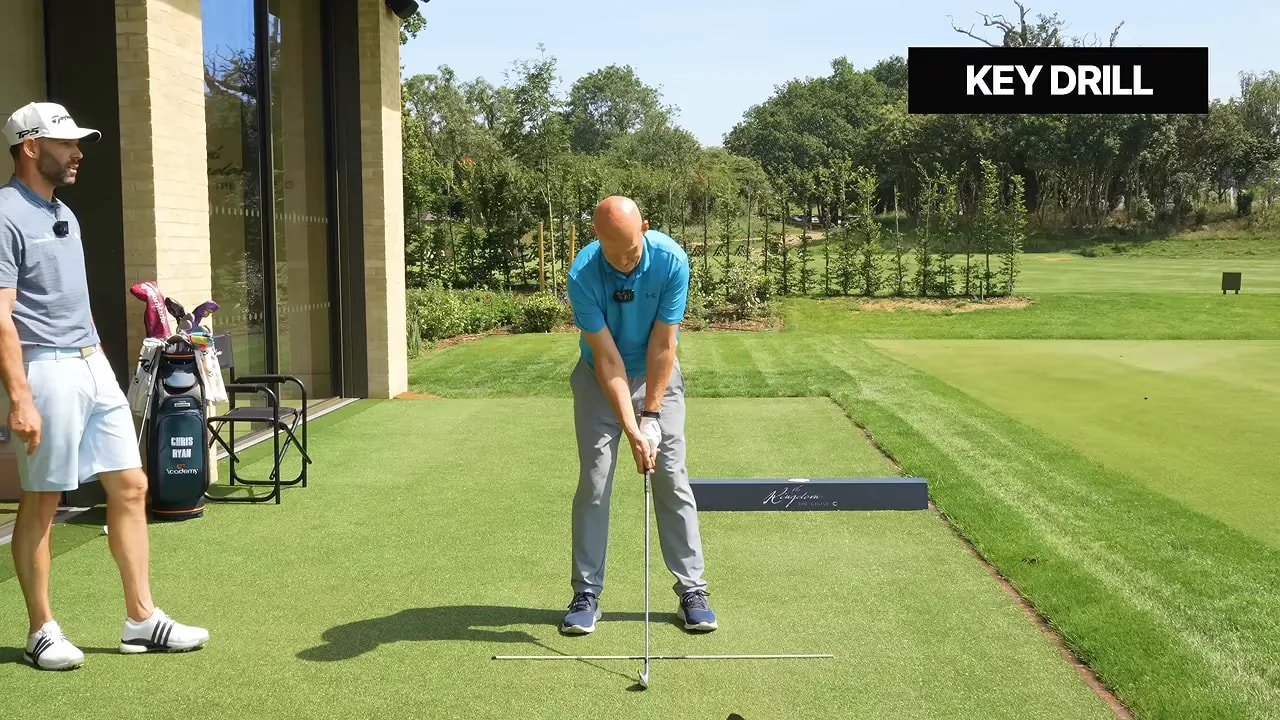
You cannot easily see the clubhead when it reaches the top of your golf swing. A tee can provide a simple external reference. Place a tee into the small hole at the end of the grip, then set an alignment stick on the ground along your target line.
During rehearsal swings, use the tee to help you recognize where the club is pointing at the top. Instead of trying to force the shaft exactly parallel, use a simple reference in front of you, such as a launch monitor or a fixed point on the range.
For this drill, your sequence is:
- Take your normal iron setup.
- Make a backswing and feel the tee pointing toward your chosen forward reference.
- Start down slowly.
- When the clubshaft is roughly horizontal, feel it running parallel to the alignment stick on the ground.
- Continue through without rushing to hit a ball.
The exact positions do not need to be perfect. The purpose is to give your golf swing a repeatable map: tee toward the forward reference at the top, then shaft parallel to the ground stick during the downswing.
Step 6: Use a Forward Ball Position to Change Your Golf Delivery
Once the rehearsal feels clearer, add a ball in a deliberately forward position for the drill. This does not mean changing your normal golf ball position permanently. It is a training tool that discourages your old early-bottoming, out-to-the-right movement.
If your club wants to strike the ground too early, a forward ball feels difficult to reach. That is exactly why the drill works. To contact it, you need to move the club into a more neutral delivery and allow the low point to occur farther forward.
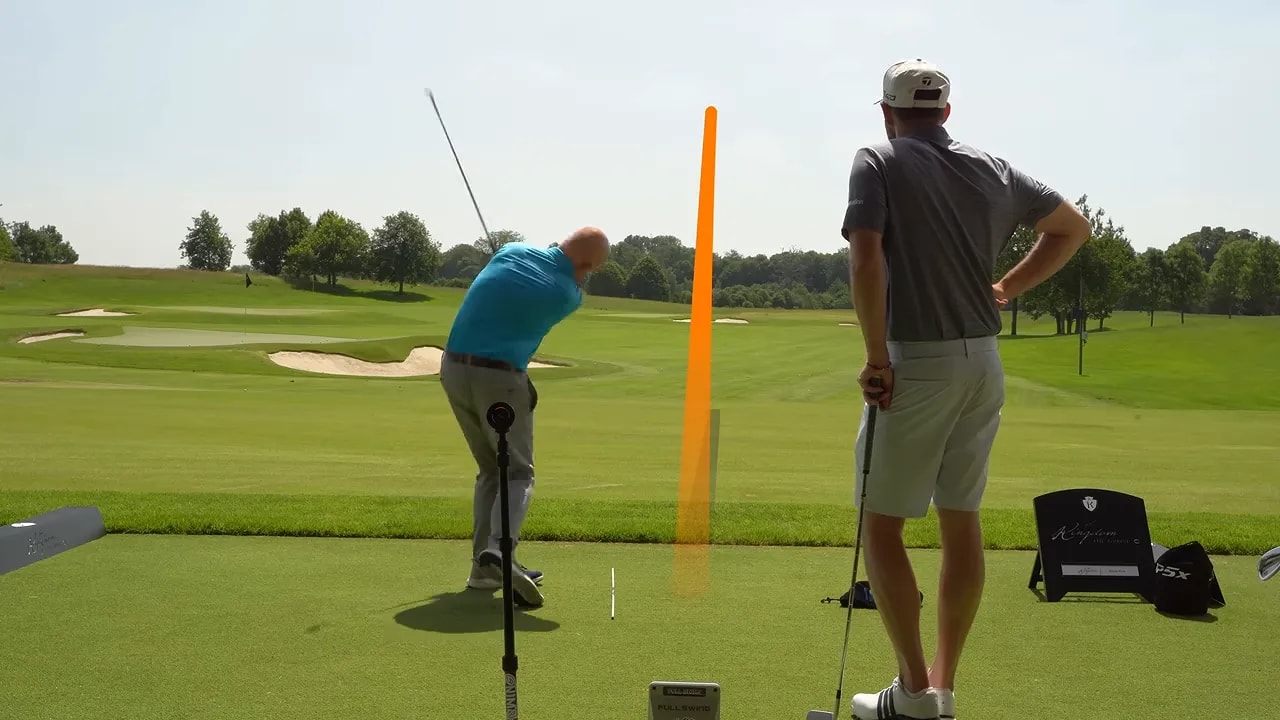
Begin without trying to hit the ball hard. Make the backswing with the tee pointed toward the forward reference, then bring the club down so the clubhead feels as though it travels outside a nearby golf ball basket or other safe marker. Let the club brush the turf somewhere forward of the center of your stance.
Only after you can rehearse that motion should you clip a ball. Expect a few heavy strikes initially. A slightly heavy shot can be part of the adjustment because you are changing where you expect the club to contact the ground.
Step 7: Train the New Golf Concept With a Controlled Through-Swing
After establishing the new backswing and delivery feel, make a swing while setting up normally but feeling that you swing through slightly inside the ball. This is an intentional practice feel, not necessarily a literal description of the finished club path.
The important point is to replace the old intention of swinging far out to the right. Your golf brain needs a different task. The new task is to bring the club down more in front of you, brush the ground later, and keep moving through impact without throwing the clubhead at the ball.
Use this progression during practice:
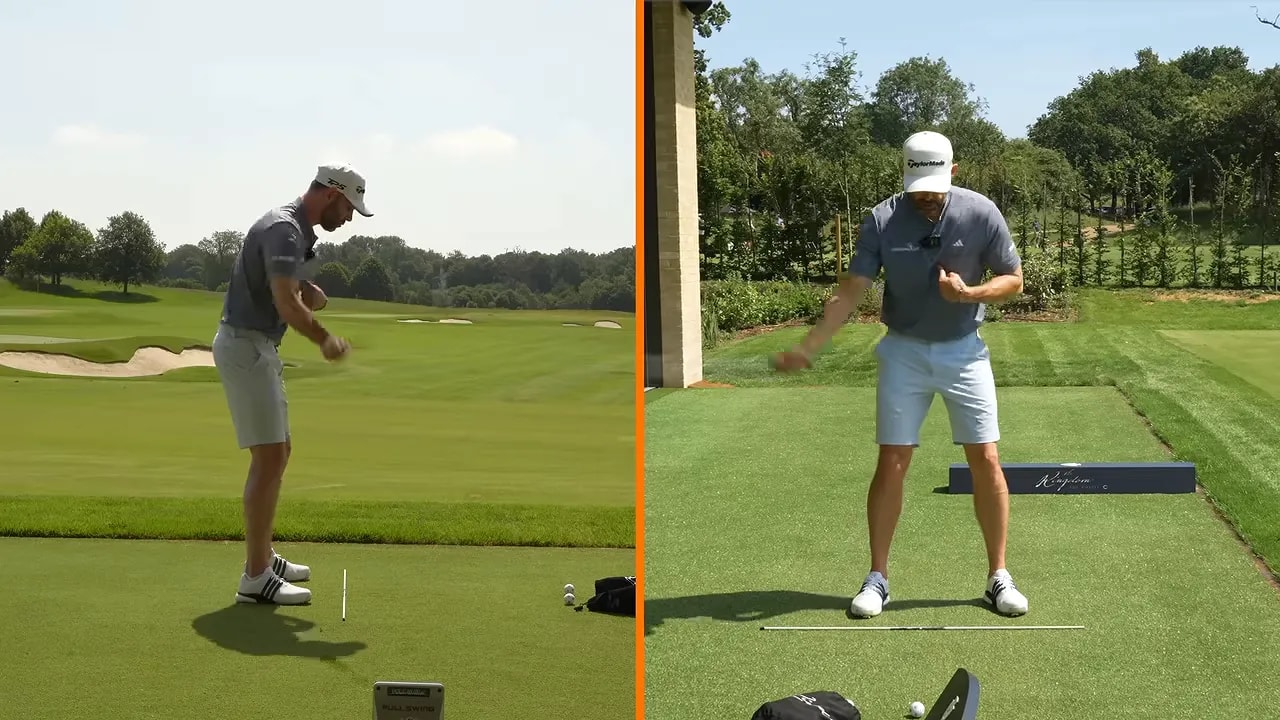
- Five slow rehearsals: tee toward the forward reference, then shaft parallel to the alignment stick.
- Five brush-the-ground swings: no ball, with the low point forward of the middle of your stance.
- Five soft shots: use the forward-ball drill and prioritize strike over distance.
- Five normal shots: return the ball to your standard position while keeping the same overall intention.
Do not chase technical numbers while hitting every ball. If you use launch-monitor or swing-analysis data, use it to confirm whether the club has become less shallow and less extreme from the inside. Then return your attention to one clear movement cue.
Step 8: Judge Your Golf Progress by Strike and Dispersion
The best early sign of progress is not a perfectly straight golf shot. It is a tighter pattern. A controlled draw that starts near your intended line is a major improvement over alternating hooks and blocks.
Pay attention to these signs:
- Contact sounds and feels more solid.
- Divots begin closer to or just after the ball.
- Your right miss becomes less severe.
- Your draw has less curve and stays playable.
- You need fewer hand-action saves through impact.
Build speed gradually. First make the motion at rehearsal pace, then at half speed, then with a smooth normal swing. Your golf swing needs enough repetition to make the new delivery available when a single important shot matters.
A simple adjustment can produce a meaningful change when it addresses the underlying pattern. By reducing how far the club falls behind your hands, you can make your iron path, strike, and ball flight much more consistent.
Step 9: Golf FAQ
Should you try to hit a fade if you normally hook your irons?
Not necessarily. If your natural golf shot is a draw, begin by reducing the amount of draw rather than attempting a dramatic change to a fade. A smaller curve is usually a more manageable first objective.
Why do you hit good iron shots on the range but not on the course?
Range practice allows you to repeat a successful feel immediately. During a round of golf, there is more time between full shots, so timing-based fixes are harder to reproduce. Build a simple movement pattern rather than relying on a fleeting sensation.
Can a shallow iron swing cause heavy or weak contact?
It can. A path that travels too far out to the right may cause the club to reach its low point too early. That can make clean, compressed golf iron contact more difficult.
What is the purpose of putting a tee in the end of the grip?
The tee gives you a visible reference for club direction near the top of your golf swing. It helps you rehearse a more organized backswing and downswing when you cannot see the clubhead directly.
0 Comments