

Focus keyphrase: golf ball striking drill
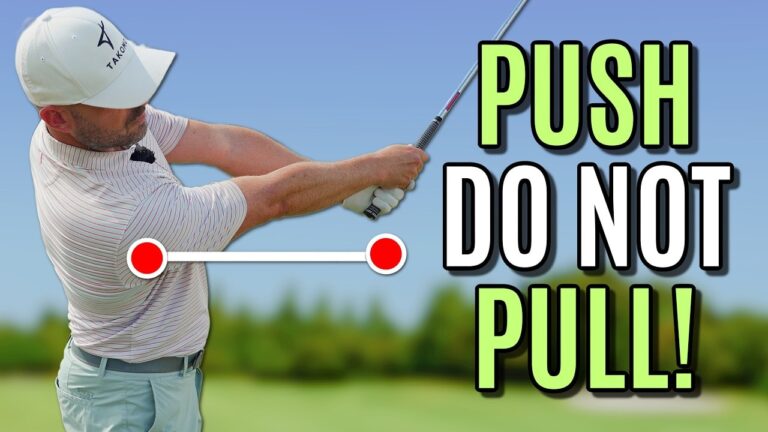
If your iron play feels unpredictable, the problem is often not how hard you swing. It is how you move through the ball. One of the fastest ways to improve contact is to build a wider, more extended follow-through that keeps the club moving down and out through impact instead of pulling inward too early.
This golf ball striking drill is built around that idea. It is simple enough to practice in short sessions, but detailed enough to clean up the kind of swing issues that lead to thin shots, heavy strikes, weak contact, and inconsistent turf interaction.
The method centers on one main move with four connected pieces:
- Push the butt of the club away through the strike
- Rotate your body toward the target
- Extend with the hips forward and chest up
- Add side bend so you can still reach the ball properly
When these parts work together, you create width in the follow-through, improve compression, and make your strike pattern much more repeatable.
Table of Contents
- Step 1: Understand why this golf ball striking drill starts with width
- Step 2: Use the golf ball striking drill to push the handle away through impact
- Step 3: Straighten the trail arm and keep the elbows working together
- Step 4: Add body rotation to make the golf ball striking drill work
- Step 5: Extend properly with hips forward and chest up
- Step 6: Use side bend so you can stay on the ball while extending
- Step 7: Blend all four pieces into one repeatable golf ball striking drill
- Step 8: Follow the four-phase golf ball striking drill practice routine
- Step 9: Manage the clubface if your ball starts curving too much
- Step 10: Use this golf ball striking drill to build better iron play over time
- FAQ: Golf ball striking drill
Step 1: Understand why this golf ball striking drill starts with width
The foundation of this golf ball striking drill is a wide arc through the follow-through. Good ball strikers tend to send the handle away from their body after impact rather than letting the club collapse inward.
That difference matters. When the handle stays close to your body too soon after impact, your arms usually fold, the clubhead rises away from the ground, and clean contact becomes much harder to repeat. That pattern often produces tops, thin shots, weak contact, and little or no divot.
By contrast, when the club is pushed away from you from about hip-high before impact to hip-high after impact, the clubhead can continue traveling down and out. That gives you a much better chance to strike the turf in the right spot and compress your irons.
So before you think about full swings, start with a simple checkpoint:
- Is the handle moving away from your body through impact?
- Are your arms staying extended longer?
- Does the clubhead stay working through the strike instead of lifting too early?
If the answer is no, this is exactly the kind of issue the drill is meant to fix.
Step 2: Use the golf ball striking drill to push the handle away through impact
Start with an 8 iron and hit short punch-style shots. Keep the motion around hip-high to hip-high. The goal is not distance. The goal is to feel the handle, or butt end of the club, moving as far away from your body as possible through the strike without sending your upper body out with it.
This should feel compact and controlled, almost like a little knockdown shot. Even with that smaller motion, you can produce solid, crisp contact.
A few key feels help here:
- Keep the motion short
- Focus on the club moving out through the ball
- Do not yank the club inward after impact
- Let the follow-through stay wide rather than narrow
This is the first and most important piece of the golf ball striking drill. If you do not create width through the strike, the rest becomes much harder to organize.
Step 3: Straighten the trail arm and keep the elbows working together
Once you have the idea of width, the next step is to understand how your arms create it.
Your lead arm should already be fairly straight by the time you reach impact. The trail arm is the one that needs to lengthen through the shot. As the trail arm straightens, the handle naturally moves farther away from your body.
A useful checkpoint is your elbow spacing. If the elbows begin with a certain amount of space between them at address, try to maintain that spacing or even feel them move slightly closer together through the strike. That keeps the arms from separating and folding too early.
Helpful feels for this section of the golf ball striking drill:
- Let the trail arm straighten through impact
- Keep the lead arm long
- Feel the elbows staying connected
- Avoid the look of bent, collapsed arms right after the ball
If you have ever felt cramped through impact, this adjustment can be a game changer. More extension usually leads to cleaner contact and a stronger, more stable strike.
Step 4: Add body rotation to make the golf ball striking drill work
You cannot keep the club moving away from you for long if your body stops turning. Rotation is what gives your arms room to extend.
Try this idea as a simple test. If your belt buckle and chest stay pointed at the ball and you attempt to push the handle away, you run out of space quickly. At that point, your arms have no choice but to fold.
Now picture the opposite. If your knees, hips, and chest continue turning toward the target, your arms can stay extended much longer. Rotation creates the space that width needs.
Use this finish checkpoint:
- Knees turned through
- Hips facing the target
- Chest and shoulders turned through
- Handle still away from the body
This is why a finish position matters even though the ball is already gone. If your body gets all the way to a properly rotated finish, it had to start rotating earlier in the downswing. A good destination helps organize the motion that happens before it.
For many golfers, a stalled body is the hidden reason iron contact falls apart. Rotation gives your swing structure and keeps your arms from taking over at the wrong time.
Step 5: Extend properly with hips forward and chest up
The next part of the golf ball striking drill is extension. This does not mean standing straight up with no turn. It means your body is moving into a balanced through-swing shape.
From a face-on view, proper extension looks like:
- Hips pushing forward toward the target
- Rib cage and chest rising
- Head staying back relative to the ball
From down the line, this gives you room to keep the club moving through the strike while staying athletic.
If instead your hips stay back and your chest stays down, your arms once again run out of room. They fold, the handle pulls inward, and the strike loses consistency. Extension solves that by opening up space through impact.
This is one of the more misunderstood pieces in golf instruction because many players hear warnings about early extension and then become afraid to extend at all. The key distinction is timing and shape. In a good strike, extension happens while the body is rotating, not as a random stand-up move with no pivot.
A simple feel is that your belt buckle becomes the forward-most part of your body through the finish. Your hips are up over your ankles, your chest is elevated, and your arms have room to stay long.
Step 6: Use side bend so you can stay on the ball while extending
This is the final piece that ties the golf ball striking drill together. If you rotate and extend but do not add side bend, it becomes difficult to stay the proper distance from the ground through impact.
Side bend means your trail shoulder works lower than your lead shoulder through the strike. For a right-handed player, that means the right shoulder is lower, creating a slight crunch on the right side of the torso.
This move helps you keep delivering the club to the ball while your body is turning and extending. Without it, you may feel too tall too soon and lose the strike.
Think of these pieces as one blended motion:
- Push the handle away
- Rotate through
- Extend with hips forward and chest up
- Maintain side bend so the shoulder stays down enough to reach the ball
Strong ball strikers keep their body organized relative to the ground all the way through. Side bend is the piece that makes that possible.
Step 7: Blend all four pieces into one repeatable golf ball striking drill
Although there are four checkpoints, you do not want four separate swings. You want one coordinated motion.
Your through-swing should have this overall feel:
- The elbows stay connected
- The trail arm straightens
- The handle moves away from you
- Your body turns fully through
- Your hips move forward
- Your chest rises
- Your trail shoulder stays lower through the strike
Put those together and the result is a low to mid-flight, compressed iron shot that comes off the face solidly. That is why this golf ball striking drill can help so much with iron consistency. It addresses contact first, then ball flight.
If you have struggled with narrow, handsy follow-through mechanics, this pattern can completely change the way impact feels.
Step 8: Follow the four-phase golf ball striking drill practice routine
The smartest way to learn this move is to build it in layers. Instead of jumping straight to a full swing, use a four-phase practice routine.
Phase 1: No backswing
Set up to the ball and move directly into the follow-through checkpoint with no backswing at all. Your goal is simply to arrive at a position where:
- The handle is away from you
- Your body is rotated
- Your hips are forward and chest is up
- Your trail shoulder is lower
This teaches the destination first.
Phase 2: Club back to parallel
Next, take the club back only until the shaft is roughly parallel to the ground. Then swing through slowly and finish in the same checkpoint position. Make sure the club brushes the mat or turf in the correct area.
This adds just enough motion to connect your backswing to the follow-through without losing control.
Phase 3: Lead arm parallel
Now lengthen the backswing to where your lead arm is about parallel to the ground. Swing through and stop again at the same follow-through checkpoint. This gives you more speed and more range of motion, but still keeps the drill structured.
Phase 4: Almost full backswing
Finally, move into a nearly full backswing. Even here, you still stop the follow-through around the arms-parallel checkpoint so you can verify the same pieces are in place.
This is the full progression:
- No backswing
- Shaft parallel back
- Lead arm parallel back
- Near full backswing
Two or three reps at each stage is enough to create awareness. Practiced a few days each week, this progression gives you a clear path from slow-motion training to a playable swing.
Step 9: Manage the clubface if your ball starts curving too much
Sometimes a golfer starts this golf ball striking drill and immediately notices better contact, but the ball curves a little too much left or right. That should not stop you from doing the drill.
If the ball is fading too much to the right, allow a little more clubface rotation through the strike. If the ball is hooking too far left, reduce that rotation and feel the toe staying a bit more behind the heel through impact.
The goal is not to abandon the motion. The goal is to keep the improved strike while making a small face-control adjustment.
That is an important distinction. Ball striking and face control are related, but they are not the same thing. This drill is primarily about improving the quality of contact. Once the strike improves, you can fine-tune the face as needed.
Step 10: Use this golf ball striking drill to build better iron play over time
The biggest value of this golf ball striking drill is that it gives you a dependable pattern for practice. Instead of guessing why your irons are inconsistent, you can check four concrete pieces:
- Did you push the handle away?
- Did you rotate fully?
- Did you extend with hips forward and chest up?
- Did you maintain side bend so the shoulder stayed down properly?
That checklist makes practice more productive and less frustrating. It also gives you a way to self-diagnose on the range when contact starts slipping.
If your arc narrows, your arms fold, and the club lifts too early, go right back to the drill. Start short, rebuild the correct through-swing, and then gradually lengthen the motion again.
For golfers who want better ball striking with irons, lower scores, and more reliable contact, this is a practical place to start. It is not complicated for the sake of being technical. It is a simple blueprint for how your body and arms should work together through impact.
FAQ: Golf ball striking drill
Who is this golf ball striking drill best for?
This drill is especially helpful if you struggle with inconsistent iron contact, thin shots, tops, or a follow-through that feels cramped and narrow. It is designed for golfers who need a more repeatable through-swing.
What club should you use when practicing this golf ball striking drill?
An 8 iron is a strong choice because it is easy to control and gives clear feedback on strike quality. Once the motion feels solid, you can apply the same pattern to other irons.
Should you practice this golf ball striking drill at full speed?
No. Start slowly with short punch-style swings. Use the four-phase progression to build the movement correctly before adding speed or a longer backswing.
Why does pushing the handle away help with iron contact?
It creates width in the follow-through. That width helps keep the club traveling through the strike instead of lifting too early, which improves your chances of contacting the ground in the right place and compressing the ball.
What if the ball starts curving too far left or right during the drill?
Keep the drill, but adjust the clubface slightly. Add a little more face rotation if the ball leaks right, or reduce face rotation if it hooks left. That allows you to maintain the improved strike while straightening the flight.
How often should you practice this golf ball striking drill?
A few sessions per week is enough to build the pattern, especially if you keep the reps focused and structured. Quality matters more than volume.
0 Comments