
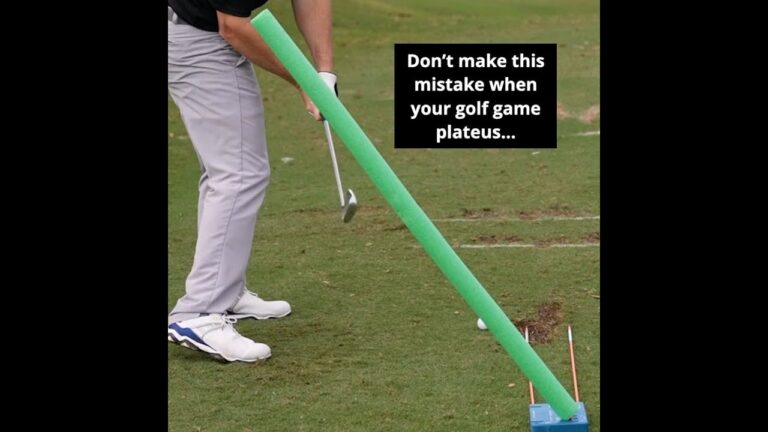

If your golf game has stalled, the problem may not be effort. It may be how you practice. A common reason golfers plateau is spending too much time repeating the same ball flight pattern instead of learning how to control both sides of it. If you want straighter shots in golf, a more neutral swing path, and more reliable contact, you need a practice plan that balances draw and fade patterns instead of reinforcing only one.
This guide explains a simple step by step golf practice method to help you stop plateauing, neutralize your path, and start hitting the ball straighter. The core idea is straightforward. If you always swing too far from the inside and hook the ball, practice fades. If you always cut across it and hit fades, practice draws. Once you can create both on command, it becomes much easier to find neutral.
Table of Contents
- Step 1: Understand why your golf game plateaus
- Step 2: Diagnose your current golf shot pattern
- Step 3: Use opposite-shot practice to break the golf plateau
- Step 4: Set up a simple golf station for draw and fade practice
- Step 5: Hit intentional draw shots in golf
- Step 6: Hit intentional fade shots in golf
- Step 7: Apply the win-shift, lose-stay golf practice rule
- Step 8: Track whether your golf practice is working
- Step 9: Return to center and hit straight golf shots
- Step 10: Make small golf corrections if the ball starts curving again
- Step 11: Use divots as feedback in your golf practice
- Step 12: Avoid the golf mistakes that keep players stuck
- Step 13: Build a simple golf range session around this drill
- Step 14: Know what success looks like in golf
- FAQ
- Final takeaway for a golf game that has stalled
Step 1: Understand why your golf game plateaus
A golf plateau often happens when your body gets very good at repeating one movement pattern, even if that pattern is slightly off. You may be improving your consistency, but only within a flawed shape. That means your hook becomes a more repeatable hook, or your fade becomes a more repeatable fade.
In practical terms, many golfers get stuck in one of two patterns:
Too far from the inside, which often leads to pushes and hooks.
Too far to the left through impact, which often leads to pulls and fades.
The mistake is trying to fix a biased path by doing even more of the same thing. In golf, that usually deepens the habit instead of correcting it.
The better approach is to train the opposite pattern on purpose. That creates balance and gives you real control over your club path.
Step 2: Diagnose your current golf shot pattern
Before you start changing anything, identify your usual miss in golf. You do not need launch monitor numbers to begin. Start with ball flight and divot direction.
Signs you are too far from the inside
The ball starts right and curves left.
You hit hooks or overdraws.
Your divots tend to point slightly right of the target.
Signs you are cutting across the ball
The ball starts left and curves right, or starts on line and fades too much.
You hit weak fades or slices.
Your divots tend to point left of the target.
This matters because your best correction in golf is often the opposite shot shape of your common miss.
Step 3: Use opposite-shot practice to break the golf plateau
If your goal is straight ball flight in golf, the fastest route is usually not trying to hit straight shots over and over. Instead, train both curves intentionally.
Use this simple rule:
If you normally hook the ball, practice hitting fades.
If you normally fade or slice the ball, practice hitting draws.
This works because straight shots are often the result of balance, not force. When you can produce both sides of the curve on command, your swing path is no longer trapped at one extreme.
For many golfers, this is the missing link in practice. They chase one fix for weeks, then wonder why their golf game stops improving.
Step 4: Set up a simple golf station for draw and fade practice
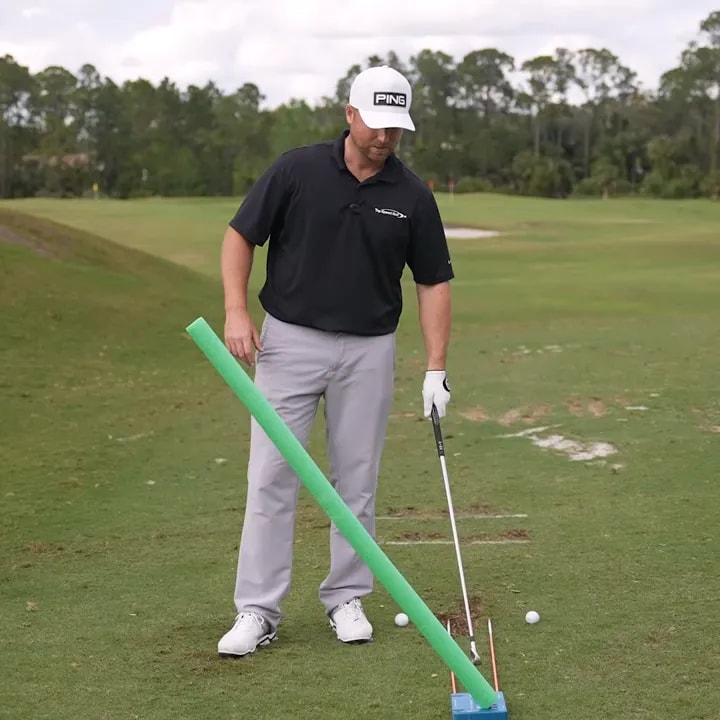
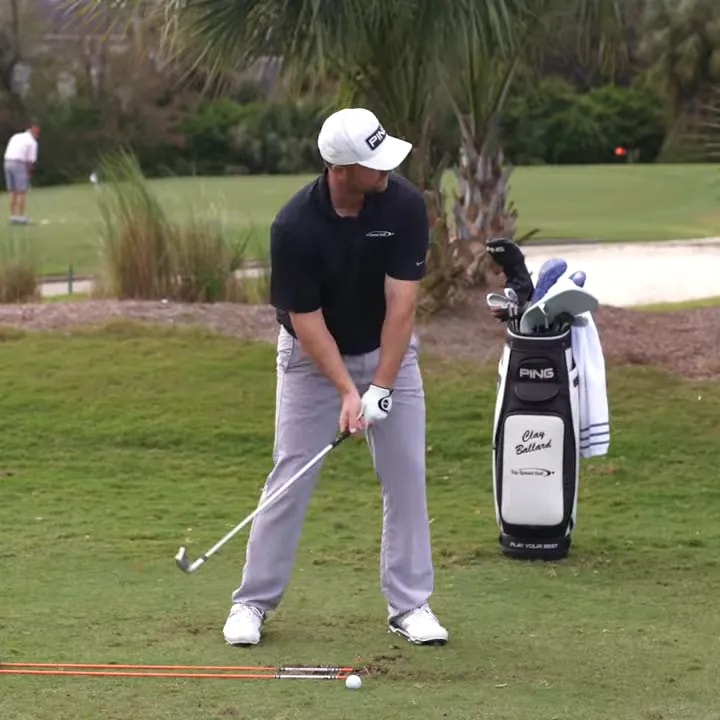
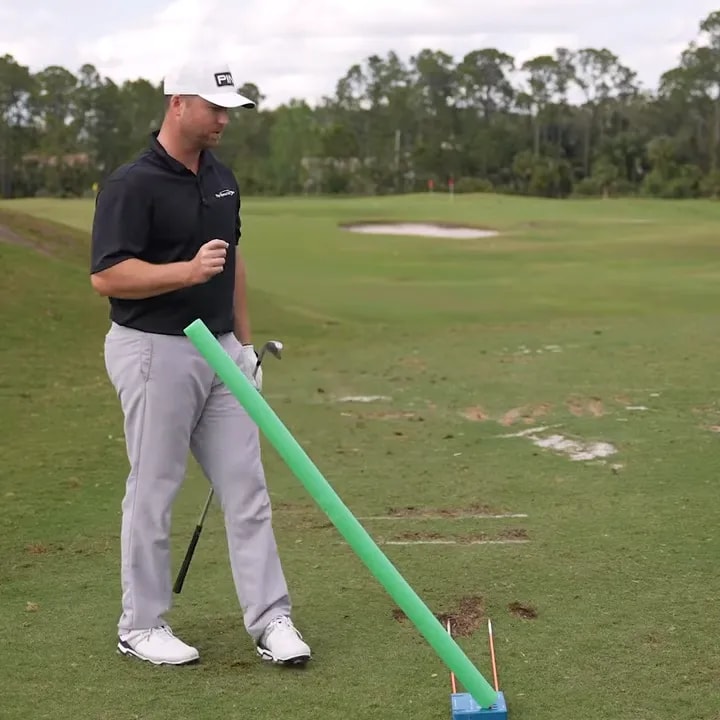
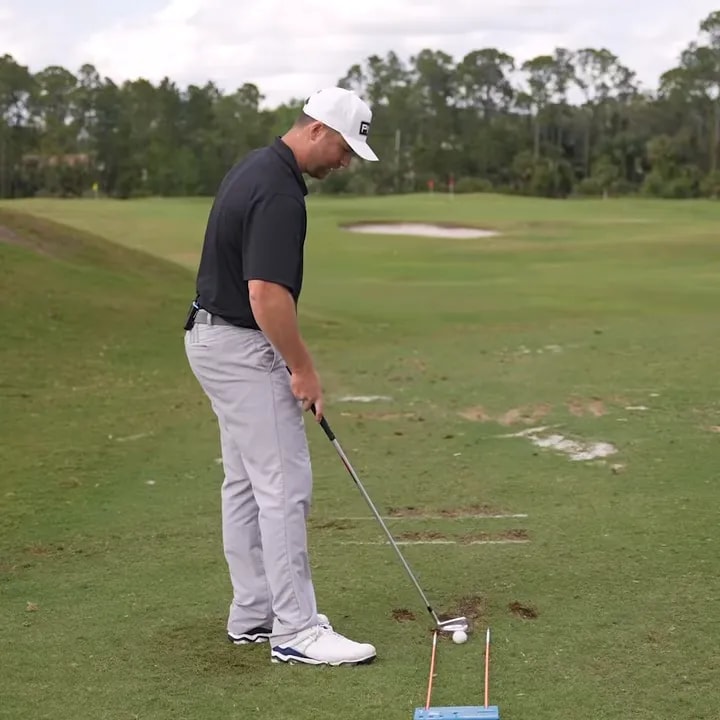
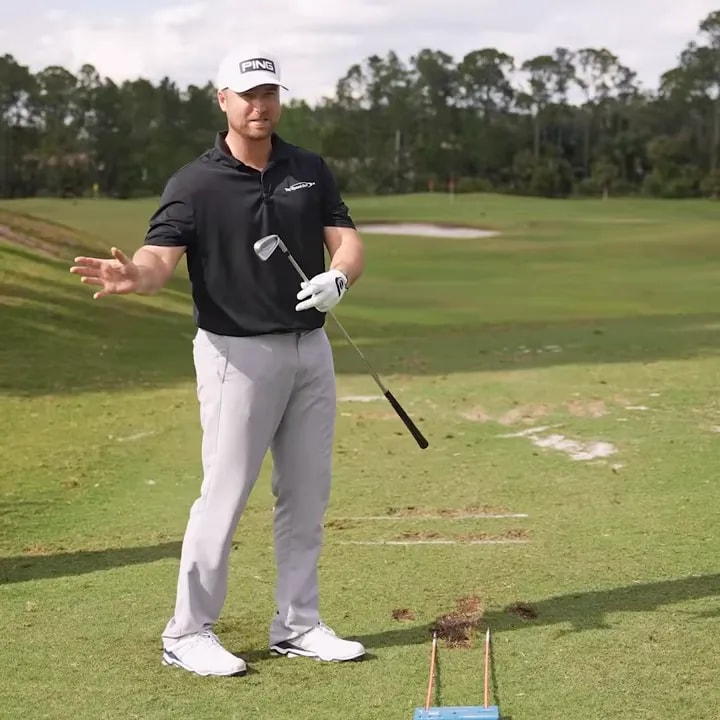
You can do this drill with alignment rods or any visual guides that help you organize your setup. The key is to create one station that encourages a draw pattern and another that encourages a fade pattern, then alternate between them.
Use a mid iron such as a 6 iron if available. A mid iron gives you enough loft to see shape clearly without the difficulty of a long iron or the extra spin of a wedge.
Your setup should let you rehearse:
Draw pattern: a slightly more inside approach.
Fade pattern: a slightly more leftward path through impact.
Neutral pattern: a centered setup for straight shots once both shapes are under control.
The exact training aid is less important than the concept. In golf, visual constraints can help you organize your swing path and divot direction more clearly than random range work.
Step 5: Hit intentional draw shots in golf
Start by learning to create a draw on purpose. To do that, use a feel that encourages the club to approach a little more from the inside.
Helpful feels include:
A slight tilt away from the target at address or through the motion.
A sense that the club is approaching from the inside.
A shot that starts near the target line and turns gently left.
You do not need a huge curve. In fact, in good golf practice, a modest draw is better than an exaggerated hook. Think of a controlled shape, not a rescue shot from the trees.
Stay with this task until you produce a clear draw. If you fail to hit the shape you intended, keep working on that side before switching.
Step 6: Hit intentional fade shots in golf
Next, move to the opposite pattern. For a fade, use a feel that makes your motion a little more vertical and lets the swing travel slightly more left through impact.
Helpful feels include:
A more upright or vertical spine feel compared with the draw setup.
A sensation of the club moving a little more left through the strike.
A shot that starts a touch left of target and falls back gently.
Again, the goal is not a dramatic curve. In golf, a playable fade is a small, controlled movement. You are training command, not exaggeration for its own sake.
Step 7: Apply the win-shift, lose-stay golf practice rule
One of the most useful practice ideas here is very simple:
Lose, stay: if you miss the intended shot shape, stay on that task.
Win, shift: once you hit the intended shape, move to the other task.
This gives your golf practice structure. Instead of mindlessly alternating, you earn the right to switch. That helps you spend more time on what is actually weak.
For example:
Try to hit a draw.
If it does not draw, repeat until you get one.
Once you succeed, switch to a fade.
If it does not fade, stay there until you produce it.
Keep going back and forth.
This style of interleaving can make golf practice more effective than grooving one shape for an entire session.
Step 8: Track whether your golf practice is working
You need a simple benchmark. A practical target is to make your intended draw or fade about 60 to 70 percent of the time.
That means if you attempt 10 alternating shots in golf practice, you should see around 6 or 7 shots with the pattern you intended.
If you are below that, do not rush to the next stage. Stay with the alternating drill until your control improves.
This is important because many golfers move to straight-shot practice too early. If you cannot produce both curves with reasonable consistency, neutral is usually just a guess.
Step 9: Return to center and hit straight golf shots
Once you can alternate draw and fade with decent success, move to a neutral setup and aim for a straight shot.
Your goal in golf is not to eliminate all curve forever. A nearly straight shot may still move a yard or two. That is normal. What you want is a ball flight that is effectively straight and predictable.
At this point, think of your straight shot as the middle point between the two trained patterns.
A good checklist:
Ball centered in your neutral station
No exaggerated draw or fade feel
Balanced setup and posture
A starting line close to the target
Very little curve either direction
Step 10: Make small golf corrections if the ball starts curving again
Neutral does not mean perfect forever. If your straight shot starts drifting back toward your old pattern, use the opposite side to rebalance.
If your ball starts overdrawing, rehearse a few fade shots, then return to neutral.
If your ball starts overfading, rehearse a few draw shots, then return to neutral.
This is one of the most practical ways to self-correct in golf. Instead of making a major swing overhaul, you nudge yourself back to center by revisiting the opposite shape.
Step 11: Use divots as feedback in your golf practice
Divots can tell you a lot about path direction in golf. You do not need to obsess over every turf mark, but they are useful feedback when working on shape control.
In general:
A draw-oriented swing tends to leave a divot that feels more neutral or slightly rightward relative to the target.
A fade-oriented swing tends to leave a divot that points more left.
If the ball flight and divot direction match, you can be more confident that your path is changing as intended.
If they do not match, check strike quality. A poor strike can blur the feedback. In golf, shape practice works best when contact is reasonably solid.
Step 12: Avoid the golf mistakes that keep players stuck
Most plateaus come from a few repeatable errors. Avoid these if you want your golf practice to produce real change.
Only practicing your favorite shot shape
If you always hit draws because they feel powerful, or always hit fades because they feel safe, you may be feeding your imbalance.
Trying to hit straight shots too early
Straight is usually the midpoint between two controlled curves. If you cannot create either side on command, straight shots are hard to own.
Making curves too big
Overdoing the shape can create a new problem. Small, playable curves are better for building control in golf.
Switching tasks before you succeed
If you change drills after every poor shot, you never build enough awareness to fix the pattern. Use the win-shift, lose-stay rule.
Ignoring your common bias
Most golfers are not neutral. They are biased toward one pattern. Honest diagnosis leads to better practice.
Step 13: Build a simple golf range session around this drill
If you want a practical structure, use this short golf session:
Warm up with easy wedge or short iron swings.
Identify your pattern from the first few full shots.
Practice the opposite shape if one side is dominating.
Alternate draw and fade using win-shift, lose-stay.
Aim for 6 to 7 successful shaped shots out of 10 attempts.
Move to neutral and hit straight shots.
Rebalance as needed by revisiting draw or fade practice.
This type of golf session is more effective than beating balls with one intention all day. It teaches adaptability, which is exactly what many golfers lose when they plateau.
Step 14: Know what success looks like in golf
Success is not zero curvature and perfect contact every swing. In golf, success is having enough control to:
Produce a draw when you want one
Produce a fade when you want one
Return to a nearly straight stock shot
Recognize when your path drifts too far one way
Correct it with a few purposeful swings
The straighter and more consistent ball strikers usually live close to neutral. That does not mean they never curve the ball. It means they are not trapped by one shape.
FAQ
Why does practicing fades help if I hook the golf ball?
Because your path is likely too far from the inside. Practicing fades gives you the opposite movement pattern and helps pull your swing back toward neutral. In golf, balance between the two shapes often leads to straighter shots.
How many successful shots should I hit before moving on in golf practice?
A good benchmark is about 60 to 70 percent success. If you try 10 alternating shots, aim for 6 or 7 intended shapes. If you are below that, keep working before switching to straight-shot practice.
Can this golf drill help if I normally fade the ball too much?
Yes. If your common golf miss is a fade or slice, spend more time learning to hit a controlled draw. Once you can produce both patterns, your neutral shot becomes easier to find.
Should I practice only straight golf shots if that is my goal?
Usually no. Many golfers improve faster by learning both a draw and a fade first. Straight shots are often the midpoint between those two controlled patterns.
What if my golf ball is still curving after I move back to neutral?
If the ball starts overdrawing, practice a few fades and then return to center. If it starts overfading, practice a few draws and then return to center. Small corrections are often enough to rebalance your golf swing path.
Final takeaway for a golf game that has stalled
If your golf game has plateaued, do not just repeat your default swing harder and longer. That is the mistake. Instead, train the opposite shape, alternate between draw and fade, and only then settle into neutral. This gives you a more complete skill set and a better chance of producing the straight ball flight most golfers want.
The simple idea is this: control both sides, then own the middle. In golf, that is often the fastest path out of a plateau.
0 Comments