
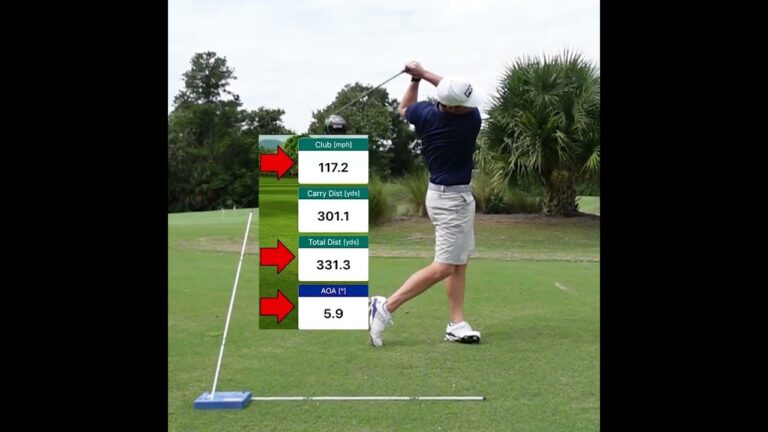

If your golf driver shots launch low, curve weakly, or feel like you are chopping down on the ball, your setup may be costing you speed before the swing even starts. For many golfers, the issue is not effort. It is body tilt, ball position, and the path the club is forced to take through impact.
This guide explains how to build a better driver setup in golf, why a slight spine tilt away from the target matters, and how to use a simple obstacle drill to encourage a more inside path and a more upward strike. The goal is straightforward: longer, straighter drives with a motion you can repeat on the range and on the course.
Table of Contents
- Step 1: Understand why your golf driver setup matters so much
- Step 2: Check your golf spine tilt before you even swing
- Step 3: Position the golf ball so you can swing up on it
- Step 4: Use an obstacle drill to improve your golf swing path
- Step 5: Match your golf attack angle to the driver
- Step 6: Build a repeatable golf warm-up around this move
- Step 7: Know the difference between golf driver mechanics and iron mechanics
- Step 8: Fix the most common golf driver mistakes
- Step 9: Decide whether a golf training aid can help you
- Step 10: Use a simple golf checklist before every driver swing
- FAQ
- Final takeaway for better golf drives
Step 1: Understand why your golf driver setup matters so much
Driver is different from most other golf clubs. With irons and wedges, you usually want a descending strike that compresses the ball and creates a divot after impact. With driver, the ball is teed up, and the most efficient motion is often a shallower approach that allows you to hit more level or slightly upward.
That upward strike matters because it can help you:
Launch the ball higher
Reduce the weak, glancing contact that robs distance
Create a more powerful ball flight
Use your speed more efficiently in golf
When your upper body leans toward the target at address, it becomes much easier to chop down on the ball. That usually leads to shorter drives, poor launch, and less efficient contact. A slight tilt away from the target does the opposite. It puts your body in a position that makes it easier to sweep up through the shot.
Step 2: Check your golf spine tilt before you even swing
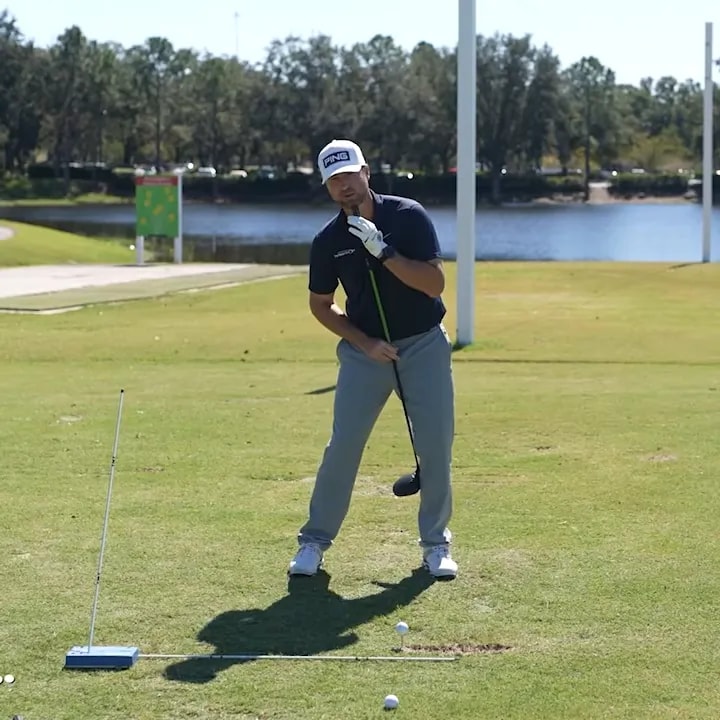
One of the simplest setup keys in golf is the angle of your spine at address. A useful checkpoint is the line from the center of your lead ankle to your lead shoulder socket. For a right-handed golfer, that means the left ankle and left shoulder. That line should not be leaning toward the target.
Instead, with driver, you want a slight tilt away from the target.
This is not a dramatic lean. It is a small, athletic adjustment that helps you:
Keep your upper body behind the ball
Create room to approach from the inside
Promote a better attack angle in golf
A practical way to feel this is to set a club vertically so one end touches your chin and the other lines up near the bottom of your belt. From there, tilt slightly away from the target. That gives you a simple reference for the body position you want with driver.
If you overdo this move, you can hang back and lose control. If you do not do it at all, you may set yourself up to hit down too steeply. The sweet spot is a modest tilt that feels balanced and athletic.
Step 3: Position the golf ball so you can swing up on it
Good golf driver contact starts with good ball position. If the ball is too far back, you are more likely to catch it earlier in the arc while the club is still traveling downward. If the ball is too far forward, you may struggle to find the center of the face or control the start line.
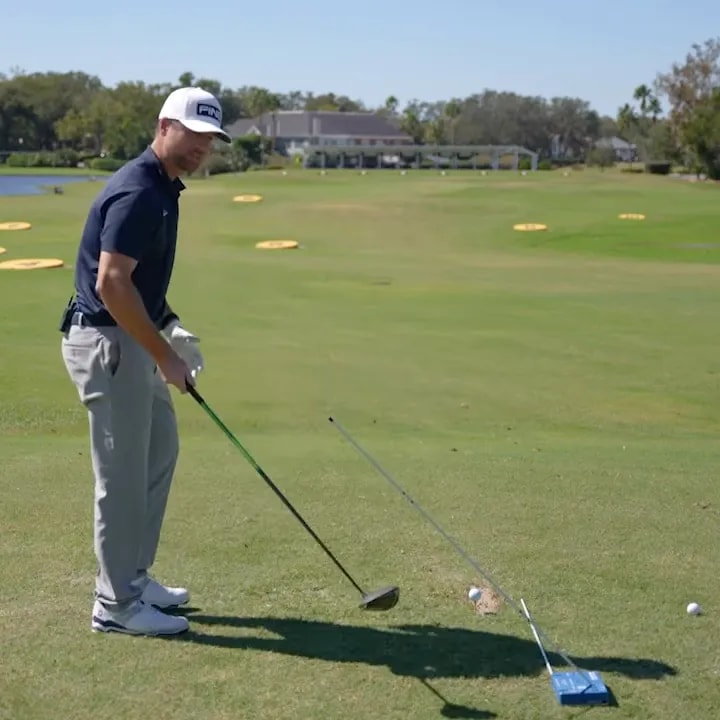
For this drill, the ball is teed up with clear space inside an alignment reference. The key idea is to give yourself enough room to swing without feeling trapped, while still creating a visual guide for the path you want.
As a general concept in golf:
The ball should be forward enough to encourage an upward strike
You should still feel balanced and able to turn through the shot
Your setup should let the club travel from the inside without hitting the obstacle
If you have been struggling with weak pop-ups, low line drives, or glancing slices, revisit ball position before changing your whole swing.
Step 4: Use an obstacle drill to improve your golf swing path
Many golfers in golf fight an over-the-top move. The club moves out toward the ball too early, cuts across it, and creates a path that often produces slices, pulls, or weak contact. A simple barrier drill can help you feel a better route into the ball.
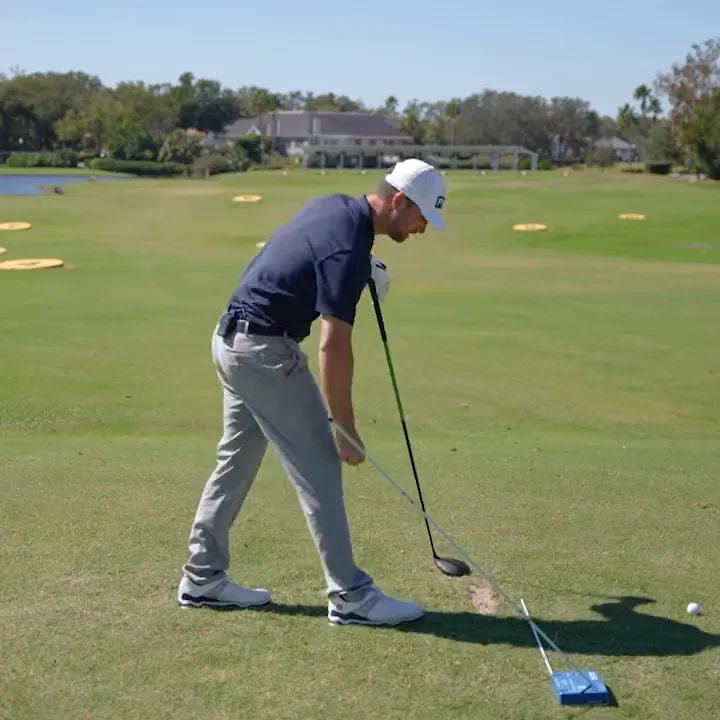
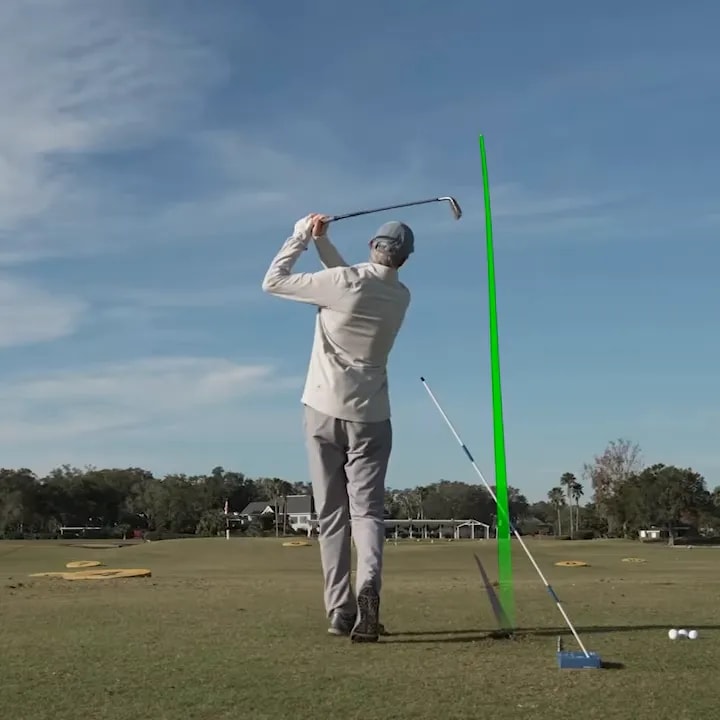
The idea is to place an object outside the target line so you must deliver the club more from the inside. In the source material, a training aid is aligned toward the target, and the ball is teed up a clubhead to two clubhead widths inside that line. That spacing gives you room to start, while still providing feedback if the club comes down too steeply or too far outside.
Why this works in golf:
It gives immediate feedback on path
It encourages a shallower approach
It pairs naturally with a spine tilt away from the target
It helps you rehearse a more efficient driver delivery
You do not need to swing hard when learning this drill. Start with slow rehearsals, then half-speed shots, then build up only after you can miss the obstacle comfortably.
How to set up the obstacle drill
Pick your target line in the distance.
Place your alignment reference or training aid along that line.
Tee the ball up inside that reference with enough clearance that you will not strike it on a normal inside path.
Set your spine slightly away from the target.
Make smooth swings that travel inside the obstacle and through the ball.
If the club keeps colliding with the obstacle, you are likely throwing the club outward too early or setting up without enough tilt.
Step 5: Match your golf attack angle to the driver
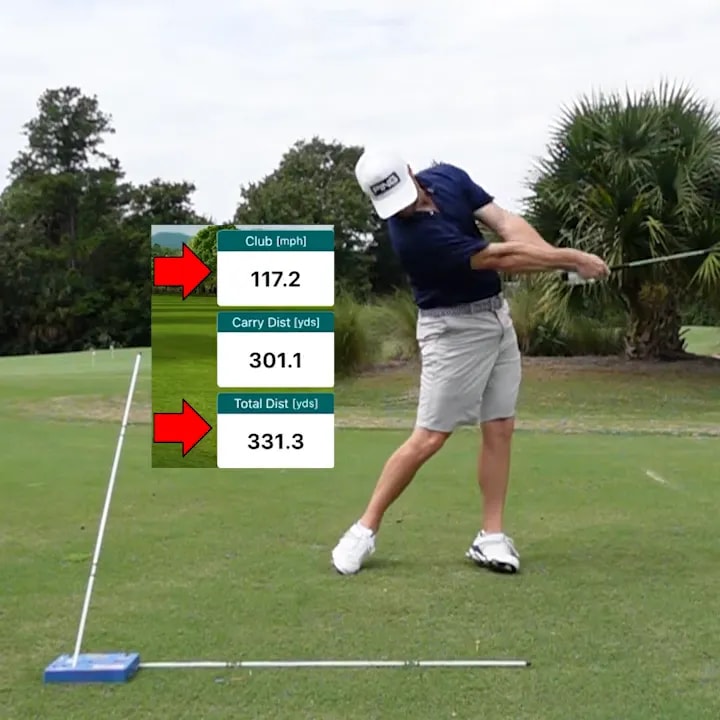
Attack angle describes whether the clubhead is moving down, level, or up at impact. For driver in golf, a more upward strike can help create a stronger launch and more distance. The source material highlights an example of hitting up on the ball by almost six degrees, paired with high speed and long total distance.
The exact number is not the main point for most golfers. The practical takeaway is that driver should not be treated like a wedge or short iron. Your setup and path should support a shallower, more upward strike.
Signs your attack angle may be too steep in golf include:
Low launch with driver
Heavy feeling contact even though the ball is teed
Weak shots that fall out of the air
Deep divot instincts carrying over from iron swings
Signs you may be moving in a better direction include:
A higher, stronger flight
Cleaner contact near the center of the face
Better carry distance
A feeling that the club is sweeping through the ball
Step 6: Build a repeatable golf warm-up around this move
A useful golf drill is only valuable if you can return to it consistently. One of the strengths of a simple path-and-tilt drill is that it fits easily into a pre-round or range warm-up.
A repeatable warm-up might look like this:
Make 5 slow rehearsals without a ball, feeling the spine tilt away from the target.
Make 5 slow swings inside the obstacle, focusing on path.
Hit 5 half-speed drivers, prioritizing clean contact.
Hit 5 normal-speed drivers, keeping the same setup and feel.
This kind of progression helps you avoid a common golf mistake: going straight to full speed and reinforcing the old motion.
If you only have a few minutes before a round, even a handful of slow rehearsals can remind your body what a better driver motion feels like.
Step 7: Know the difference between golf driver mechanics and iron mechanics
Many golfers struggle with driver because they apply iron ideas to a tee shot. In golf, that mismatch can create confusion.
With irons and wedges, you often want:
More shaft lean
A descending strike
Divot after the ball
With driver, you generally want:
Ball teed up
Slight spine tilt away from the target
A motion that can deliver the club more level or upward
This distinction is important in golf because many players hit irons reasonably well but struggle with the driver. The issue is often not talent. It is using the wrong setup intention for the club in your hands.
Step 8: Fix the most common golf driver mistakes
If you are trying to improve your driver in golf, watch for these mistakes.
Leaning toward the target at address
This often promotes a steep, downward hit. Check your spine tilt and make sure your upper body is not drifting toward the target before you start.
Trying to help the ball up with your hands
When golfers hear “hit up on it,” they sometimes flip the club or scoop at impact. A better upward strike comes from setup and motion, not from throwing the wrists.
Swinging outside the obstacle
If you keep hitting the training aid or alignment reference, your path is still too steep or too far over the top. Slow down and rehearse the inside route.
Standing too close to the obstacle
You need enough room to make a normal swing. Start with more space, then narrow it only if needed.
Using full speed too early
Speed magnifies old habits in golf. Train the pattern first, then add power.
Step 9: Decide whether a golf training aid can help you
Some golfers learn best from verbal swing thoughts. Others improve faster when they have an external reference that gives instant feedback. A simple training aid that creates a path barrier can be especially helpful if you:
Fight an over-the-top move
Slice the driver
Hit low, weak drives
Need a simple warm-up station for golf practice
The biggest advantage is clarity. Instead of trying to guess what “inside” or “shallow” should feel like, you have a physical checkpoint. If your club avoids the barrier and your contact improves, you know you are moving in the right direction.
That said, a training aid is not magic. In golf, it works best when you pair it with the correct setup, especially the slight tilt away from the target.
Step 10: Use a simple golf checklist before every driver swing
Before each driver shot, run through this quick golf checklist:
Target: Pick a specific line.
Ball position: Forward enough to encourage an upward strike.
Spine tilt: Slightly away from the target.
Path intention: Deliver the club from the inside.
Tempo: Smooth first, fast second.
This keeps your focus on the fundamentals that matter most in golf driver performance.
FAQ
Why do I hit down on my golf driver?
You may be setting up with your upper body leaning toward the target, placing the ball too far back, or bringing the club down too steeply from the outside. A slight spine tilt away from the target can make it easier to deliver the club more level or upward in golf.
How much spine tilt should I have with driver in golf?
You only need a slight tilt away from the target. It should feel athletic and balanced, not exaggerated. Too little tilt can encourage a downward strike, while too much can make you hang back and lose control.
Can an obstacle drill help an over-the-top golf swing?
Yes. An obstacle placed outside the intended swing path gives instant feedback. If you come over the top in golf, you are more likely to hit the barrier. If you shallow the path and approach from the inside, you can swing past it cleanly.
Should I use the same swing feel for golf irons and driver?
Not exactly. In golf, irons and wedges usually favor a descending strike, while driver benefits from a setup and motion that support a shallower or upward strike. The clubs are built for different impact conditions.
What is a good sign that my golf driver setup is improving?
Look for a higher, stronger ball flight, cleaner contact, and less of the chopped-down feeling through impact. You may also notice that it becomes easier to swing from the inside without forcing it.
Final takeaway for better golf drives
If your driver has always felt inconsistent in golf, do not assume the fix is a more complicated swing. Start with the setup. A slight spine tilt away from the target, a ball position that supports an upward strike, and a simple obstacle drill can change the way the club enters impact.
That combination helps you avoid the steep, over-the-top pattern that produces weak drives. It also gives you a practical system you can rehearse in every golf warm-up.
When driver is set up correctly, you give yourself a better chance to launch the ball high, use your speed efficiently, and hit the kind of long, solid tee shots that make the rest of the hole easier.
0 Comments