


If you want to compress your wedges, the goal is not to hit down harder with your hands. It is to create a motion where your body, arms, and club move together so the club strikes the ball first and the turf after. That is what produces a lower, more controlled flight, cleaner contact, and better distance control.
Many golfers struggle with wedge shots because they get too handsy. The result is familiar: thin shots, heavy shots, or shots that start left when the clubface flips through impact. A more reliable wedge motion comes from staying connected and using your core to control the swing.
This guide explains the key body movement that helps you compress your wedges, how to set up for it, how to train it, and what errors to avoid.
Table of Contents
- Step 1: Understand what it means to compress your wedges
- Step 2: Learn the key body movement for wedge compression
- Step 3: Use the medicine ball feel to compress your wedges
- Step 4: Build a setup that makes wedge compression easier
- Step 5: Turn around your center instead of sliding
- Step 6: Keep the clubface quieter through impact
- Step 7: Let the hinge happen naturally
- Step 8: Practice a simple motion that produces a flighted wedge
- Step 9: Fix the most common mistakes when trying to compress your wedges
- Step 10: Use a quick checklist before every wedge shot
- Step 11: Apply the same feel to partial and full wedges
- Step 12: Know what good wedge compression should feel like
- FAQ
- Final takeaway
Step 1: Understand what it means to compress your wedges
To compress your wedges, you need an efficient strike. In simple terms, that means:
- The ball is contacted before the ground
- Your low point is slightly in front of the ball
- The clubface stays stable through impact
- The ball launches on a controlled, flighted trajectory
Compression with wedges is not about trying to smash the ball. It is about delivering loft with control. A properly compressed wedge often looks and feels quieter than a poor one. The body keeps moving, the hands do not race ahead independently, and the strike sounds clean.
This matters because wedge play influences much more than short approach shots. It can improve your awareness of low point, face control, rhythm, and impact quality across the whole bag.
Step 2: Learn the key body movement for wedge compression
The key body movement to compress your wedges is a connected, core-driven motion. Think of the swing more like a medicine ball toss than a hand-dominated flick.
With wedges, the club is shorter and more lofted, which makes it easier for your hands and body to move at a more similar pace. That is useful because consistency improves when your torso controls the motion and your arms stay connected to your body.
The feel to use is this:
- Your core starts and supports the motion
- Your arms stay with your torso
- Your body turn moves the club
- Your hands do not outrun your pivot
When this happens, the club approaches the ball with a more predictable low point and a quieter face. That is why connected wedge swings tend to produce flighted shots that bore through the wind rather than ballooning.
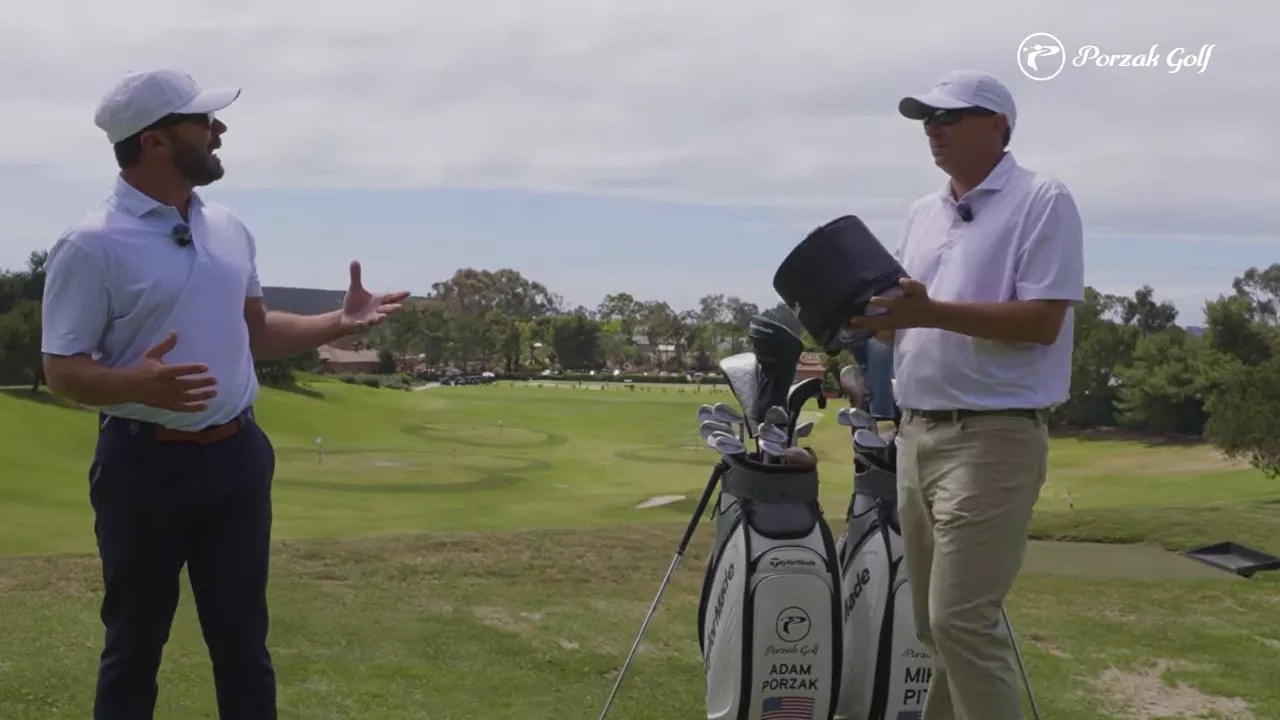
Step 3: Use the medicine ball feel to compress your wedges
One of the best feels for wedge motion is a short medicine ball throw. You do not need to throw a golf club like a medicine ball, but the sensation is helpful because it teaches you to use your big muscles instead of your wrists.
Here is what that feel should teach you:
- Connection between arms and torso
- Core engagement instead of arm throw
- Stable balance through the motion
- Release down the line instead of weakly out to the right
If you were to toss a medicine ball properly from a golf-like setup, you would not separate your arms from your body and fling it with your hands. You would brace your body, turn through, and let the motion come from your core. That same athletic pattern is ideal for wedge play.
When golfers disconnect, the motion often gets sloppy. The arms lift away, the club gets out of sequence, and then the body has to stall or stand up so the hands can catch up. That is when contact becomes unpredictable.
How to practice the medicine ball drill
You can do this drill with a partner and a light medicine ball, or simply rehearse the movement without one.
- Set up in a golf posture.
- Stand a short distance from your partner.
- Hold the ball below shoulder level.
- Turn back and through using your core.
- Keep your arms connected to your torso.
- Release the ball on line, not weakly off to the side.
As you improve, you can increase the distance of the toss. That encourages more turn and better sequencing. The main purpose is not to throw harder. It is to feel your body powering the motion in one connected piece.

Step 4: Build a setup that makes wedge compression easier
Even a good body motion gets harder if your setup works against you. To compress your wedges, start with a simple, stable address position.
Use a narrower stance
For most wedge shots, a narrower stance helps you stay centered and turn around a stable base. It also matches the smaller size of the swing.
A useful rule is that as the shot gets shorter, your stance gets narrower. A partial wedge should not look like a full driver setup.
Stay centered over the ball
Your sternum and head should remain centered over the ball area rather than drifting laterally. This helps keep the top of your swing arc in a consistent place.
When your center moves too much off the ball, low point control becomes much harder. That often leads to fat and thin contact.
Favor a stable lead side
A stable lead leg can act like a post for the turn. On the backswing, the goal is not to sway away from the target. Instead, you want to turn around a stable base.
This promotes a more reliable strike because your body is not constantly trying to recover from excess motion.
Match stance width to swing length
Your setup should remind you how far you are trying to hit the shot.
- Smaller shot: narrower stance, smaller motion
- Full wedge: slightly wider, but still controlled
This connection between setup and swing size helps simplify distance control.

Step 5: Turn around your center instead of sliding
A major key to compress your wedges is reducing unnecessary lateral movement. Wedge swings work best when you turn around your center rather than shift dramatically off the ball and then try to recover.
That does not mean you should be rigid. It means your motion should be rotational, stable, and balanced.
Focus on these feels:
- Turn, do not sway
- Stay anchored through your lead side
- Keep your chest moving through the shot
- Let rotation control the strike
When you stay centered and rotate well, the club returns to the ball more predictably. The bottom of the arc moves in front of the ball, which is exactly what you want for crisp wedge contact.
Step 6: Keep the clubface quieter through impact
Golfers who struggle with wedges often think only about contact, but face control matters just as much. A connected body-driven swing helps keep the face quieter because the hands are not making a last-second save.
That is important because disconnected swings often produce three different misses from the same underlying problem:
- Fat shots when the club bottoms out too early
- Thin shots when the body rises and the club misses the turf
- Left misses when the hands flip and the face closes
Those may look like separate problems, but they often come from the same source: the arms getting away from the body, followed by a compensation through impact.
If your wedge swing feels like your body and hands are racing against each other, the fix is usually not more hand action. It is better connection and better body pacing.
Step 7: Let the hinge happen naturally
When trying to compress your wedges, many golfers ask whether they should actively hinge the wrists. The better answer is usually to allow the hinge to happen naturally rather than forcing it.
With wedges, the club is already shorter, your grip may be down the handle, and your arms are closer to you. That setup naturally creates some angle between the lead arm and the club.
As you move the club away with a connected shoulder and torso motion, a modest wrist set will appear. You do not need to manufacture a large, abrupt hinge.
That matters because too much conscious wrist action often leads to:
- Excess hand speed
- Loss of connection
- Inconsistent low point
- Flippy impact
For most wedge shots, think body-driven with natural leverage, not forced wrist action.
Step 8: Practice a simple motion that produces a flighted wedge
If your goal is to compress your wedges and hit lower, more controlled shots, use this simple rehearsal:
- Take a narrow, balanced stance.
- Set a little pressure into your lead side.
- Keep your chest, arms, and hands connected.
- Make a compact backswing.
- Turn through with your core.
- Feel the club brush the turf in front of the ball.
- Finish balanced with your body still connected.
The ball flight should come out relatively flat and controlled rather than floating too high. A compressed wedge often looks like it leaves the face with purpose and little wasted motion.

Step 9: Fix the most common mistakes when trying to compress your wedges
Most wedge issues come from a handful of patterns. If you can identify yours, the solution becomes much easier.
Mistake 1: Swinging with the hands only
This is the big one. If your hands dominate, the club can get out of sync with your body. Contact and direction both suffer.
Fix: Rehearse the medicine ball feel. Let your torso move the club.
Mistake 2: Taking too wide a stance
A wide stance can encourage too much lateral motion and make shorter swings feel awkward.
Fix: Narrow your stance to match the size of the shot.
Mistake 3: Swaying off the ball
Excessive movement away from the target makes low point harder to control.
Fix: Turn around a stable lead-side anchor instead of sliding.
Mistake 4: Trying to force wrist hinge
An overactive wrist set can disconnect the club from your pivot.
Fix: Let the hinge happen naturally as the club moves away.
Mistake 5: Standing up through impact
When the body stalls and rises, the club often strikes the ball thin or loses face control.
Fix: Keep rotating through the shot and stay connected.
Step 10: Use a quick checklist before every wedge shot
When you are over the ball, a few clear checkpoints can help you compress your wedges without overthinking.
- Narrow enough stance?
- Centered over the ball?
- Lead side stable?
- Arms connected to the torso?
- Turning through with the core?
- Low point in front?
If those pieces are in place, your odds of producing clean, controlled contact go way up.
Step 11: Apply the same feel to partial and full wedges
The connected, core-driven feel is especially useful on partial wedges, but it also helps on fuller wedge swings. The main difference is the size of the motion, not the basic pattern.
On shorter shots:
- Stance is narrower
- Swing is smaller
- Everything feels compact
On fuller wedges:
- Stance can widen slightly
- Turn can be longer
- Rhythm stays smooth and connected
The common thread is that your body remains the engine. If the shot gets longer and your hands take over, the strike usually gets worse, not better.
Step 12: Know what good wedge compression should feel like
If you are learning to compress your wedges, the right feel may be different from what you expect. It usually feels less like a hit and more like a coordinated turn through the ball.
Good signs include:
- Clean ball-first contact
- Divot or turf interaction after the ball
- Stable, controlled flight
- Balanced finish
- No sense of a last-second hand flip
Bad signs include:
- Sharp changes in trajectory from swing to swing
- Fat, thin, and left misses mixed together
- Feeling that you need to save the shot with your hands
- Loss of balance through impact
FAQ
How do you compress your wedges without taking huge divots?
You compress your wedges by controlling low point, not by trying to dig. The ideal strike is ball first and turf second, with the bottom of the swing arc slightly ahead of the ball. A connected, body-driven motion helps you do that without chopping steeply.
Why do I hit wedge shots fat and thin in the same round?
That often comes from the same pattern: disconnection between your arms and body. When the club gets out of sync, you may hit behind the ball on one swing, stand up and catch it thin on the next, and flip the face closed on another. Better connection usually improves all three misses.
Should I use a narrow stance for all wedge shots?
For most wedge shots, a narrower stance is helpful because it matches the shorter swing and encourages a centered turn. As the shot gets longer, your stance can widen a bit, but it should still remain controlled and appropriate for a wedge, not a driver.
Do I need to hinge my wrists to compress your wedges?
You do not need to force a big wrist hinge. Some leverage will form naturally as the club moves away in a connected motion. Too much active wrist action can make wedge contact less reliable.
What is the best drill to compress your wedges?
A medicine ball style drill is highly effective because it teaches you to move the club with your core rather than your hands. The main feeling is connection, rotation, and release from the body center.
Can this help with full swing mechanics too?
Yes. Wedge work can improve your understanding of impact, face control, rhythm, and low point. Those skills transfer into the rest of your swing, even though longer clubs involve more speed and different timing demands.
Final takeaway
If you want to compress your wedges, start by changing the source of the motion. Do not rely on your hands to create the strike. Build the shot from a stable setup, stay centered, keep your arms connected to your torso, and let your core turn the club through the ball.
The medicine ball feel is especially useful because it teaches the athletic pattern behind crisp wedge contact. Pair that feel with a narrow stance, a centered pivot, and a quiet clubface, and your wedge shots will become more consistent, more flighted, and much easier to control.
For most golfers, better wedges begin with a simpler idea: body and arms moving together through impact.
0 Comments