


Focus keyphrase: over-the-top golf swing fix
If you struggle with pulls, weak fades, and inconsistent contact, your swing may be suffering from the same chain reaction that traps many high handicap golfers. The club gets too far inside early, the downswing works too far left, the face stays open, and your body stalls through impact. The result is frustrating ball striking that feels hard to trust.
The good news is that an over-the-top golf swing fix does not always require a complete rebuild. Often, you need to identify the first broken link in the chain, exaggerate the opposite feel, and practice it slowly enough that the movement actually changes.
This lesson breaks that process into two big projects:
- Fix the backswing so the club is more on plane and less over-hinged.
- Fix the through-swing so the arms, hands, and club work higher and more to the right while the hips extend properly.
Together, those changes can help you turn a leftward, glancing strike into a more solid, straighter, higher shot.
Table of Contents
- Step 1: Diagnose the ball flight before trying to fix it
- Step 2: Understand why an under-plane takeaway creates an over-the-top downswing
- Step 3: Use the “out over two, down over four” drill for your over-the-top golf swing fix
- Step 4: Fix the wrist hinge so the club does not get steep and cupped
- Step 5: Blend swing plane and wrist hinge into one simple backswing feel
- Step 6: Fix what happens through the ball, not just before it
- Step 7: Practice the through-ball drill from a mini-swing position
- Step 8: Build your 30-day practice routine the right way
- Step 9: Use feedback so your feels stay honest
- Step 10: Focus on the first broken link, not every swing flaw at once
- FAQ
- Final takeaway
Step 1: Diagnose the ball flight before trying to fix it
The starting point is simple. If your path is moving too far left through impact, you usually get two common misses:
- Pulls when the face matches that leftward path
- Fades when the face is open relative to that path
That pattern is common in an over-the-top motion. The club approaches from outside the target line, cuts across the ball, and produces the exact mix of misses many golfers describe as “I either pull it or I hit that weak fade.”
But the path problem does not begin only in the downswing. In this case, the root cause starts earlier. The club works too far under plane in the takeaway, then gets too much wrist hinge later, which sets up a steep, leftward move coming down.
That is why a real over-the-top golf swing fix starts with diagnosis, not random drills. You want to know whether the first problem is:
- Takeaway too far inside
- Too much late wrist hinge
- Downswing path too far left
- Poor body extension through impact
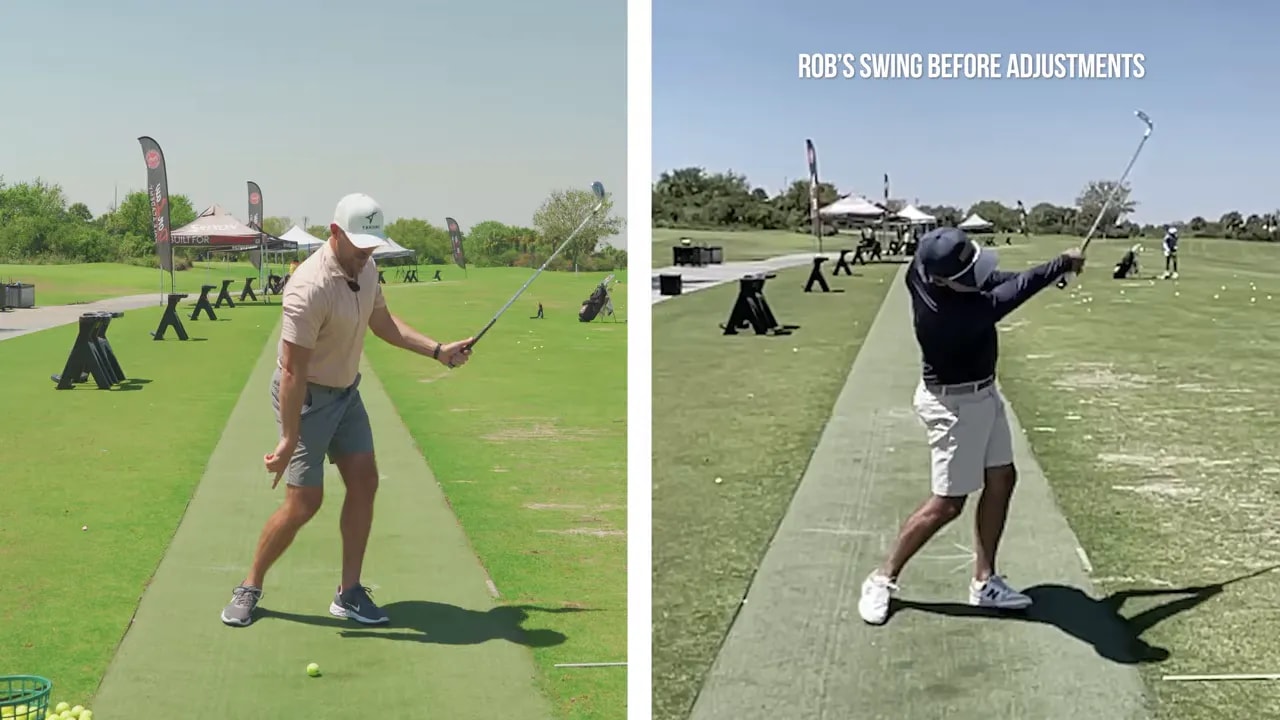
When you identify the first broken link, the rest of the corrections become much easier.
Step 2: Understand why an under-plane takeaway creates an over-the-top downswing
One of the most useful insights in this lesson is that a club taken too far inside early often has “nowhere to go” but out and over on the way down.
That sounds backward at first. Many golfers think an inside takeaway should lead to an inside downswing. In reality, it often does the opposite. Once the club gets trapped behind you and under plane, you may instinctively throw it out, steepen it, and cut across the ball just to find contact.
That is the exact pattern being corrected here.
The goal in the backswing is to get the club more on plane earlier so it can shallow and deliver more naturally later. Instead of working under plane and then rerouting steeply, the club should trace a much cleaner path.
A helpful reference used in the lesson is the clock system:
- 4 o’clock takeaway means the club is moving too far inside
- 3 o’clock takeaway is more neutral, roughly down the toe line
- 2 o’clock feel is the exaggeration needed to produce a real 3 o’clock position
This is one of the most important principles in golf improvement: feel is not real. To move from a flawed pattern to a neutral one, you usually have to feel like you are doing far more than you actually are.
Step 3: Use the “out over two, down over four” drill for your over-the-top golf swing fix
The core backswing drill is memorable because it gives you a simple feel:
Out over two, down over four.
Here is what that means:
- On the takeaway, feel the clubhead move out toward 2 o’clock.
- In transition, feel the club loop and work down over 4 o’clock.
- Start with short, slow rehearsal swings.
- Clip the mat or brush the ground without trying to hit hard.
This reverses the golfer’s original loop. Instead of going too far inside on the way back and then steep on the way down, the drill creates the opposite pattern as a training feel.
Importantly, this is an exaggeration drill. The takeaway feel should seem outside. That is intentional. Once a ball is introduced, most golfers naturally do less of the correction than they think they are doing.
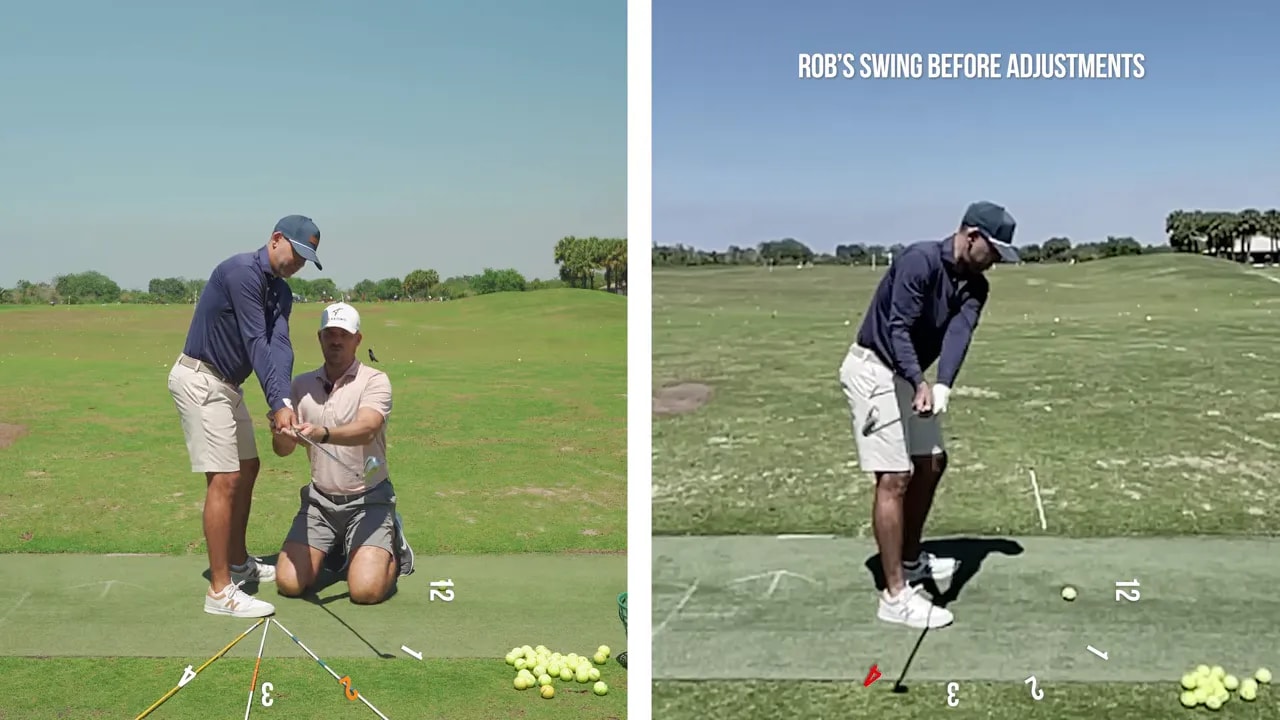
A strong practice structure for this drill is:
- Two rehearsals without a ball
- One practice swing clipping the mat
- Then one shot at reduced speed
This keeps you from rushing into full-speed swings before the movement is stable.
If you want a practical over-the-top golf swing fix, this kind of sequence matters. Mindless ball beating usually reinforces the same old habit.
Step 4: Fix the wrist hinge so the club does not get steep and cupped
The second backswing issue is excessive late wrist hinge. In this lesson, too much hinge at the top is closely tied to a cupped lead wrist.
That matters because added hinge tends to steepen the shaft and make it harder to deliver the club from a neutral path. It also changes face control. If your lead wrist cups too much, the clubface often gets more open, which pairs badly with a leftward path.
The fix is not “no hinge forever.” It is hinge earlier to a reasonable amount, then stop adding more.
A simple reference point is this:
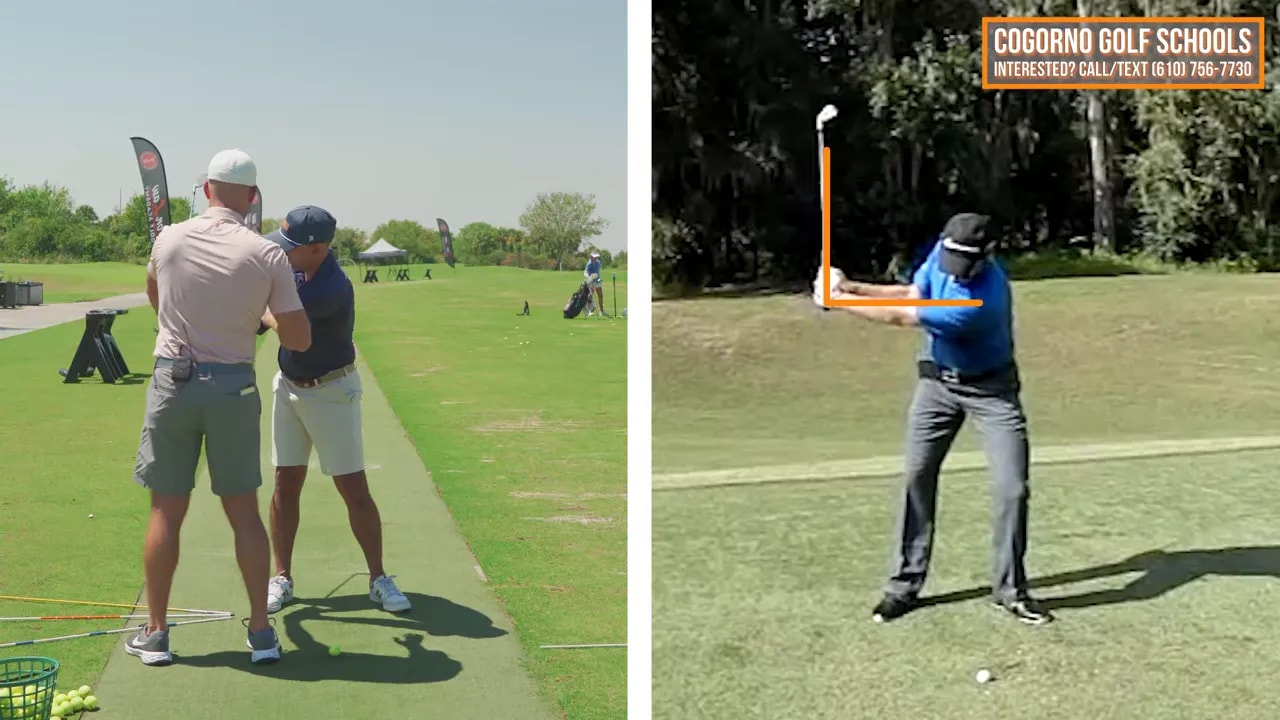
- When the shaft is about parallel to the ground, use a normal amount of hinge
- By left arm parallel, the shaft and lead arm should form roughly a 90-degree angle
- From there to the top, keep that angle feeling wide rather than adding extra hinge
The feeling for this player was dramatic. Once the club reached a certain point in the backswing, he was asked to feel like that was almost all the wrist hinge he would have.
Again, this should feel extreme at first. But on video, it looked normal. That is exactly what you want.
Feel exaggerated, look perfect.
That phrase is one of the best checkpoints you can use when changing your swing. If the move feels tiny, it probably is tiny. If it feels dramatic and looks neutral, you are usually in the right zone.
Step 5: Blend swing plane and wrist hinge into one simple backswing feel
Once the two backswing pieces are understood separately, they can be blended together.
The combined feel is:
- Out with the club
- Wide with the wrists
- Then let it work down under in transition
Another way to describe it is this:
- The clubhead feels farther away from your shoulder in the backswing
- The wrists feel less “snappy” or hinge-heavy late
- The transition feels like a soft loop back into the slot
This is not a quick cosmetic tweak. It is the kind of movement pattern that may need months of repetition. In the lesson, it is framed as something worth working on for a long stretch, not a single range session.
That is a useful reminder. A true over-the-top golf swing fix is usually about replacing your stock motor pattern, not finding one magic thought for a day.
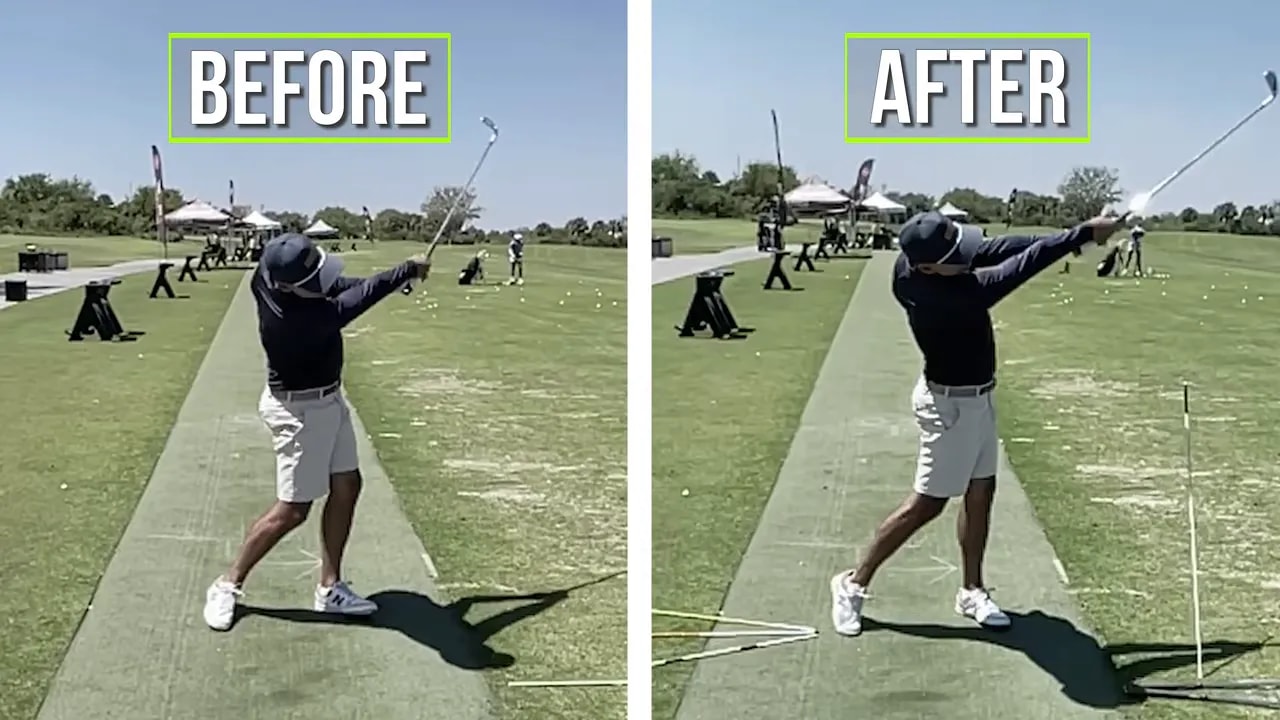
Step 6: Fix what happens through the ball, not just before it
Many golfers stop their analysis at the top of the backswing. But impact and follow-through patterns often reveal what your body is trying to do to save the shot.
In this case, the through-swing showed several problems:
- The golfer stayed in too much flexion
- The hips worked down and back instead of up and forward
- The right foot stayed back
- The hands worked left too early
That pattern makes it difficult to extend through the strike. It also encourages a leftward path and weak face delivery.
The better model is the opposite:
- Arms, hands, and club moving higher and more to the right
- Belt buckle and hips moving up and forward
- Clubface closing enough to stabilize the strike
This does not mean you should flip your hands or wildly throw the club out to right field. It means your post-impact motion should no longer collapse left with a stalled body.

Step 7: Practice the through-ball drill from a mini-swing position
To train the through-swing correctly, the lesson uses a partial-motion drill starting from a shortened delivery position.
The setup is simple:
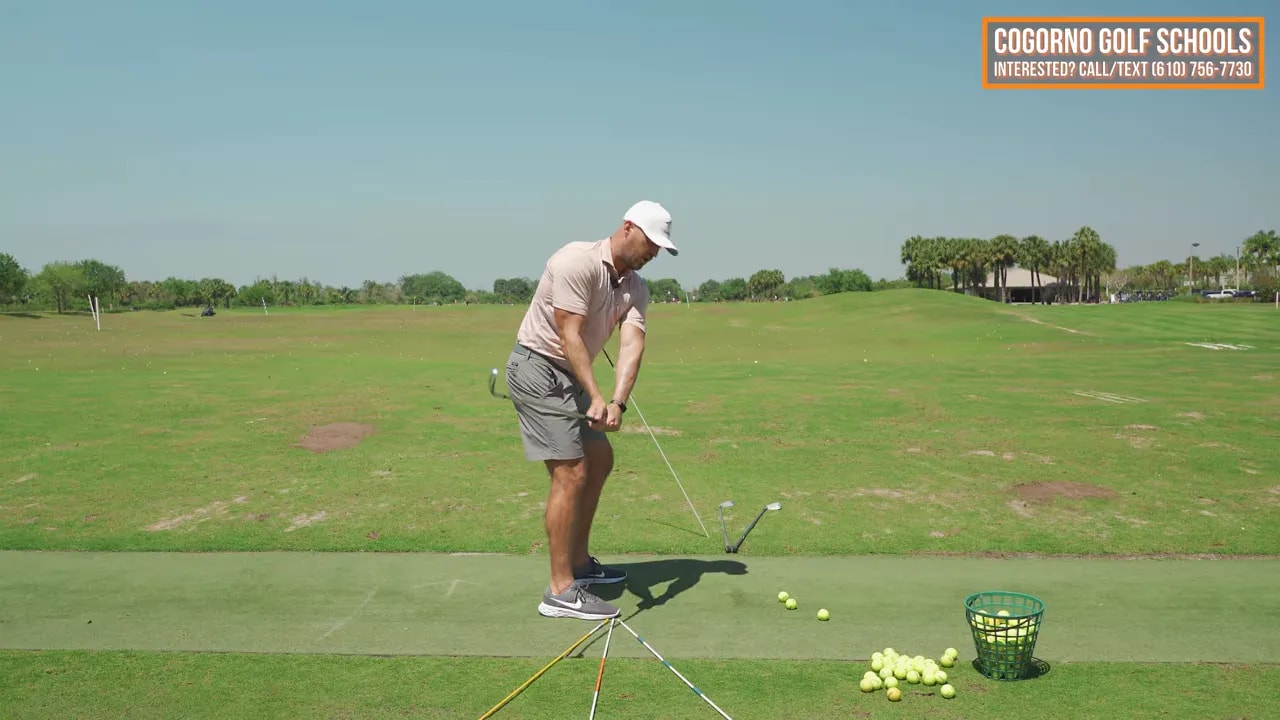
- Start with the club around a 4 o’clock delivery position
- From there, swing through and clip the mat
- Feel the arms, hands, and club working high and to the right
- Push the hips up and forward
- Allow the face to close a little
The checkpoints matter:
- Your hands should feel more to the right than normal
- Your club shaft should also work more to the right
- The toe should feel slightly more in front of the heel, showing some face closure
- Your hips should be extending, not sitting down and back
That may sound like a lot, but the purpose is clear. You are teaching your body a completely different exit pattern after impact. When the club no longer gets dragged left immediately, contact and curvature can improve quickly.
In the lesson, this change also improved strike height. The golfer noted that he could not remember hitting an 8-iron that high. That is a strong clue that the motion created a cleaner, more compressed strike with better loft delivery.
Step 8: Build your 30-day practice routine the right way
The most useful part of this lesson may be the practice structure. The instruction is not “here are three things, go figure it out.” It is a clear process for building new movement over time.
Here is the suggested approach:
Backswing drill
- Rehearse the takeaway: out over two
- Rehearse the transition: down over four
- Add the reduced wrist hinge feel
- Make slow swings brushing the ground
Through-ball drill
- Start from a shortened downswing position
- Clip the mat
- Feel arms and hands going high and right
- Push hips up and forward
- Let the face close a little
Weekly structure
- 20 to 30 reps of each drill
- 2 to 3 practice sessions per week
- Begin short and slow
- Add speed only when the movement is repeatable
This is how swing changes actually stick. You rehearse the move, confirm it with feedback, and slowly add ball flight pressure.
Trying to change everything at full speed with a bucket of balls usually leads to confusion. Slow, disciplined reps compound. That is especially true for an over-the-top golf swing fix, because old patterns tend to return the moment you swing hard.
Step 9: Use feedback so your feels stay honest
One more important idea runs through the entire lesson: you need feedback.
That can come from:
- Video from down the line
- Face-on video
- A coach
- Alignment sticks and reference lines
Without feedback, you may think you are exaggerating when you are barely changing anything. Or worse, you may overdo the wrong move.
Useful signs that your practice is headed in the right direction include:
- The takeaway looks more on plane
- The shaft is less steep at the top
- The lead wrist looks flatter
- Your finish has more extension
- Your weight gets off the back foot more naturally
- Ball flight starts straighter and higher
That last one is especially encouraging. Better motion tends to produce better contact quickly, even before the swing is fully rebuilt.
Step 10: Focus on the first broken link, not every swing flaw at once
There is a subtle coaching point here that can save you months of frustration. Even though several issues were addressed, the lesson makes it clear that this was a long-term roadmap, not a recommendation to pile everything into one practice session.
In most cases, you should work on one main thing at a time. For this golfer, the lesson identified the top priorities for a much longer improvement window.
That is a smart model for your own game. If your swing has multiple problems, ask:
- What is the first broken link?
- What exaggeration reverses it?
- What drill lets me practice it slowly?
- What feedback proves I am doing it correctly?
That framework is far more powerful than searching for random tips.
FAQ
What is the fastest way to start an over-the-top golf swing fix?
Start by checking your takeaway. If the club gets too far inside early, feel like the clubhead works more “out over two” in the backswing. Rehearse that slowly before hitting balls. For many golfers, that is the first broken link in the chain.
Why do I hit pulls and fades with the same swing?
That usually means your swing path is traveling too far left. When the face is square to that leftward path, you pull it. When the face is open relative to that path, you hit a fade or weak slice-type shot.
How much wrist hinge is too much in the backswing?
If you keep adding hinge late in the backswing, especially after reaching a solid 90-degree relationship between the lead arm and shaft, you may steepen the club and cup the lead wrist too much. The better feel is often to set the hinge and then stop adding more.
What does “feel exaggerated, look perfect” mean in golf practice?
It means the correct swing change usually feels much bigger than it appears. If you are trying to move from a flawed position to a neutral one, the proper correction may feel extreme while video shows it looks normal.
How should I practice these drills during the month?
Use 20 to 30 slow reps of each drill, two to three times per week. Start with rehearsals and practice swings, then add balls at reduced speed. Increase speed only when the movement pattern becomes more consistent.
What should the follow-through feel like in this over-the-top golf swing fix?
Your arms, hands, and club should feel higher and more to the right through the ball, while your hips push up and forward. That helps replace the common pattern of hands working left too early with the hips staying down and back.
Final takeaway
A reliable over-the-top golf swing fix is not about swinging harder, making your grip stronger, or chasing a perfect top position in isolation. It is about changing the motion that creates your ball flight.
If your club works too far inside early, over-hinges late, then cuts left through impact, the fix is to reverse that pattern with clear training feels:
- Out over two, down over four
- Reduce late wrist hinge
- Get the arms, hands, and club high and right through impact
- Push the hips up and forward
Practice those moves slowly, use feedback, and give the change enough time to settle in. When you do, the improvement can show up fast in strike quality, launch, and overall consistency.
For more help building your own over-the-top golf swing fix, explore additional instruction from Eric Cogorno Golf and keep using video feedback to match your feels to reality.
0 Comments