
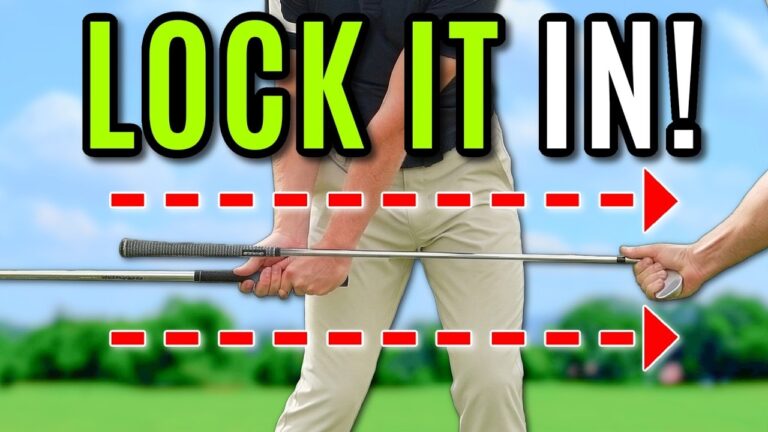

If you struggle with inconsistent contact, distance loss, or shots that start out of sync, the fix is often simpler than you think. The most common cause is not “not enough power.” It is usually a timing problem at impact: your hands get behind the club head, your club face closes the wrong way, and you end up hitting with the wrong wrist and forearm position.
This guide focuses on one practical idea: training your wrist-forward position through impact, using a simple at-home drill with your phone. The goal is a repeatable feel that leads to better shaft lean and a club face that squares without a scramble.
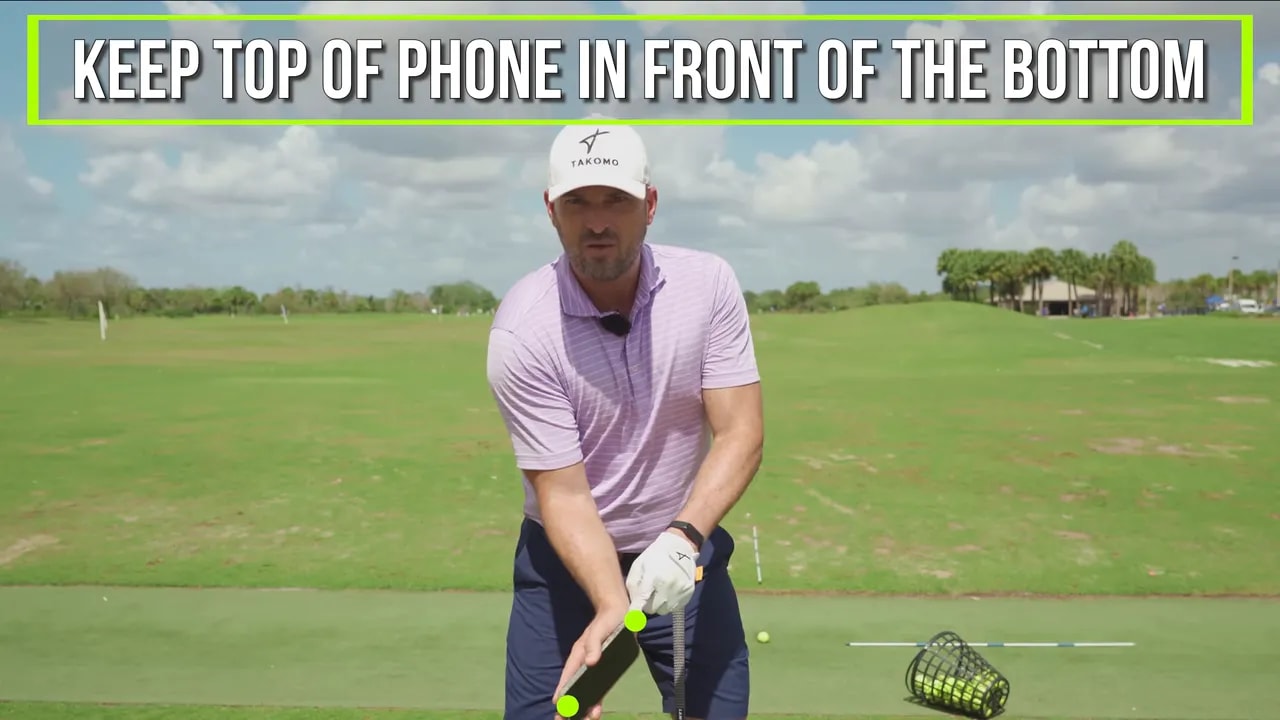
Table of Contents
- Step 1: Understand the wrist vs. fingers secret (and what goes wrong)
- Step 2: Use the iPhone drill to train “wrist-forward” impact
- Step 3: Train Step 1 feel with your trail hand only (focus keyphrase: wrist-forward through impact)
- Step 4: Fix the club face side with forearm rotation (phone screen cue)
- Step 5: Add lead hand feel (focus keyphrase: wrist-forward through impact)
- Step 6: Use real-time feedback with an AI shaft lean coach
- Step 7: Understand the full motion (it still requires body rotation)
- Step 8: The “twist the toe, keep hands ahead” finishing cue
- Step 9: Turn the drill into a practice routine
- FAQ
- Embed
- Key takeaway: build shaft lean by keeping the wrist ahead of the fingers
Step 1: Understand the wrist vs. fingers secret (and what goes wrong)
A high-level ball striker controls impact by keeping the wrist ahead of the fingers, not the other way around. When you “flip” the club face closed with your fingers ahead of your wrist, your hands often drift behind the club head. That produces inconsistent contact and poor strike quality.
Here is the contrast to feel:
- Good ball strikers: twist the club face closed while keeping hands ahead of the club head. Their wrist stays forward.
- Poor ball strikers: flip the club face closed, and the hands go behind the club head. That often shows up as contact inconsistencies and poor timing.
A key outcome of the good pattern is real shaft lean through impact. Without that, it becomes much harder to compress the ball consistently and get the strike quality you want.
Step 2: Use the iPhone drill to train “wrist-forward” impact
This drill uses one object you already have: your phone. You are training the relationship between two parts:
- Top of the phone and bottom of the phone
- How that changes as your trail hand and then lead hand move through impact
Set up the phone:
- Flip your phone upside down.
- Place it so the bottom (where you talk) is near your fingers.
- Keep the top of the phone above toward your wrist.
Core rule: through the downswing and into impact, you want to keep the top part of the phone in front of the bottom part.
When you do it well, you should also notice the phone’s screen pointing slightly down (not up).
If you do it poorly, you will feel the opposite: the bottom part of the phone comes forward, and the phone screen points more toward you. That is the version associated with hands behind the club head and the common flipping problem.
Step 3: Train Step 1 feel with your trail hand only (focus keyphrase: wrist-forward through impact)
Start simple. You will first build the feel with your trail hand alone. This is where many players need the most help.
How to swing:
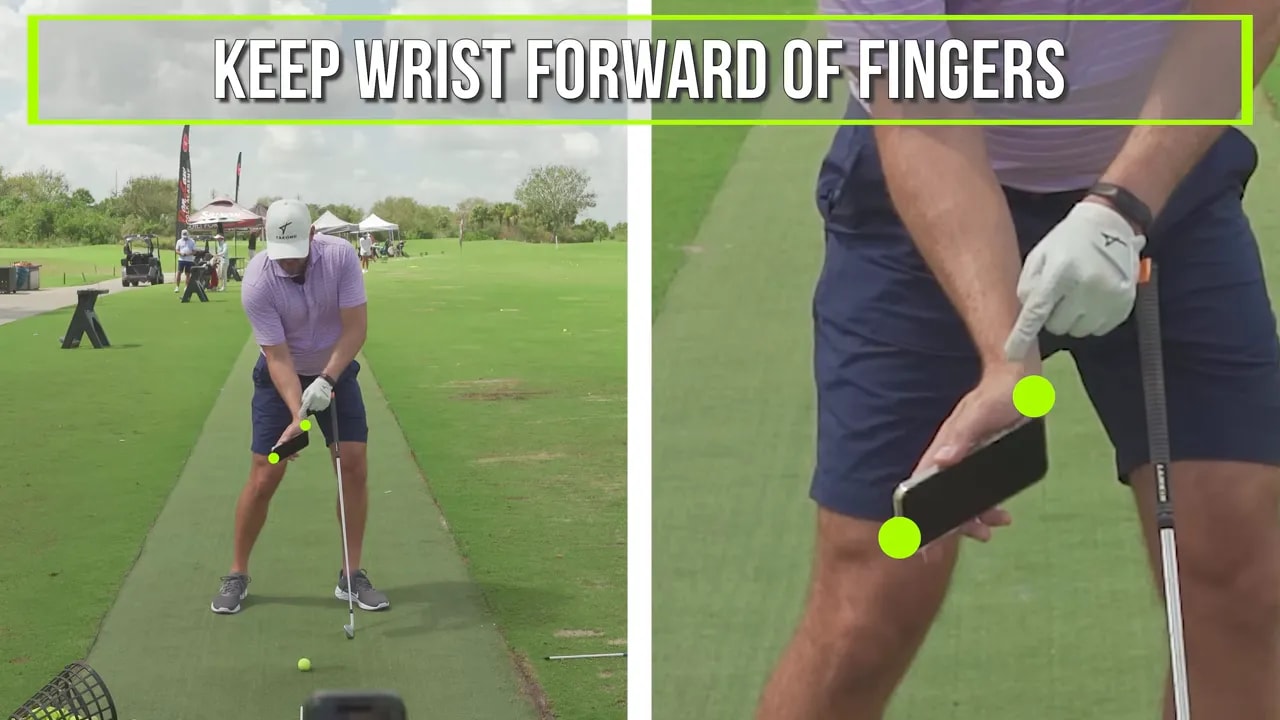
- Grab the phone in your trail hand the upside-down way.
- Make a couple controlled swings.
- As you move through your impact position, make sure the top of the phone stays in front of the bottom.
What this trains: the forward wrist position that helps you create shaft lean. In elite mechanics, the hands are able to get inside the left thigh (as an example cue used for ball strikers like Adam Scott). Even if you never copy the exact same geometry, you can copy the hand and wrist relationship that makes shaft lean possible.
To get that kind of impact, you generally need:
- Wrist in front of the fingers
- A little bend in the trail wrist/arm position
Step 4: Fix the club face side with forearm rotation (phone screen cue)
Training wrist-forward alone is not enough. You must pair it with club face control. The phone gives you a second cue that relates to rotation.
In the correct pattern:
- You keep the top of the phone in front of the bottom.
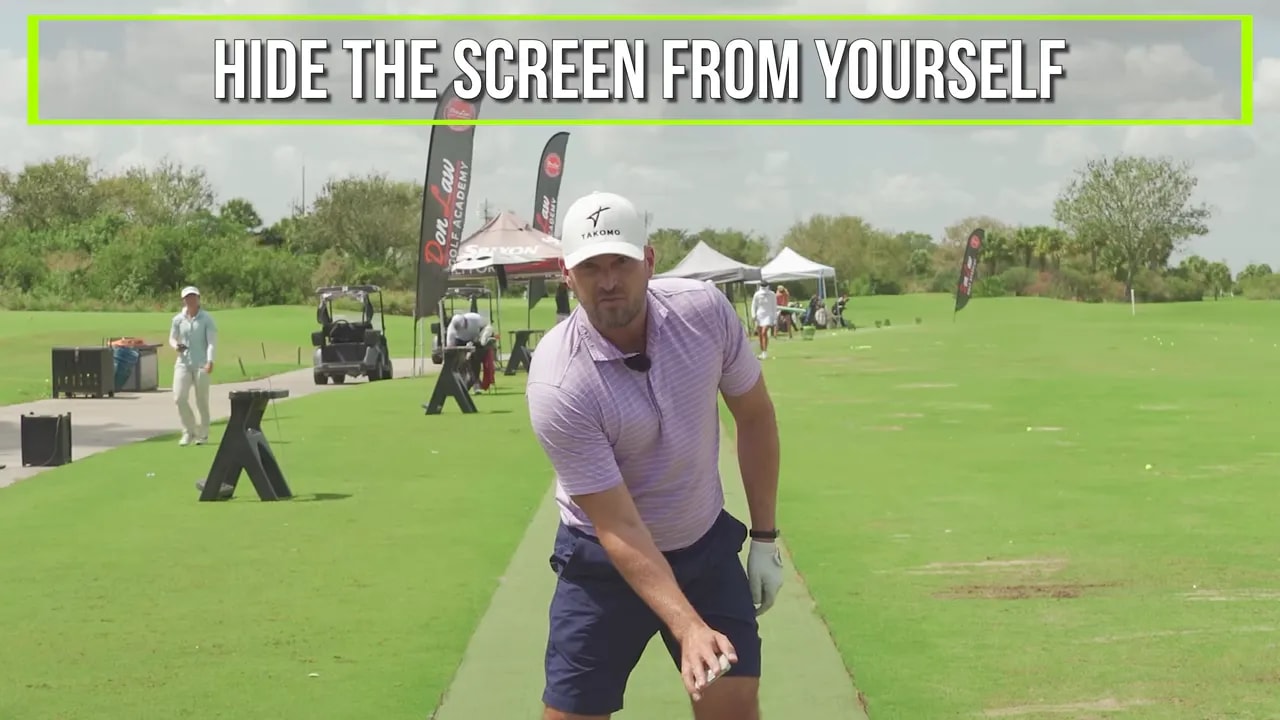
- You have a small amount of forearm rotation so the screen points away and appears less visible.
- You want the screen hidden rather than staring up at you.
Why the “screen hidden” cue matters: if you can see the entire screen when you pass through, that is a sign you are likely flipping or rolling the wrong way. That typically makes it harder to square the club face at impact.
Step 5: Add lead hand feel (focus keyphrase: wrist-forward through impact)
Once the trail-hand version makes sense, you can practice the same idea with your lead hand. This helps you integrate what “wrist-forward” feels like from the other side.
Lead hand phone setup: use the phone the same upside-down way.
What to feel at impact:
- The top part of the wrist stays in front of the knuckles (the concept is exaggerated on purpose so you can learn it).
- The phone screen points down toward the ground.
- You maintain the phone relationship: top of phone in front of bottom.
This is also why the drill often works well for golfers who are afraid of “using their hands.” You are not trying to throw the club at the ball. You are training a specific wrist-forward and forearm-rotation relationship that leads to better club face delivery.
Step 6: Use real-time feedback with an AI shaft lean coach
Feedback is a major challenge in practice. Many golfers rehearse flaws without knowing they did it wrong. The common result is “repeating the problem perfectly,” which stalls improvement.
To make this drill more effective, use an AI-driven training app that can measure and report shaft lean. The idea is simple: you swing, the app detects your impact position, and you get immediate audio feedback on whether your shaft lean is in a better range or off by too much.
The app discussed in this training is called Swing Coach, and it is described as detecting the real root cause of swing faults and giving instant feedback after every swing.

How to use it with the phone drill:
- Do a few swings while maintaining the wrist-forward feel: top of phone in front of bottom.
- When you strike the ball, compare what you felt to what the app reports.
- Use the feedback to adjust the intensity of wrist-forward and forearm rotation.
This helps you stop guessing and builds consistency faster.
Step 7: Understand the full motion (it still requires body rotation)
One common misunderstanding is thinking you can “force” the hands forward forever. That is not the goal.
In a correct swing, your body rotation still drives the shot. Your job is to maintain the wrist-forward position while the club and hands move naturally through the arc.
The drill should feel like a coordinated motion, not a hand shove:
- Keep the wrist forward
- Allow forearm rotation that squares the club face
- Let the body turn so the hands still move left through impact (you are not “locking” your hands on the target line)
If you worry about striking the ball on the heel when you push the hands forward, that can happen when you overdo the wrong motion. The key is not to throw the club toward a static position. It is to train twist the club face closed while keeping hands ahead, progressively.
Step 8: The “twist the toe, keep hands ahead” finishing cue
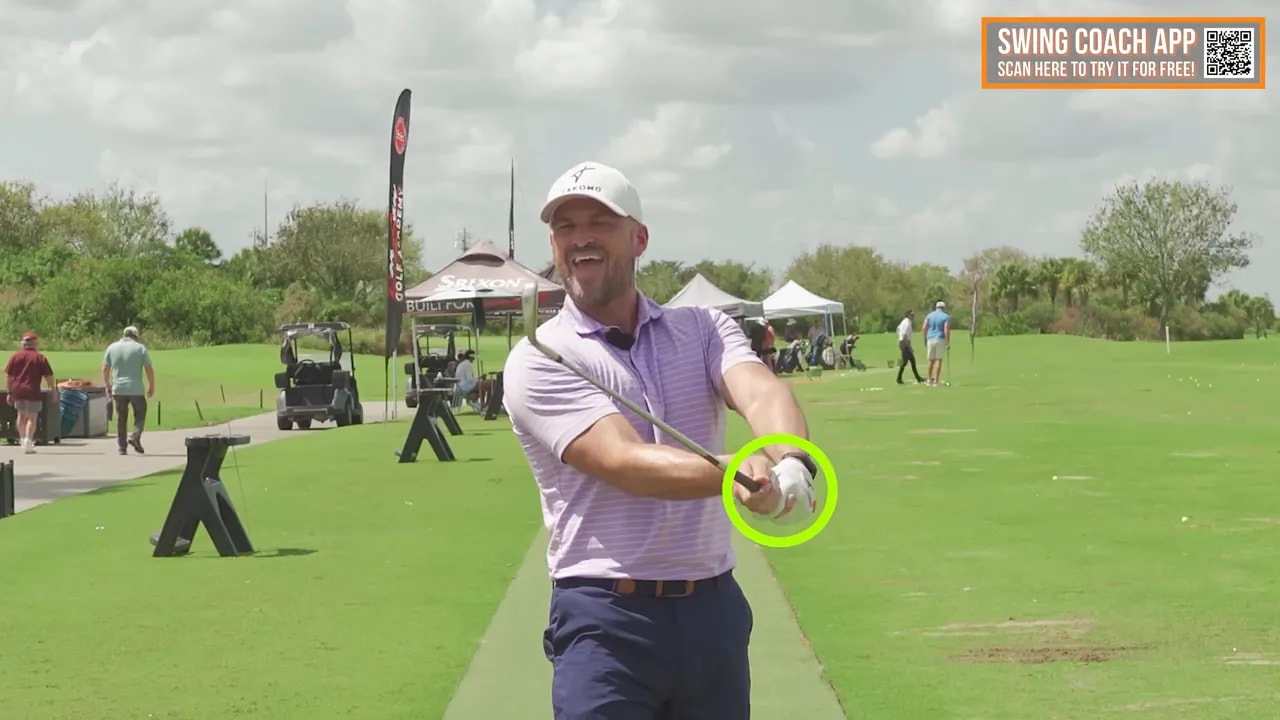
Another way to summarize the action is this: good players twist the toe closed in front of the heel while their hands stay ahead of the club head. That twist is part of why you can square the club face without flipping.
Mechanics to look for in your feel:
- Right wrist bent back slightly (trail wrist position)
- Wrist still forward of fingers
- Club face closing as hands stay ahead, not as the club head outruns the hands
What to avoid: if the club head gets in front of your hands and the face is already open or you “toss” it to square, you are likely moving into the inconsistent flipping zone. Instead, you want progressive closure while the hands lead.
Returning to the phone cue helps here: as your fingers get in front of your wrist, the phone screen coming into view is usually your warning signal that you are drifting into the bad version.
Step 9: Turn the drill into a practice routine
You can use this drill anywhere because it does not require a special training aid beyond your phone. Here is a simple structure that matches the training logic:
-
Phone-only rehearsal (2 to 3 minutes):
- Trail hand version: top of phone in front of bottom, screen slightly down
- Lead hand version: top of wrist in front of knuckles, screen down toward ground
-
Dry swings (1 to 2 minutes):
- Use your feel as you swing without a ball
- Focus on forearm rotation that hides the screen
-
Range shots (10 to 20 minutes):
- Hit a few shots while keeping “wrist-forward through impact” as the primary intent
- Use a feedback tool if available to confirm shaft lean trends
As you improve, you can dial the intensity down. The training includes exaggeration at first because it creates a clear sensation. Overdoing the feel may produce a draw or leftward start, and that is often a sign you are training the correct pattern too aggressively. The fix is to reduce volume while keeping the same relationship.
FAQ
What does “wrist-forward through impact” actually mean?
It means your wrist stays ahead of your fingers as you pass impact. When you flip, your fingers often get ahead of your wrist, your hands drift behind the club head, and contact becomes inconsistent. Training the “top of the phone in front of the bottom” relationship is a simple way to ingrain that position.
Is the phone drill only for the trail hand?
No. Start with trail hand feel to build shaft lean through impact. Then switch to the lead hand version to understand the same wrist-forward relationship from the front side and improve club face delivery.
What should I look for with the phone screen cue?
In the preferred motion, the screen points slightly down and becomes less visible as you rotate. If you can see your entire screen as your fingers lead your wrist, that is a common sign you are flipping or squaring the face without the correct wrist and hand-ahead position.
Will this help my distance?
It can. The training is designed to improve shaft lean and strike quality. When the hands do not get behind the club head, you are more likely to compress the ball solidly instead of losing energy through inconsistent contact and add-on loft.
How do I avoid overdoing the wrist feel and hooking the ball?
Treat the phone feel as a relationship, not a shove. If your shots start curving too far left, dial the intensity down while keeping the same core positions: wrist ahead of fingers and forearm rotation that squares the club face without throwing the club head past your hands.
Do I still need body rotation when using this drill?
Yes. The drill helps you manage wrist-forward through impact while your body continues to turn and your hands still arc through left. The goal is coordination, not isolating the hands from the rest of the swing.
Embed
Key takeaway: build shaft lean by keeping the wrist ahead of the fingers
If you remember one idea from this approach, make it this: hitting the ball with your right wrist makes the golf swing so much easier when that wrist-forward position is paired with forearm rotation that squares the club face. The phone drill provides clear, simple feedback by showing whether the top of the phone stays in front of the bottom through impact.
Practice the relationship, use real feedback when possible, and let your body rotation do its job. The result you want is consistent contact, better shaft lean, and club face delivery that feels repeatable swing after swing.
0 Comments