


If your golf drives feel short, inconsistent, or hard work, you are likely losing power before it ever reaches the clubhead. The fix is not another complicated swing change. It is about creating more force under your lead foot and then using that force the right way so you do not just move heavier, you actually move better.
This golf guide breaks down a simple move that helped add distance immediately for one golfer, including the two-part idea behind it: heavier to get lighter, and then push and rotate so the club travels farther.
Table of Contents
- Step 1: Understand why “rotation only” does not create distance
- Step 2: Create “heavier” under your lead foot (force creation)
- Step 3: Turn “heavier” into “lighter” by pushing away
- Step 4: Rehearse the feel: heavier, then left foot moves as you get lighter
- Step 5: Push your toes forward to rotate your hips (speed transfer)
- Step 6: Combine the sequence and compare it to “rotation only”
- Step 7: Apply it in real driver swings (timing without overthinking)
- Optional add-on drill: The “one swing” confidence check
- FAQ
- Bottom line for your next golf driver swing
Step 1: Understand why “rotation only” does not create distance
Most golfers know they need rotation. The body turns back, then turns through. That is true. But rotation by itself can feel like a lot of motion with very little result, especially if you are not pairing it with the right force timing.
To make this visible, hold the club in a way that removes most control. The point is not to copy the exact grip. The point is to see what the clubhead does when you rotate without a powerful push.
Try a quick “motion-only” concept at home:
- Hold the top of the grip lightly with two fingers.
- Keep your other hand behind your back.
- Make a back swing and through swing using only turn back and turn through.
You will likely notice the club does not travel particularly far. There is still rotation, but you are not building the kind of speed that leads to big carry distance.
That leads to the key insight: speed needs force, not just movement.
Step 2: Create “heavier” under your lead foot (force creation)
The core of the distance move is the sequence heavier to get lighter.
Instead of thinking “I move my weight,” you want to think slightly differently: you want to become heavier under your lead foot as you transition into the downswing.
A simple way to visualize it is with two bathroom scales. Imagine you are standing on one scale with your left foot and the other with your right foot.
Example visualization:
- You weigh 100 kilograms.
- Standing perfectly balanced might show 50 kilograms on each scale.
- If you move your weight and lift the right foot, the left scale might read 100 kilograms while the right scale reads 0.
Many golfers already do that. They shift. But the improvement for distance comes from the next level: increasing force relative to your body weight, not merely shifting pressure.
Here is the practical golf takeaway:
- Amateurs tend to be closer to about one times their body weight in force.
- Higher-level players can create roughly two times their body weight in force.
You do not need to copy those exact numbers. But you do need the same goal: make your lead foot feel like it can handle a lot more force as you start down.
Step 3: Turn “heavier” into “lighter” by pushing away
Creating pressure is only half the job. If you get heavier and then just swing your arms, your body does not convert that force into lift-off and speed.
To understand the “get lighter” part, think of jumping. When you push down into the ground, you exert force. For a moment, you become light because you are no longer in as much contact pressure with the ground.
Golf is not a simple jump. The body uses multiple directions of force. But the concept you need from this model is the vertical component: push and momentarily reduce the load as you approach impact.
A useful checkpoint from the coaching approach was this: watch the lead foot during rehearsals. If you are doing it correctly, the left foot can move because you pushed and the ground reaction changes briefly.
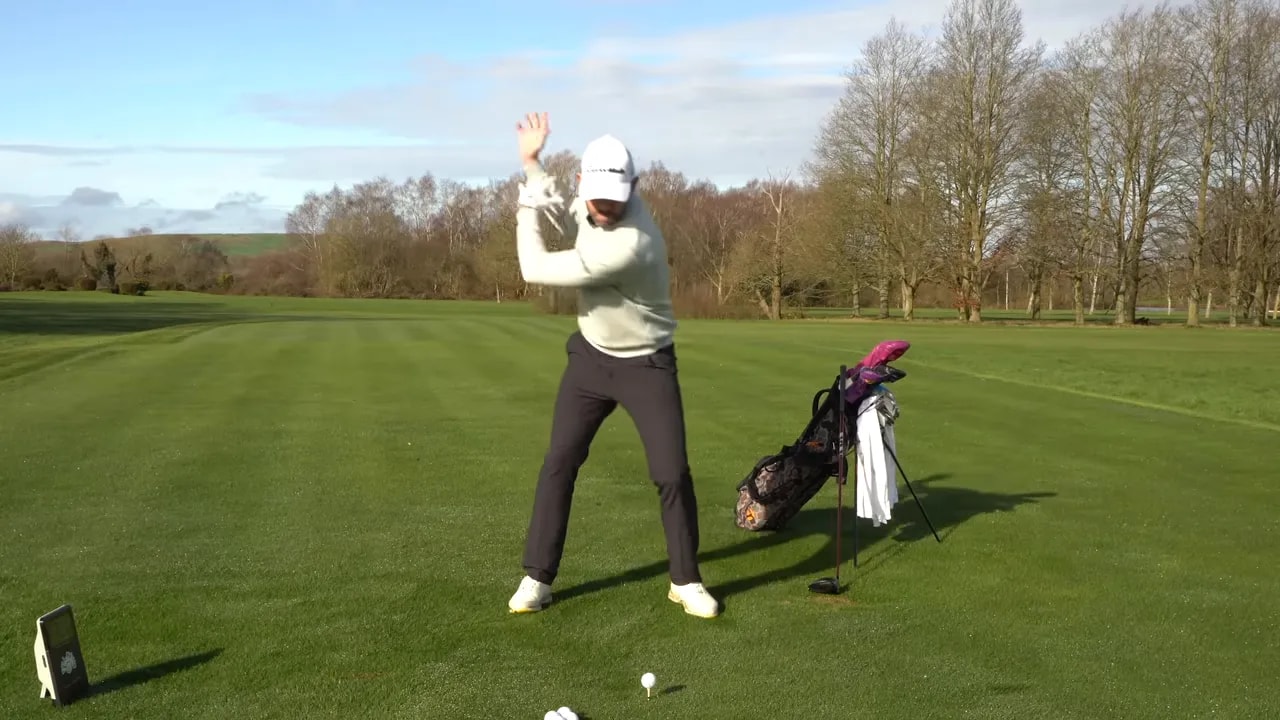
Step 4: Rehearse the feel: heavier, then left foot moves as you get lighter
Do not skip the rehearsal. The whole point is to train the sequence so your brain can repeat it when you swing a driver.
Use this simple plan for practice swings:
- Get heavier under your lead side at the start down. Feel like the lead foot can handle pressure.
- Then push so you momentarily feel lighter as you progress toward impact.
- Look at your left foot. In the coached drill, the left foot movement was a sign you were actually pushing and converting pressure into motion.
During coaching, the “rehearsal” was broken down so the golfer could feel the transition without needing complicated timing cues. The simplest summary of the method was:
- heavier to get lighter
- push
- move through
When your left foot “goes along for the ride,” you are training the correct conversion of force into motion rather than staying stuck under pressure.
Step 5: Push your toes forward to rotate your hips (speed transfer)
Now you add the missing piece that turns force into clubhead speed: rotation created by what you push into the ground.
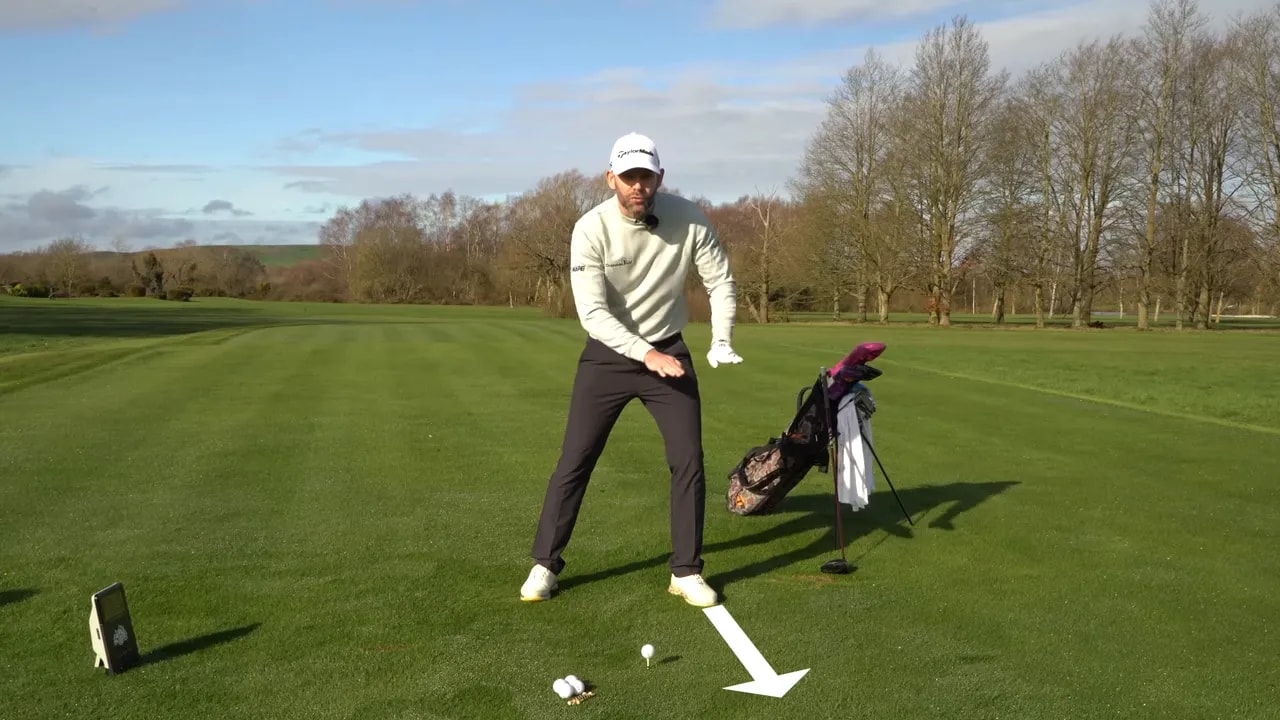
The coaching cue was to focus on the inside of your lead shoe and imagine pushing up and forward so much that it helps rotate your hips.
Try this as a dry-land feel:
- Keep your attention on your lead foot.
- Try to push your toes toward the front of your shoe.
- As you push, notice what happens to your left leg and hips.
When done correctly, your left leg straightens as you push away from the ground (your “getting lighter” moment). At the same time, pushing forward through the toes encourages hip rotation.
This matters because distance comes from speed. But speed needs the correct chain: push force and then rotation so the body can open up and create speed into the clubhead.
Step 6: Combine the sequence and compare it to “rotation only”
Once you practice the two-part movement, you can connect it back to the earlier “rotation only” concept.
Here is what changes when you add force and use it:
- Rotation only: you turn back and through, but the club does not travel far and speed does not appear.
- Rotation plus force plus push: you still rotate, but now you also create a push-away moment that changes how the club travels.
In the coached example, the club traveled much further once the sequence was included.
That is the point. The goal is not to invent a new swing path. The goal is to change what your body does during the downswing so energy actually reaches the club.
Step 7: Apply it in real driver swings (timing without overthinking)
The distance move also addresses a common amateur pattern: getting onto the lead side late and then jumping early.
When that happens, you tend to:
- move to the lead side late
- create less force
- jump sooner
- use energy too soon
The rehearsal sequence teaches you to do the opposite: get into the lead side for longer, then push later so the body converts pressure into speed right through the moment that matters.
One simple way to apply it next time you hit golf driver:
- As you transition, feel your lead foot is ready to get heavier.
- Do not rush to jump. Stay grounded slightly longer.
- As you start through, feel like you push the toes forward and the hips rotate from that push.
You are effectively pairing “heavier” with “lighter” and then using the lighter, rotated moment to accelerate the clubhead.
Optional add-on drill: The “one swing” confidence check
The title of the method implies speed can show up quickly, but it only happens when you do the sequence rather than guessing at your swing.
Use this quick check during a warm-up:
- Make a smooth downswing feel that includes heavier to get lighter.
- Focus on pushing the toes forward and letting the hips rotate.
- After the swing, note the strike and ball flight, not just the distance.
If you feel yourself rushing the jump or shifting without push, reset and exaggerate the “push later” feel with another rehearsal swing.
FAQ
How does “heavier to get lighter” help golf distance?
It helps because it trains your body to create force under the lead foot and then convert that force into speed. Getting heavier sets up the pressure. Pushing away and feeling lighter helps you deliver that energy at the right time into the clubhead.
Is this just another rotation drill?
No. Rotation is necessary, but rotation by itself can lead to limited clubhead travel. The key difference is pairing rotation with a push that creates force and a moment of lightness.
What should my lead foot do during the downswing?
During good execution, your lead foot can move as you push and momentarily reduce ground pressure. In the coached rehearsal, that left foot movement was a sign you were doing “push and get lighter,” not just staying heavy.
How do I feel the “push my toes through my shoe” cue without forcing my body?
Keep it as a feel, not a literal action. Imagine pushing your toes forward and into the ground so it encourages hip rotation. If you feel you are collapsing or losing balance, reduce the intensity and focus on smooth timing.
When will I notice more distance?
Some golfers can notice change quickly when they apply the sequence correctly. The method emphasizes a simple force conversion that should improve clubhead speed. However, it still depends on making the push happen later rather than jumping early.
Bottom line for your next golf driver swing
To gain more distance in golf, stop trying to manufacture speed with rotation alone. Instead, focus on two linked actions:
- Heavier under your lead foot to create force
- Push to get lighter and let that push encourage hip rotation
If you do that sequence, you give the clubhead a reason to travel farther. And more importantly, you build a repeatable way to drive that does not rely on hours of complicated practice.
0 Comments