
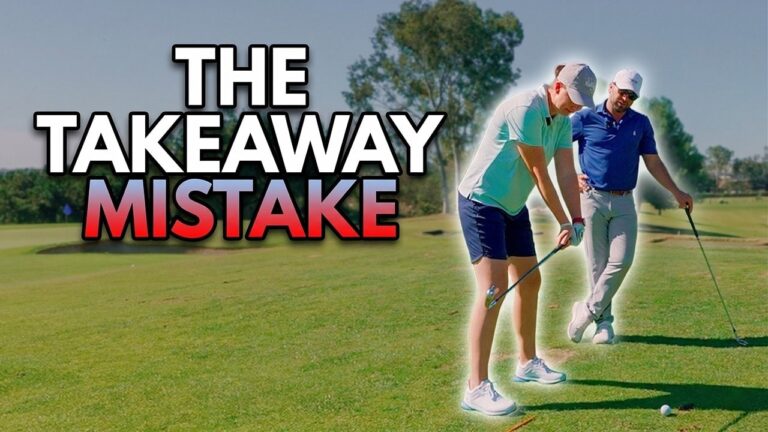

Are your golf shots falling short? The problem often isn’t your equipment or lack of strength. Instead, a common takeaway error might be quietly sabotaging your distance. This guide will uncover the underlying mistakes and provide practical drills to correct them, setting you on a course for improved impact and optimal distance.
What the Takeaway Mistake Actually Does to Your Distance
A flawed takeaway can lead to a problematic downswing, resulting in:
- Heavy or “chunked” contact on irons
- Reduced carry distance despite a solid strike
- Steep delivery due to misaligned club and hands
- Rightward misses with shots veering right
When your takeaway sets your hands and club off course, you must compensate later in your swing, often at the expense of leverage and distance.
Step 1: Identify the Takeaway Pattern that Leads to “Make-up” Swings
Most distance issues in the takeaway arise from hands and club straying off lines as you rotate. This can manifest in:
- Hands drifting outward while the club lags
- Club moving inside too soon during transition
- Late or jammed feeling that prompts flipping through impact
Many believe keeping the club outside early maintains plane. However, this often causes unintended effects like heavy contact or rightward shots.
Step 2: Use a Visual Line to Train Where Your Hands and Club Should Go
To correct the takeaway, you need more than just feel. Implement a line drill to guide your hands and club:
- Place an alignment stick as a clear boundary for your hands.
- Keep hands inside the line through the backswing to avoid outward drift.
- Ensure the club stays in front instead of falling behind.
This setup helps link cause and effect, minimizing corrective moves and promoting consistent, precise contact.
Step 3: Fix the Takeaway by Pairing “Hands Inside” with Proper Hinging
To retain leverage, you must hinge correctly from a stable spot.
- At the swing’s peak, allow natural hinge without forced wrist posture.
- Avoid forced wrist shapes; let body position and club alignment create the hinge.
Misguided focus on wrist bending can introduce new errors. Consistency in positioning is key to letting the hinge develop naturally.
Step 4: Rehearse the “Arrive Here” Checkpoint to Prevent Steepness and Chunks
Takeaway issues often manifest in steep impacts. Rehearse a sequence to ensure correct downswing motion:
- Initiate with hips forward to prevent backward sliding.
- Keep hands low and close to maintain control.
- This positioning enhances club delivery efficiency.
Breaking detrimental patterns can lead to a stable low point and improved contact.
Step 5: Blend the Feel with a Turn that Brings the Swing Back “Down the Line”
Proper takeaway correction involves more than arm positioning. Integrate the following:
- Maintain hand and club alignment along trained lines.
- Avoid getting stuck during transition.
- Guide the club down the target line with body movement.
Securing a proper takeaway sets a stable transition platform to avoid compensating for distance loss.
Step 6: Compare Your Before-and-After Ball Flight and Contact, Not Just Swing Positions
After practicing takeaway improvements, evaluate with these metrics:
- Measure carry distance with consistent stance and conditions.
- Check divot consistency with irons for less random contact.
- Assess directional stability to diagnose takeaway errors.
- Observe shot shape changes for alignment improvements.
Even minor contact enhancements can significantly increase carry distance. Focus on delivery, not just power.
Common Misconceptions to Avoid
Misconception 1: “I need a bowed wrist to hit farther.”
Instead of chasing wrist shapes, focus on consistent positioning that promotes natural hinging.
Misconception 2: “If my hands go outside, that keeps the club out.”
Going hands-out can lead to inward club rotation requiring steep delivery corrections.
Misconception 3: “Takeaway drills do not affect impact.”
Incorrect takeaway lines dictate the necessary downswing compensations.
Pitfalls: Practicing the Fix Without Creating New Problems
- Avoid over-tension: Relax the line drill while maintaining control.
- Integrate with your swing: Scaffold drills into real-time transition.
- Track singular variables: Ensure focus on consistent conditions.
- Use film: Verify with visual references to avoid reverting to old habits.
FAQ
What takeaway mistake most commonly steals distance?
Outward hand movement with inward-club fall forces compensatory motions, reducing distance.
How do I know if my takeaway is causing steepness or chunking?
Heavy irons and inconsistent impact suggest misalignment of hands and club.
Do I need a specific wrist position?
No, focus on stable setup positions for natural hinging.
What drills help correct a faulty takeaway?
Boundary drills and checkpoint rehearsals are effective for maintaining lanes.
How long should improvement take?
Once consistent takeaway alignment and transition are attained, results should follow quickly.
Next Steps Checklist
- Set boundary lines: Maintain hand lane integrity.
- Practice hinge checkpoints: Avoid forced wrist shapes.
- Incorporate turns: Transition with whole body, not arms alone.
- Track progress: Use the same club to measure improvements.
- Make gradual changes: Stabilize patterns before further alterations.
Summary: The Fast Path to More Distance
The takeaway mistake is not about missing power but incorrect early-stage alignment forcing steepness or compensations. Use drills, refine through turning, and assess through practical measures for true distance gains.
If your carry is lacking and contacts are off, adjust hand lanes during takeaway. Correcting this early element typically rejuvenates the swing for improved ball launch and flight.
0 Comments