


Focus keyphrase: prop drill for fairway woods
Fairway woods and hybrids can be frustrating because you often hit one “great one,” then the next swing goes high, low, topped, or flat. The reason is usually not your swing speed. It is contact and loft delivery. If the club does not arrive at the same spot consistently and your fairway wood does not receive enough loft at impact, you will lose distance and launch.
A simple setup-based drill can fix a lot of that quickly: the prop drill for fairway woods. It requires almost no equipment beyond a stake (or post) and a consistent address position. Instead of teaching complicated mechanics, it trains two common swing problems that rob you of both clean contact and proper loft.
Table of Contents
- Step 1: Know what good fairway wood contact requires
- Step 2: Identify the two patterns that usually cause the problem
- Step 3: Set up for the prop drill for fairway woods
- Step 4: Understand what the prop is doing for your swing
- Step 5: Perform the drill correctly (without overcomplicating it)
- Step 6: Expect restriction at first (and learn to trust it)
- Step 7: Use the drill on real ground with your course conditions
- Step 8: Adjust the key feel for different results (contact vs. spin)
- Step 9: Take the prop drill for fairway woods into hybrids and irons
- FAQ
- Quick checklist: your prop drill for fairway woods routine
Step 1: Know what good fairway wood contact requires
To strike fairway woods and hybrids every time, you need two things dialed in:
- Consistent turf contact: the club must land in the same area on the ground. That is what creates repeatable divots and repeatable ball position contact.
- Consistent loft delivery: fairway woods do not have much loft compared to irons. If you do not deliver the right dynamic loft, you will not get the high, soaring flight you are looking for.
When either one breaks down, your ball flight suffers. When both break down at once, you typically see topped shots and weak launches.
Step 2: Identify the two patterns that usually cause the problem
Most golfers struggling with fairway woods show two repeatable patterns.
Pattern 1: Too much side-to-side movement
Fairway woods demand a stable lower body and a steady delivery path. If your body sways too much left and right, your swing plane and impact location drift. That makes it harder to land the club in the same spot, which directly harms contact consistency.
Pattern 2: Excessive twisting on the way down
The second common issue is spinning or twisting too hard on the way down. This does two damaging things:
- It can throw the club “over the top,” changing the path and steepness and increasing the odds of topping.
- It takes loft off the club. If the club comes down in the wrong manner, you lose the dynamic loft needed to launch the ball high.
The fix is not “swing slower” or “try harder.” The fix is learning a setup position that naturally helps you stay centered and deliver the club with the loft you paid for.
Step 3: Set up for the prop drill for fairway woods
The prop drill is designed to make one change at address that improves several swing behaviors automatically. You can practice it on a range or, in many cases, right on the course.
You will need:
- A stake or post you can position in the ground (a real stake works, or a small training post). The goal is to have something your trail leg can “prop” against.
- Your fairway wood or hybrid
- A consistent ball position
Step-by-step setup
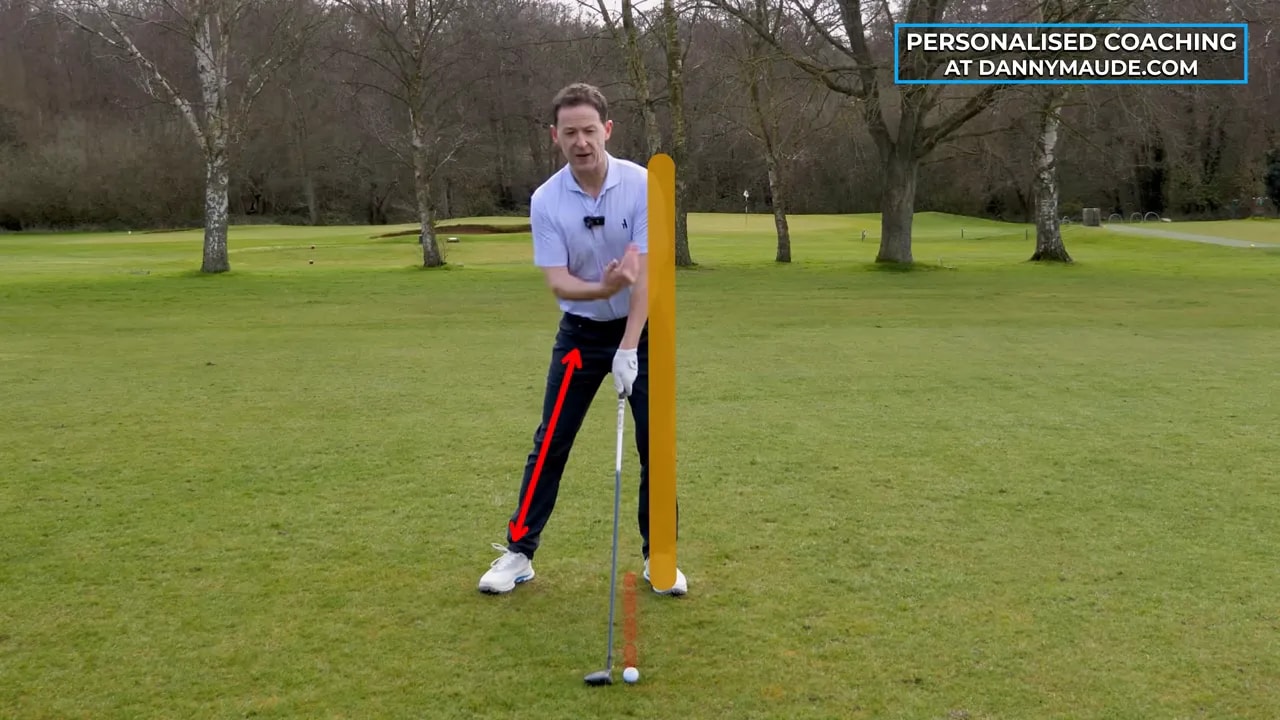
- Place the ball about a club width inside your lead heel.
- Imagine the stake/post is positioned so that your trail leg can prop it up at address and during your backswing.
- Address the ball normally, then focus on your trail leg having the ability to apply pressure to that “prop.”
The drill’s purpose is simple: it teaches you how to stay centered while turning, instead of twisting and spinning yourself into a steep, loft-leaking delivery.
Step 4: Understand what the prop is doing for your swing
The prop drill is effective because it gives you two key benefits at the same time.
Benefit 1: It stops you from swaying and collapsing
If you sway side to side off the ball or your right leg starts to collapse, the prop helps “support” you. It acts like a physical reminder that your lower body needs to stay in the right posture while you move.
As you move back, you should feel your trail leg pushing and propping the right side behind you. That feedback helps you turn around the ball more consistently and prevents drift.
Benefit 2: It helps keep your trail pocket from “spinning over”
Spinning on the way down often causes you to lose loft. It is usually accompanied by the trail side rolling over too soon, which makes it harder for the club to return on the correct arc.
In the drill, your trail leg keeps propping you up so the club can work back on the arc instead of flipping over the top and stealing loft.
That is why the drill is not a gimmick. It is controlling the conditions for a loft-rich delivery.
Step 5: Perform the drill correctly (without overcomplicating it)
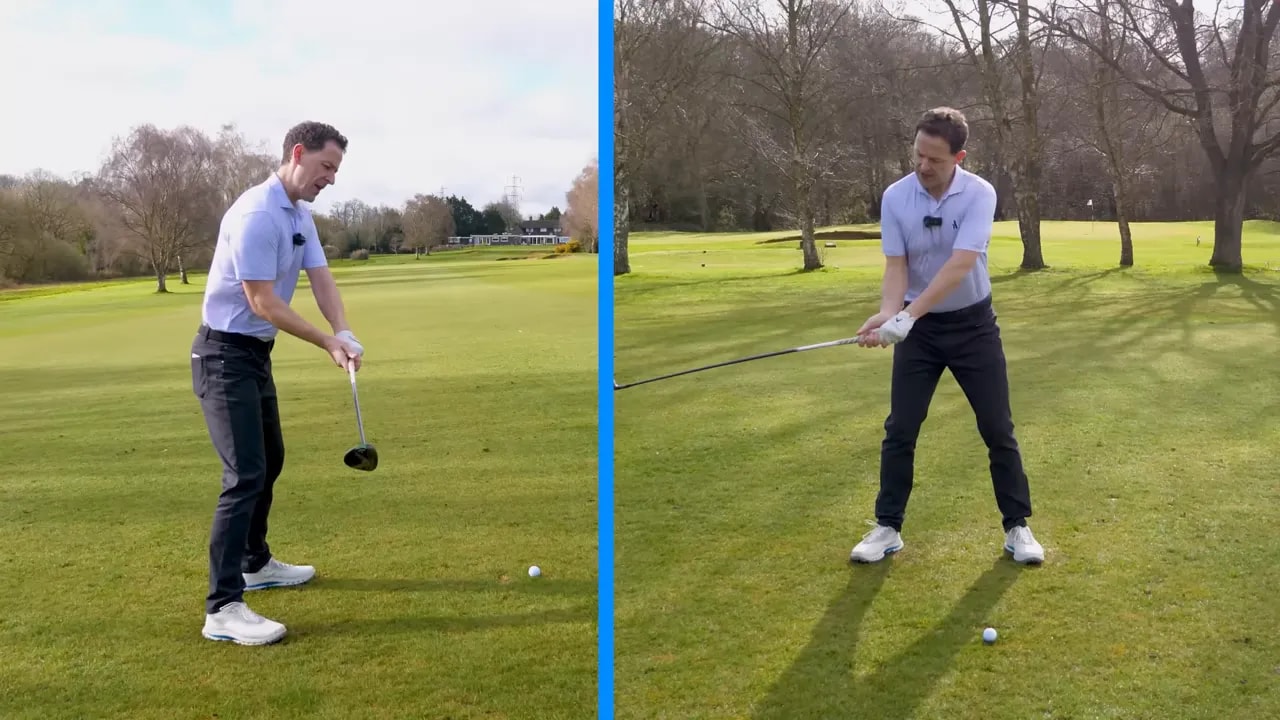
Do not try to “force” the swing. Your job is to hold the feel and let your body do the turning.
Ball and body positioning cues
- Keep the ball position consistent relative to your lead heel.
- Use the trail leg to keep the prop engaged.
- Feel centered as you pivot back.
The impact-focused feel
- As you come down, you should sense that your trail pocket stays back.
- That “kept back” feeling creates space for the club to swing properly and deliver loft.
- Think “prop myself up” as your main swing thought.
When you get it right, the strike often feels clean and “ball first.” That is exactly what you want with fairway woods and hybrids.
Step 6: Expect restriction at first (and learn to trust it)
When you first try the prop drill for fairway woods, it may feel restrictive. That is normal.
A good swing requires correct forces to be delivered to the club. Without restriction, you are more likely to be pulled by the club into the wrong sequence, especially the twisting/spinning pattern.
Restriction is essentially your body controlling the swing better.
One student who struggled at 146 yards with fairway woods used this setup-based drill and increased his yardage dramatically after just one session. The improvement came from better contact and proper loft delivery, not from swinging harder.
Step 7: Use the drill on real ground with your course conditions
Real lies matter. The prop drill helps with swing delivery, but you still need to adjust to the ground height relative to your stance.
For example, if the ball is on ground that is above your feet, it can change how the club interacts with the turf. In that scenario, the correct response is to adjust your setup such as going down the grip slightly (as appropriate for your situation) and then using the prop drill feel to keep your contact consistent.
Use the drill to stabilize your impact, then apply normal course judgment for stance and ball position relative to elevation.
Step 8: Adjust the key feel for different results (contact vs. spin)
If you are still topping or hitting the ball too low:
- Double down on the “prop myself up” feel.
- Focus on keeping your trail pocket back as you rotate through.
- Make sure you are not sliding side to side while maintaining that prop pressure.
If you are hitting the ball with inconsistent contact but the ball flight is generally okay:
- Prioritize landing the club in the same turf spot.
- Keep your ball position consistent (about a club width inside your lead heel as the drill baseline).
- Check for excessive sway. If your lower body is drifting, the drill will feel like it “won’t sit” correctly on the stake.
Step 9: Take the prop drill for fairway woods into hybrids and irons
The same principle applies to other clubs in the same “delivery” category. Hybrids and fairway woods share the same general problem space: limited loft relative to irons and a need for correct dynamic loft at impact.
Because the drill organizes your pivot and helps you prevent the twisting/spinning sequence, it can also be used with:
- Hybrids to improve launch and contact
- Irons to improve strike location and consistency
Once you find a setup feel that creates better ball-first contact, carry it into the next club. Consistency improves fastest when you repeat the same setup-to-impact intentions.
FAQ
What exactly is a “prop drill” for fairway woods?
It is a setup-based drill where you place a stake or post so your trail leg can “prop” against it. That physical support helps you stay centered and reduces excessive twisting/spinning on the way down, improving consistent turf contact and loft delivery.
Where should the ball be positioned for the prop drill?
A common baseline is about a club width inside your lead heel. Keep this consistent while you train the feel of propping yourself and delivering loft.
Will the drill stop me from turning through impact?
No. It may feel restrictive at first, but turning is still part of the motion. The goal is to turn more steadily and more slowly enough to keep the club working on the correct path and with enough loft.
Why does spinning on the way down ruin fairway woods?
Excessive spinning and twisting can throw the club over the top, change the descent angle, and reduce dynamic loft. With fairway woods and hybrids, that loft loss often shows up as thin, topped, or low-launch shots.
Can I use the prop drill for fairway woods on the course?
Yes. The drill is designed to be practical. You can use a stake or post in a controlled area and take the same setup feel directly to your next practice swings or real hole situations.
Does this drill work for hybrids and irons too?
Yes. The same consistency and loft delivery principles apply. If you found it helps fairway woods, try it with hybrids and then consider using it with irons as well for strike consistency.
Quick checklist: your prop drill for fairway woods routine
- Ball position: about a club width inside your lead heel.
- Prop: trail leg supports a stake/post at setup and during the move back.
- Main feel: “prop myself up” and keep your trail pocket back as you come down.
- Goal: consistent impact location and enough loft for high, soaring flights.
- Course adjustment: account for ball elevation relative to your feet, then use the same prop feel.
If you keep the setup consistent and trust the restriction, your fairway wood and hybrid contact should become more repeatable. Distance usually follows as soon as you stop losing loft and start striking the ball the same way swing after swing.
0 Comments