


If pitch shots from 30 to 80 yards feel awkward, you are not alone. This range sits in a no-man’s-land where a full swing feels too big and a chip shot feels too small. Most golfers end up yanking the club, guessing the distance, and creating inconsistent contact. The result is a pitch game that adds unnecessary strokes even when your full swing is solid.
The good news is that better pitch shot consistency is usually not about complex technique. It is about three swing patterns that you can make repeatable. When the body and club behave the same way shot after shot, strike and distance control become far easier.
Below is a step-by-step approach built around what consistent golfers do naturally: a calm stacked setup, a rhythmic delivery for depth control, and a clubface action that works with gravity instead of forcing loft.
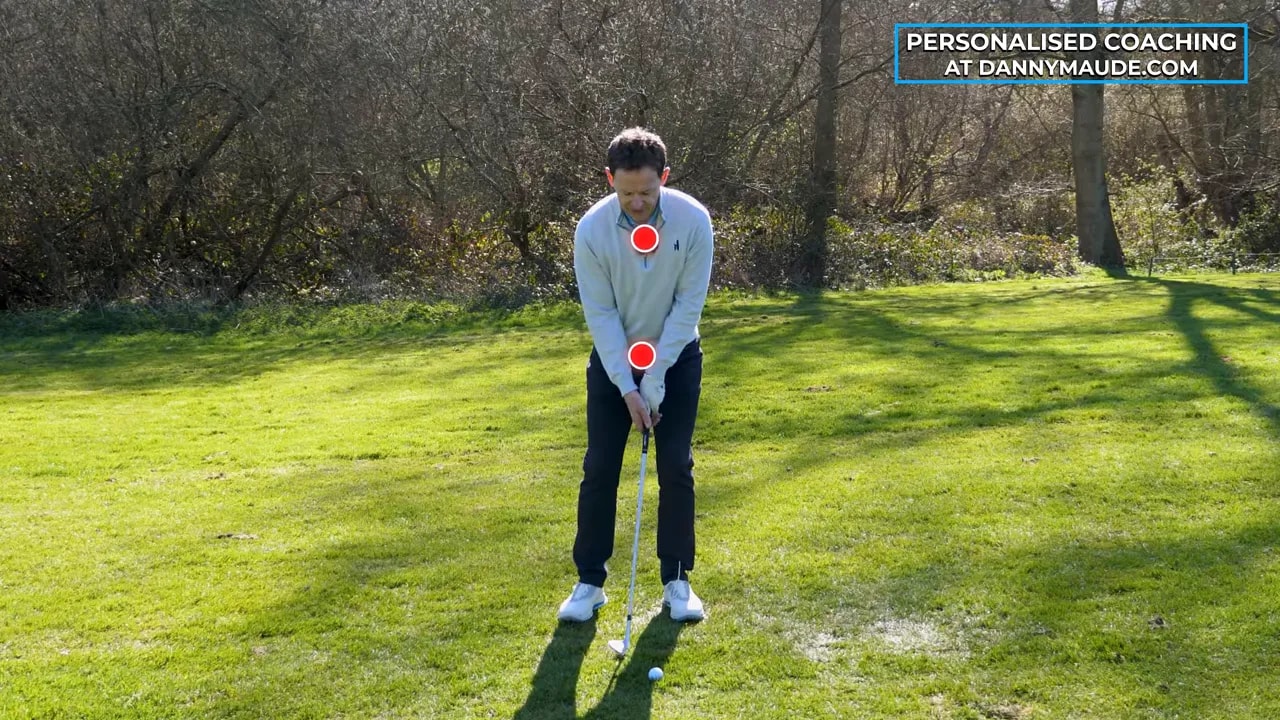
Table of Contents
- What consistent pitching actually looks like (and why it feels effortless)
- Step 1: Stack your body for consistent pitch shot contact (pitch shot consistency)
- Step 2: Use the tick-tock rhythm drill to control depth
- Step 3: The clubface secret (start open, close through impact, take loft off)
- Putting all three together for effortless pitch shots from 30 to 80 yards
- FAQ
What consistent pitching actually looks like (and why it feels effortless)
When you look at good players, their pitch shots often appear smooth and coordinated. They do not feel like they are “jabbing at the ground” one moment and “fattening it” the next. Instead, they deliver the club with calmness, control depth, and allow the motion to blend together.
The underlying goal is simple: you want to control both:
- Strike (where the club contacts the ground and ball)
- Distance (how far the ball carries based on contact and launch)
To get there, you will build three things in order:
- Step 1: Stack your body for consistent pitch shot contact
- Step 2: Use a tick-tock rhythm drill to control depth
- Step 3: Let the clubface close naturally by “taking loft off” instead of trying to lift
Step 1: Stack your body for consistent pitch shot contact (pitch shot consistency)
Start by creating calmness and stillness in your motion. The first key pattern is that your lower body and upper body stay stacked on top of each other for most of the swing. That stacked relationship helps you avoid the chaos that comes from reaching, throwing, or re-routing your hands to save a bad path.
For pitch shots at this awkward distance (often 40 to 50 yards, and broadly 30 to 80 yards), that calm delivery is especially important because you do not have room to “fix it” mid-swing.
What to do at setup
- Position the club so your ball and feet can support a controlled delivery.
- Keep your bodies close together in a stacked alignment. One simple reference: the stance can be about two club widths apart.
- Ball position can change for trajectory, but the key remains stacking (example: slightly forward for a higher shot, slightly back for a lower shot).
What to do through the swing
As you swing, you want to feel like you maintain that stack from setup through impact. Do not let the lower body slide away and do not let the upper body “run ahead.”
Golfers who slice and golfers who hook often fight the same issue from different directions. The body stack helps you reduce that fight.
How the stack idea changes for slicers
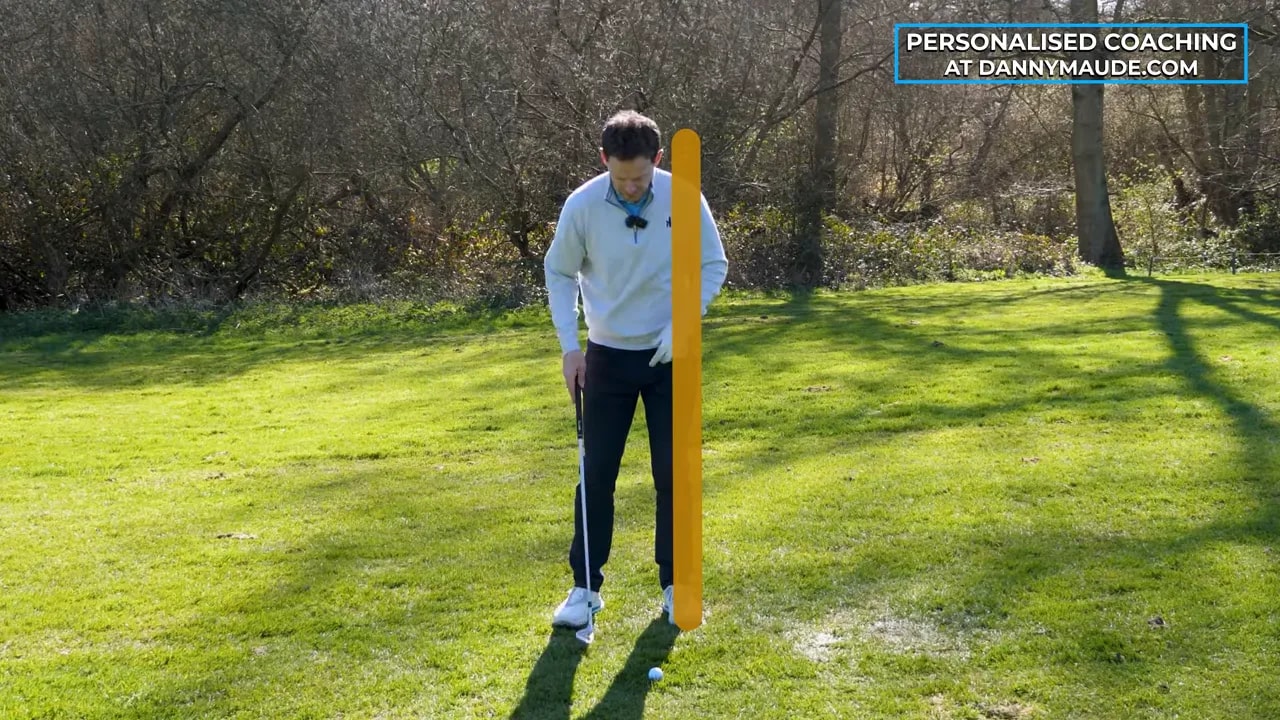
If you tend to slice, you often see an “opposite” problem: your lower body and upper body separate in a way that makes you reach for the clubface with your arms. Instead of trying to muscle the shot into control, your job is to be aware of where your bodies are in space and keep them stacked.
A helpful drill concept from a coached example was to imagine your lead side as a stake in the ground. The idea is to keep your lower body supporting under your upper body so you do not create a jabby, inconsistent strike.
One method described was using the trail foot to “prop” that stake upward so the lower body stays under the upper body. That can feel restricted at first, but the payoff is a smoother, more consistent landing of the club where you want it.
Stop and check: After implementing Step 1, your pitch shots should start to feel more repeatable before you even worry about exact distance.
Step 2: Use the tick-tock rhythm drill to control depth
Even if your body stack is correct, inconsistent pitching often comes from a motion that is too jerky or too “downward.” Depth (how shallow or deep the club lands) strongly influences both contact and distance control.
That is where rhythm comes in. Rhythm creates a consistent pattern of motion. It replaces timing chaos with a repeatable delivery.
The core idea: tick, tick, talk
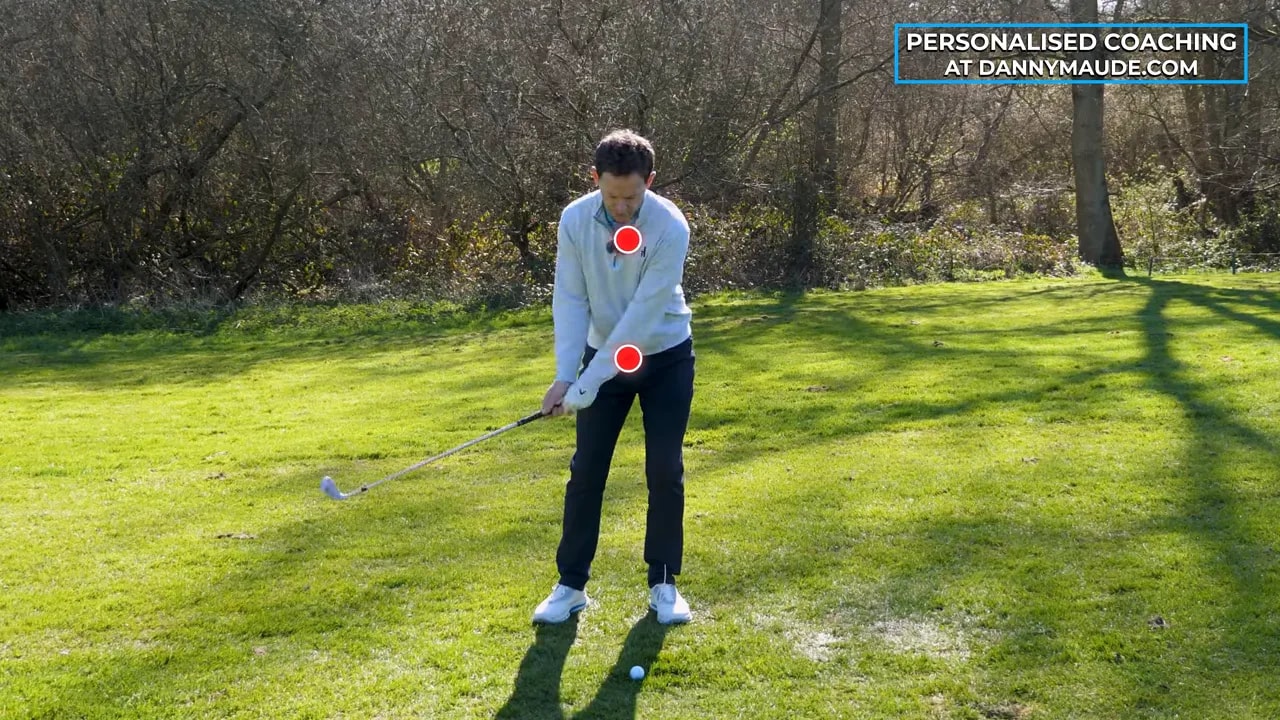
The drill uses a simple timing image. Imagine a large grandfather clock: tick, tick, talk. As the club moves, you want the club motion to be matched with a stable body height.
Here is the key detail: as the club goes down, the butt of the club goes up. This is counterbalancing the club rather than falling with it.
Why this matters for depth control
When you do not “go down with the club,” you avoid digging. The transcript described how one shot created a bigger divot than desired, while the improved rhythm produced a much shallower divot and better consistency in distance control.
What it feels like
- You feel like you are keeping your posture height or even slightly “standing up” through the shot.
- You feel the club fall under gravity while your body stays steady.
- The motion becomes more natural and effortless, not forced.
To practice Step 2, you are training a pattern:
- Set up with your stacked bodies (from Step 1).
- Feel the tick-tock rhythm as the club comes down.
- Counterbalance so your body does not collapse downward with the club.
- Let the club’s descent happen with control rather than with “drive” from your hands.
A common mistake to avoid
If you feel like your hands drive the club downward and you go under the ground too much, your depth will vary. That is often why pitch shots go from fat to thin. Rhythm prevents you from changing your depth between attempts.
Step 3: The clubface secret (start open, close through impact, take loft off)
For many golfers, pitching problems get worse because of one instinct: they try to lift the ball into the air. If you are holding loft like you are trying to “throw” the face upward, you can create flicky contact and unpredictable launch.
A game-changing concept shared by coach Joe Mayo changes how you think about loft and the clubface through the impact area:
- Great pitchers start with the fists slightly open.
- At impact, the clubface is closing.
- The action blends from open to closed in a controlled pattern.

What “open to closed” should look like
If you tend to draw/hook, one pattern described was a more “late hit” feel with dragging or less immediate closure. If you tend to slice, a different feel shows up: more flicking and a face that does not close in time.
The important fix is not to force the clubface. It is to set it up so gravity can help it close naturally.
In the slicer pattern described, thumbs were working down. That down-thumbs feeling helps the face close because the club is then allowed to drop toward the ground.
Why this works: letting gravity do the job
When the clubface starts slightly open and your thumbs move down toward the ground, you create an environment where:
- the face has a clear path to close
- the club can fall under gravity
- your strike becomes less “handy” and more coordinated
This is what creates that effortless look. Your body and clubface work together instead of fighting each other.
“Take loft off” rather than lift it
This is the counterintuitive part. Many students try to keep loft on the wedge, trying to lift the ball into the air. But the better approach is:
Take loft off the club through the impact area.
So instead of trying to add height by holding the face open and “throwing it,” you allow the motion to close and the loft to reduce naturally where it counts.
Watch the body blend: as the club face closes naturally, the body calmly goes with it. If you freeze your arms and do not allow the clubface to work, the motion tends to shut down and feel flicky.
Try this feel for a mid-trajectory pitch shot
- Set up with the ball where it supports your desired trajectory.
- Start with the clubface slightly open.
- Imagine the club face closing through impact.
- Do not force the lift. Let thumbs point down and then turn through.
When the three patterns (stack, rhythm, and face-to-gravity closure) are together, you should feel less effort and more repeatability.
Putting all three together for effortless pitch shots from 30 to 80 yards
Once you connect the steps, pitch shot consistency improves quickly because each step supports the next:
- Step 1 (stack): stabilizes where the club should land.
- Step 2 (tick-tock rhythm): controls depth so strike and distance are repeatable.
- Step 3 (clubface open to closed): creates reliable launch and spin by working with gravity and reducing loft through impact.
To make this practical, use a simple practice flow:
- Hit 5 to 8 balls focusing only on Step 1. Your priority is a smooth, stacked body action and avoiding big “re-routing” moments.
- Hit 5 to 8 balls focusing only on Step 2. Use the tick-tick-tock rhythm and feel like the butt of the club goes up while you counterbalance so you do not go down with it.
- Hit 5 to 8 balls focusing only on Step 3. Start slightly open and let the face close naturally as thumbs point down. Avoid trying to lift.
- Finally, hit 5 balls with all three combined. This is where you expect “effortless” to show up.
If timing is off, the swing will usually reveal it quickly. That is normal. The goal is to practice until your body and club arrive at impact together. With enough repeatable motion, the strike and distance control become automatic.
FAQ
Why do pitch shots from 30 to 80 yards feel so hard?
This range requires a controlled motion, not a chip shot punch and not a full swing. Small changes in depth and clubface behavior can create big distance changes, which is why nerves and “jerky” mechanics often show up here.
How do I know if my problem is depth or direction?
A quick indicator is the divot and contact. If you see very inconsistent divots (sometimes big, sometimes shallow), you likely have depth control issues. If the divots look similar but the ball curves unpredictably, your clubface and body sequencing may be off.
What is the tick-tock rhythm drill supposed to fix?
It trains a counterbalanced delivery. As the club comes down, the butt of the club goes up, and your body does not collapse downward with the club. That shallow, consistent depth improves strike and distance control.
Do I need to lift the ball on pitch shots?
No. The key idea is to avoid trying to lift by holding loft. Instead, start with the clubface slightly open and allow it to close through impact. This is described as “taking loft off the golf club” through the impact area.
How can I make my pitch shot consistency better quickly?
Use the three-step practice sequence: stack your body (Step 1), lock in the tick-tock rhythm and depth control (Step 2), then train open-to-closed clubface behavior with gravity (Step 3). Repeat each focus for a small set of balls, then combine.
Bottom line: fix pitch shot consistency with three simple swing patterns
If you want pitch shots from 30 to 80 yards every time, focus less on forcing the club and more on building repeatable motion. Keep your bodies stacked, deliver with tick-tock rhythm to control depth, and let the clubface close naturally so you take loft off through impact.
Once those patterns become consistent, the awkward yardage turns into one of the most satisfying shots in golf.
0 Comments