
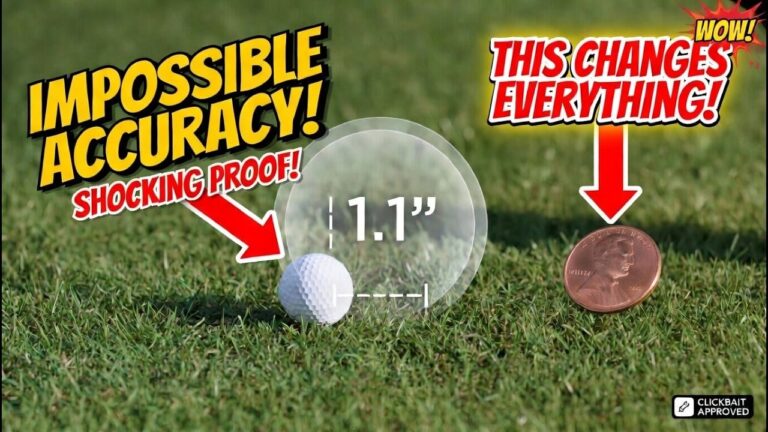

If you want more consistent golf chipping and pitching, you need a repeatable way to control the one thing that most strongly predicts good short-game results: where the club first contacts the ground relative to the ball. A simple “penny window” drill (and a second alignment aid) can help you train that depth with measurable feedback, so you stop guessing and start improving.
This guide walks you through the drill, how to score it, and the practice cues that make it work. It also covers common reasons players come up short, hit behind the ball, or get stuck in robot mechanics.
Table of Contents
- Why club-to-ground contact timing is the #1 golf short-game skill
- Step 1: Set up the penny window drill for golf
- Step 2: Score your contact over 20 reps (so progress is measurable)
- Step 3: Add a small weight shift (instead of locking everything still) for golf pitching
- Step 4: Let the club release (don’t hold angles) to improve first-contact depth
- Step 5: Use the “brick” alignment guide to keep the club on top for golf chipping
- Step 6: Combine the penny drill with a ball progression for golf pitching
- Full swing vs short game: what you should change in your golf pitching focus
- Common mistakes that ruin golf penny-window consistency
- Practice plan: how to train this golf drill effectively
- FAQ about the penny drill and brick alignment for golf short game
- Next steps to make this work for your golf short game
Why club-to-ground contact timing is the #1 golf short-game skill
The best players are able to get their club to first touch the ground extremely close to the ball. Research summarized in this approach suggests that elite consistency looks like contact landing within about an inch of the ball.
That matters because chipping and pitching speed does not need to be “big” to be effective. What you do need is reliable depth control. If your club consistently finds that narrow ground-contact window, your contact tends to improve automatically.
Step 1: Set up the penny window drill for golf
Here is the core setup. You are creating a small target area for “first ground contact.”
- Place two pennies so they face each other or sit right next to each other.
- Use the fact that a penny is about three quarters of an inch wide to create a practical “window.”
- For scoring, aim to strike the turf so the club first touches down in that window.
In practice, pros were shown to touch down in roughly a 1.1 to 1.2 inch gap. Your goal is not to copy their exact number on day one. Your goal is to become consistent enough that you can repeat the same contact area.
Step 2: Score your contact over 20 reps (so progress is measurable)
Instead of checking results only by feel, score the drill like a test. That is how you learn what actually changes performance.
- Hit about 20 shots in a row.
- Count how many shots knock out the intended “first coin” or land the clubhead contact within the target window.
- After 20, try one change (such as stance or weight shift) and repeat. Compare scores, not opinions.
This scoring method helps you avoid the common trap of running through many ideas without knowing which one moved the needle.
Step 3: Add a small weight shift (instead of locking everything still) for golf pitching
One counterintuitive piece is that staying perfectly locked can reduce your consistency. When the lower body is overly rigid and the motion becomes only “shoulders,” it can make depth control harder.
In the approach here, better results came from a small weight shift. Players who tend to hit from the inside and struggle with contact often benefit most from this adjustment.
What to feel
- Instead of “rocking only the upper body,” create a subtle transfer that gets you moving slightly toward your front foot.
- If your natural tendency is to come in from the inside and pick up turf behind the ball, prioritize depth-first contact by shifting enough to change where the club bottoms out.
Why this helps
A small shift can improve how the club approaches the turf, which in turn supports more consistent first-contact location within the penny window.
Step 4: Let the club release (don’t hold angles) to improve first-contact depth
Another major consistency lever is what you do with the club during the downswing. If you feel like you are holding an angle or “keeping it trapped,” the strike can become either thin or chunky, especially when the shot is short and the time for correction is limited.
The cue here is to allow the club to release once the weight shift happens. Think less “robot mechanics” and more “timing and feel.”
What it should feel like
As a guiding idea, treat the motion like a controlled hinge that then releases naturally. When the release occurs, you should feel confident about where the club is going to touch the ground.
This is especially useful because it reduces the odds that you accidentally drag the clubhead back from the inside and then hit behind the ball.
Step 5: Use the “brick” alignment guide to keep the club on top for golf chipping
A third tool helps make the depth goal easier to achieve. An alignment aid placed along the ground can encourage a setup and swing path that keeps the club “more on top” rather than letting it get dragged from the inside.
In the approach described, a “brick” is used as a visual line and is positioned so that the outside edge of the brick aligns with the ball. Then the club is moved back while the golfer stays above a reference line.
How to set it up
- Line up the outside edge of the brick with the ball.
- Place the brick so that when you swing, your motion clears the line on the way back.
- Use a sand wedge setting for the practice of this cue.
Why “on top” matters in golf short game
Many golfers focus on full-swing concepts like shallowing, lag, and releasing hard. Those priorities can conflict with short-game success because chips and pitches require precision, not speed.
The approach here emphasizes that when you keep the club more on top of the reference, it becomes easier to make divot contact in front of the ball repeatedly.
Step 6: Combine the penny drill with a ball progression for golf pitching
Once you can score consistently knocking out the first target, the next step is to slightly adjust the ball position forward to challenge depth without losing rhythm.
- After completing the penny reps, place a golf ball so the back of the ball is about one penny width in front of the penny target.
- Re-run the drill with the alignment cue so you do not “drag it in” and hit behind the ball.
- Focus on letting the short motion work like a hinge-and-release, with your weight transfer and contact timing doing the heavy lifting.
This progression keeps the objective the same (first contact stays in the right zone) while raising the difficulty slightly.

Full swing vs short game: what you should change in your golf pitching focus
It is common to try to use full-swing rules for chips. The better approach is to adjust your priorities.
- Full swing often includes more pronounced weight shift, wider timing windows, and larger mechanics.
- Short game requires more consistent contact depth, less emphasis on speed, and more attention to staying over a reference line and releasing at the right time.
When you treat a chip like a tiny full swing, it becomes easier to get stuck “inside,” collapse the right side, and come in low enough to pick the turf behind the ball.
Common mistakes that ruin golf penny-window consistency
If you are not seeing improvement, these are the most likely culprits.
1) Locked lower body and “all shoulders”
If you keep everything rigid and only rotate with the upper body, the club’s contact location can become inconsistent. Try adding a small transfer instead of total stillness.
2) Dragging from the inside
When the club comes in too much from the inside, it becomes easier to hit behind the ball. The goal is to keep your strike zone aligned with the penny window by managing the path and release.
3) Holding angles instead of releasing
When you try to “make it happen” by holding the clubhead position, you often reduce the ability to control depth. Allow the club to release naturally after the shift.
4) Practicing without a score
If you do not track results, you cannot tell whether a change is making you better or just giving a temporary feel-good outcome. Score at least 20 reps per version.
Practice plan: how to train this golf drill effectively
You can use the following simple session structure to build consistency over time.
- Warm up with a few easy wedge shots.
- Run the penny drill: hit about 20 reps and count how many land in the window.
- Test one change (weight shift amount, feel of release, or brick line emphasis).
- Run 20 reps again and compare the scores.
- Progress the ball position by about a penny width forward and repeat the objective with your alignment cue.
The scoring approach makes it easier to stop guessing. If your score improves, keep that setup. If it drops, revert and adjust one variable at a time.
FAQ about the penny drill and brick alignment for golf short game
How many reps should I do for the penny-window golf pitching drill?
Aim for around 20 reps per attempt. Score how many contacts land in the target window, then test one change and repeat. Scoring multiple 20-rep sets is key to knowing what is improving first-contact depth.
What if I hit the pennies sometimes but not consistently?
Treat it as a timing and path problem, not a “luck” problem. Adjust one cue at a time: add a small weight shift, allow the club to release naturally, and use the alignment aid to keep you more “on top.” Keep using scores to confirm progress.
Do I need a lot of speed to be good at golf chipping?
No. The core idea is that distance control comes from contact location, not from hitting chips fast. When first ground contact lands within that narrow window, the shot becomes more repeatable.
Is the brick drill only for full swing mechanics?
No. The emphasis here is short-game application: keeping the club more on top so divots start in front of the ball. That helps depth control and makes short-game contact more consistent.
What should I focus on if my shots are chunky or thin?
Chunky usually suggests the club is digging too early or hitting too low behind the ball. Thin can suggest the clubhead is not contacting the turf in the right depth window. Re-check: small weight shift, a natural release, and keeping the club more on top relative to the alignment line.
Next steps to make this work for your golf short game
Use the penny window to train first-contact depth, then lock in your improvements through scoring. Over time, the combination of a small weight shift, a natural release, and an “on top” alignment cue can free you from compensating moves and help you hit more consistent chips and pitches.
If you want an easy add-on, keep an alignment stick or brick-like reference available so you can practice staying over the line and focusing on feel and timing rather than trying to hold positions rigidly.

0 Comments