


Transform Your Golf Game
Ready to improve your golf swing? Explore the trail arm golf swing technique, optimize your swing plane, and eliminate inconsistencies with step-by-step instructions. Learn how the trail arm impacts connection and power, plus discover actionable drills for a solid, reliable swing.
Table of Contents
- What is the Trail Arm and Why It Matters
- Step 1: Setup — Preset the Trail Arm for Success
- Step 2: Establish Connection Without Pinning the Arm
- Step 3: Takeaway and Backswing — Keep the Trail Arm Working Properly
- Step 4: Drill Sequence to Train the Trail Arm
- Step 5: Transition and Downswing — Reduce Manipulation
- Step 6: Common Faults and Targeted Fixes
- Practice Checklist: 8-Point Drill Routine
- How to Know You Are Improving
- Common Misconceptions About the Trail Arm
- Quick Troubleshooting Guide (2-Minute Checks)
- FAQ
- Summary and Final Checklist
What is the Trail Arm and Why It Matters
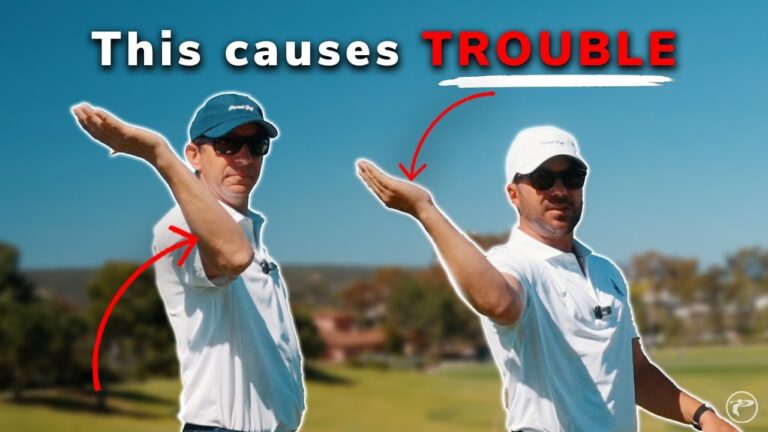
The trail arm is crucial for maintaining connection, width, and an effective swing plane. For right-handed players, it is the right arm. Proper rotation ensures a compact takeaway and consistent downswing, while incorrect positioning leads to rushed swings and face control problems.
Step 1: Setup — Preset the Trail Arm for Success
A successful trail arm swing starts with setup. Ensure proper arm position for an effective backswing:
- Grip first: Hold your normal grip before positioning your trail arm.
- “Giving blood” feeling: Slightly rotate the trail elbow to show a vein or crease; avoid collapsing the wrist.
- Point the ulna down: Rotate the forearm to position the ulna bone towards the ball, keeping hands forward.
Step 2: Establish Connection Without Pinning the Arm
Maintain connection by keeping your hands in front of your body’s center without pinning the arm or playing too loosely. Aim for a balanced gap between your trail elbow and torso.
- Keep your hands ahead of the sternum throughout your swing.
- Ensure a small gap exists between your trail elbow and torso to preserve width.
- Rotate the forearm inward towards the ball to stabilize your swing path.
Step 3: Takeaway and Backswing — Keep the Trail Arm Working Properly
A controlled trail arm during the takeaway ensures correct hand path and swing plane:
- Start with the body: Initiate with a shoulder turn, maintaining trail elbow rotation.
- Avoid pulling with the trail hand: Practice with lead-arm-only takeaways to establish the correct path.
- Maintain rotation: Keep the ulna pointed down and elbow soft as your hands move to the top.
Step 4: Drill Sequence to Train the Trail Arm
Engage in these sequential drills to improve consistency:
Drill A: Lead-arm-only backswing
- Use only your lead arm and make slow backswings to waist and shoulder heights.
- Emphasize body turn for creating path, allowing trail arm softness in real swings.
Drill B: Elbow-behind-the-lead-hand cue
Position your lead hand behind your trail elbow to maintain forward elbow position and encourage a full body turn.
Drill C: Head-cover in front-of-pec drill
- Place a head cover in front of your lead pec at address.
- Make backswings, ensuring the trail elbow doesn’t touch the object.
Drill D: Mirror-check rotation
Use a mirror to confirm proper forearm rotation and hand-on-top grip throughout your swing.
Step 5: Transition and Downswing — Reduce Manipulation
Simplify your downswing by ensuring minimal arm manipulation:
- The weight moves forward without significant arm effort.
- The clubface stays stable through impact.
- Aim for forward shaft lean for consistent contact.
Step 6: Common Faults and Targeted Fixes
Common trail arm faults, with quick solutions:
Fault: Trail elbow pinned (too narrow)
Fix: Restore width using lead-arm-only takeaways and ulna-down position.
Fault: Trail elbow flares out (too wide)
Fix: Employ lead-hand-behind-elbow drills to guide elbow to a tucked-in position.
Fault: Over-rotated wrist
Fix: Ensure trail hand stays on top of the grip. Separate wrist positioning from elbow rotation.
Fault: Trail arm dominates takeback
Fix: Practice slow, one-arm backswings with lead arms using metronomic tempo.
Practice Checklist: 8-Point Drill Routine
- Begin each session with grip and setup checks.
- Perform the “giving blood” elbow rotation.
- Lead-arm-only takeaways for shoulder height.
- Lead-hand-behind-elbow repetitions to verify position.
- Head-cover drills to maintain proper elbow space.
- Mirror to confirm trail forearm rotation.
- Half-swings focusing on maintaining hand-position width.
- Full swings aiming for consistent shaft lean and impact stability.
How to Know You Are Improving
Indicators of a successful trail arm golf swing:
- Consistent ball flight and quality of strike.
- Improved shaft lean and minimized wrist flips.
- Enhanced tempo and reduced errant swings.
- Decreased need for downswing manipulation.
Common Misconceptions About the Trail Arm
Clarifying common misconceptions:
- “Connected” doesn’t mean tight to the side: It’s about keeping hands forward, not glued to the side.
- “Rotate the elbow in” doesn’t involve shoving into ribs: Rotate forearm, not elbow, to maintain width.
- More tension doesn’t mean better control: Balance necessary tension with softness for fluidity.
Quick Troubleshooting Guide (2-Minute Checks)
- Check ulna direction at address; correct as needed.
- Slowly takeaway to waist height; adjust if trail hand leads.
- Ensure elbow-to-side gap at top for accuracy; utilize drills as needed.
FAQ
How do I preset the trail arm?
Start by externally rotating the trail elbow and pointing the ulna down, ensuring the trail hand remains neutrally placed over the grip.
Is an elbow gap problematic?
A small gap isn’t bad—it maintains swing width, advancing power and consistency.
Should I practice with my lead arm every session?
Regular lead-arm drills enhance trail arm mechanics. Incorporate alternating full swings for integration.
What if I lack the ideal trail elbow range?
Improve gradually with shoulder mobility drills. Aim for increased rotation and effective body turn without straining.
How long to change a trail arm habit?
Time varies—practice regularly for weeks to see change. Consistent drills solidify transformation over months.
Summary and Final Checklist
Elevate your golf game by refining your trail arm golf swing. Key focus areas:
- Setup: Proper arm positioning, ulna pointing down.
- Maintain Connection: Hands forward; keep width intact.
- Incorporate Drills: Emphasize lead-arm, elbow position, and feedback through head-cover and mirrors.
- Practice Diligently: Balanced reps and full swings tailored for impact-ready performance.
Apply above routines and monitor progress through consistent ball flight and contact improvements, transforming your trail arm into a reliable asset.
0 Comments