


Focus keyphrase: effortless power golf swing
If you ask most golfers about “effortless power,” they tend to list the usual suspects: a bigger backswing turn, a pause at the top, lighter grip pressure, firmer foot pressure, better tempo. Those ideas are not wrong.
The missing link is how your club behaves during the backswing. In most swings, the backswing makes the downswing harder. The fix is to learn to control the club shaft so your transition becomes free-falling instead of forced. That is the foundation of the effortless power golf swing.
You will also see what high-level players like Tommy Fleetwood and Rory McIlroy look like when they create that effortless “loop back under” in transition. Then you will use a simple clock drill and a lead-trail hand progression to groove the feel.

Table of Contents
- Step 1: Understand the real secret behind an effortless power golf swing
- Step 2: Recognize the shaft path that creates effortless power
- Step 3: Learn the clock drill (out over 2, vertical, down over 4)
- Step 4: Train it with trail hand only (first)
- Step 5: Train it with lead hand only (second)
- Step 6: Put both hands on and hit (with normal grip pressure)
- Step 7: Use lead-side checkpoints to keep the backswing light
- Step 8: Keep the effortless power when you switch to driver
- Step 9: Practice progression that actually sticks
- Step 10: Use feedback to reinforce the correct pattern
- FAQ
Step 1: Understand the real secret behind an effortless power golf swing
The core idea is simple: effortless power comes from how your club shaft feels in the backswing.
When you position the club so the shaft feels vertical during the takeaway, you will often feel it as light. When the shaft goes horizontal too early, it will often feel heavy.
That matters because the downswing wants to react naturally to what you do with the shaft on the way back.
Eric Cogorno teaches a key relationship:
- Light on the way back makes it easier for the club to fall down into transition.
- Heavy on the way back forces you to manually control the downswing. That is “effortful power,” not effortless power.
So instead of asking, “How do I hit it harder?” you want to ask, “How do I make my transition easier?”
Step 2: Recognize the shaft path that creates effortless power
High-level swings often share a pattern early in the takeaway:
- Outside the hands early (as the club starts moving back)
- Then slightly inside the hands on the way down
This pattern creates that “out and under” motion in transition. If you have ever seen a pro’s swing plane look like it loops back smoothly, this is part of what you are seeing.
It is not the only way to hit good golf. But it is one of the easiest ways to create the feel of effortless power because the club is allowed to respond instead of being forced.
Step 3: Learn the clock drill (out over 2, vertical, down over 4)
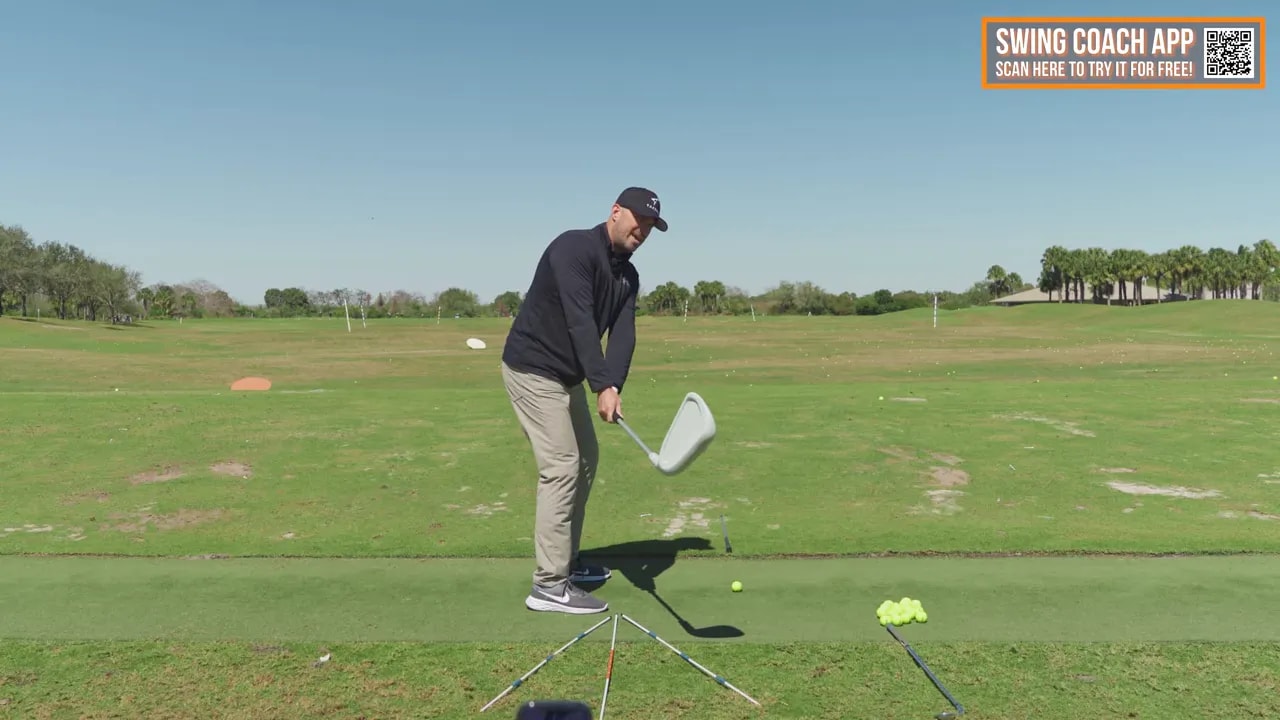
The most practical way to train this is with a clock drill using three alignment sticks.
Set up the visual reference like this (it does not need to be perfect):
- Imagine the golf ball at 12 o’clock.
- Place the first stick around 2 o’clock.
- Place an orange stick around 3 o’clock (toe line reference).
- Place a second stick around 4 o’clock.
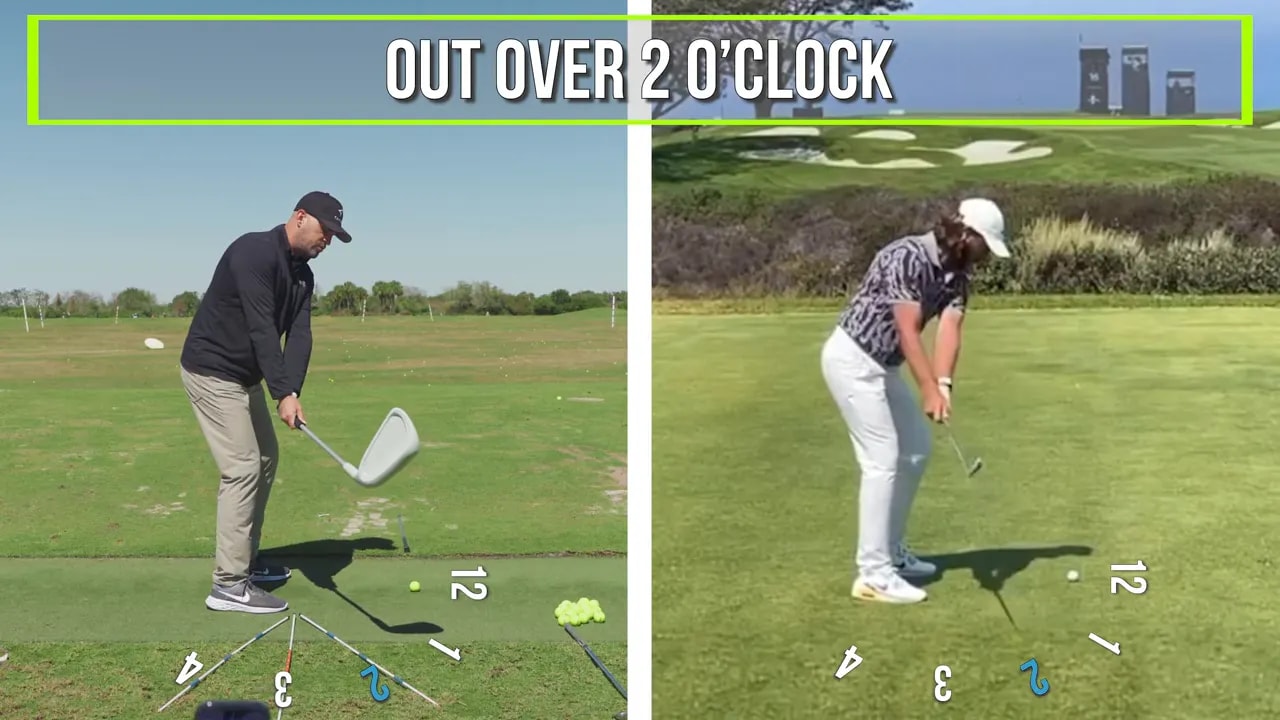
The feel you are training is a specific sequence:
- Out over 2 (outside the hands early)
- Vertical (light feeling on the way back)
- Down over 4 (a transition that allows the club to shallow and return on plane)
Repeat the phrase: Out over 2, vertical, down over 4.
Why this works: if you go the wrong way early, your backswing becomes “heavy and horizontal.” From there, your brain tries to solve the downswing that your setup already made difficult.
Step 4: Train it with trail hand only (first)
Start with a trail hand only practice so you can feel the shaft position without the “help” of the lead hand.
Use a 7-iron at first. You can use a different club later, but the 7-iron makes the feel easy to repeat.
Your trail hand drill:
- Make a short rehearsal backswing.
- Feel the club go out over 2 during the takeaway (well outside your hands).
- Keep the shaft feeling vertical (light) so the butt of the club points in the safe zone.
- Then bring it down and feel it go down over 4.
- Do this 2 to 3 times to lock in the sensation.
How to know you are in the safe zone: when you get the feel right, the butt of the club points somewhere between the golf ball and your toe line.
If you get too far inside and horizontal, the butt points outside the ball line and you will likely feel a heavy shaft, which you do not want for an effortless power golf swing.
Step 5: Train it with lead hand only (second)
Once the trail hand feel starts to show up consistently, switch to a lead hand only drill using the same motion.
Your lead hand drill:
- Feel out over 2 early.
- Keep it vertical halfway back for a light feel.
- Feel down over 4 to match the transition.
- Repeat 2 to 3 swings.
This matters because you want the shaft path to be stable regardless of which hand you “remove” from the motion. If only one side creates the right feel, you will struggle to reproduce it in a full swing.
Step 6: Put both hands on and hit (with normal grip pressure)
Now combine both hands and do one or two controlled swings.
Quick reminders while you swing:
- Use normal grip pressure. Do not white-knuckle the drill.
- Stay focused on the shaft feel: out over 2, vertical, down over 4.
The goal is not to swing “hard.” The goal is to set the backswing so the club falls naturally in transition.

Step 7: Use lead-side checkpoints to keep the backswing light
Changing shaft position is not only a wrist and arm problem. It is also strongly connected to what your lead side does in the backswing.
When the backswing is set up correctly for an effortless power golf swing, your lead-side checkpoints should look more “down” and less “up” at about halfway back:
- Lead butt of the club points down
- Lead elbow points down
- Lead shoulder stays down
If you notice the lead side lifting so that the butt of the club, elbow, and shoulder become more parallel to the ground, your shaft is likely getting too horizontal. That is typically the setup that creates a heavy, forced downswing.
Cue to replace it: feel the butt of the club pointing down at roughly the 2 o’clock vertical feel, with the idea that it is almost “pointing toward your toes” (use that as an exaggerated feel, not a literal position).
Then transition into the down movement with 4 o’clock feel.
Keep the drill mindset at first. Once your movement pattern is grooved, it becomes “thoughtful but effortless.”
Step 8: Keep the effortless power when you switch to driver
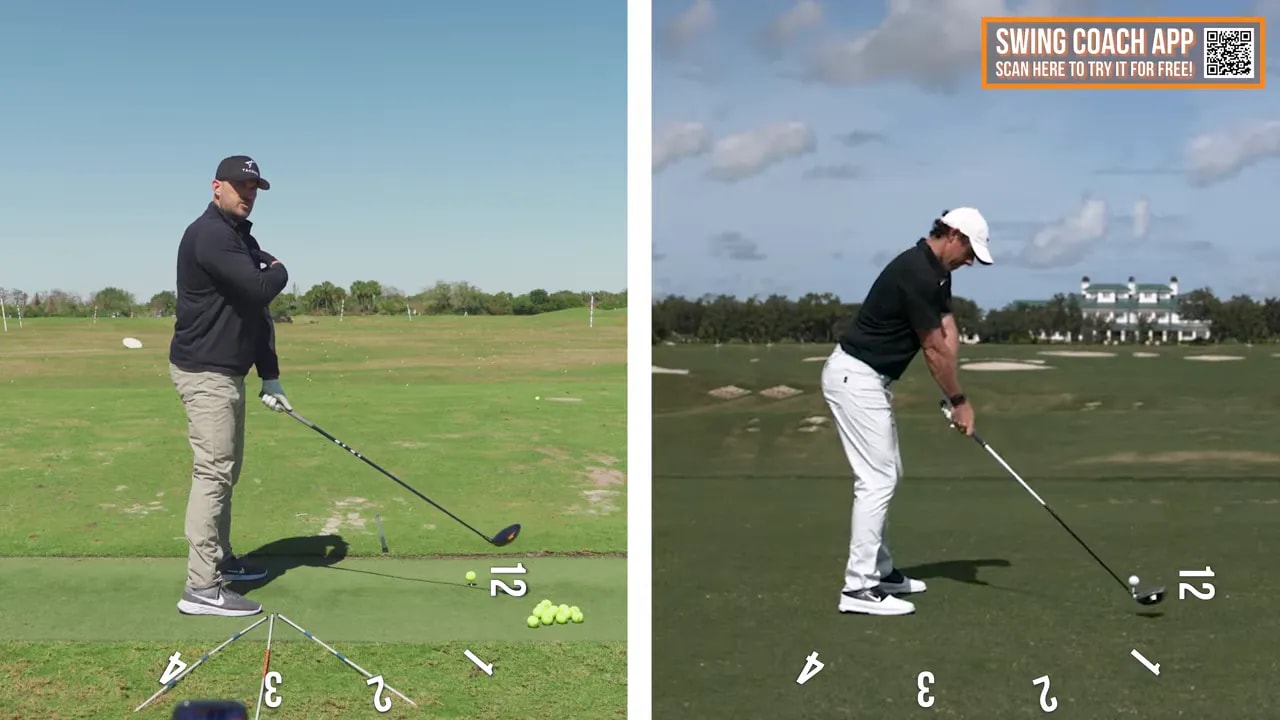
A common question is whether this approach applies to the driver. The answer is yes.
The same shaft-control concepts show up, but you will likely feel them slightly differently because of the longer shaft and different head size.
Driver version cues:
- Feel the club outside over 2 during takeaway
- Keep the shaft feeling vertical and light on the way back
- Feel down over 4 into transition
- Use the same lead-side checkpoints (shoulder down, elbow down, butt down)
If you do this correctly, the driver swing can still produce that effortless transition. Many golfers notice straighter contact because they are not forcing the downswing to “fix” a heavy shaft position.
Step 9: Practice progression that actually sticks
Here is a simple progression that matches how most golfers learn best.
For new learners (short and slow)
- Start with a pitching wedge and hit shots at 50 to 100 yards.
- Prove to yourself you can produce the same out over 2, vertical, down over 4 feel at shorter distances.
- Then move to a 7-iron.
- Only then go to driver.
For golfers who already swing fast
You may feel “effortless” only when you stop rushing the transition. Use fewer swings per session. Make each rep intentional and repeat the shaft feel, not just the turn.
Key principle: you are training effortless power golf swing mechanics by making transition easier, not by trying to brute-force speed.
Step 10: Use feedback to reinforce the correct pattern
Even with good cues, golf learning is faster when you can confirm what changed in your swing. Eric Cogorno highlights the use of the Swing Coach app as an AI-based training tool that provides immediate audio feedback after each swing and helps identify root swing issues.
The practical takeaway for your practice:
- Record a few reps after each drill stage (trail hand, lead hand, both hands).
- Use feedback to confirm the club is getting the intended path relationship in takeaway and transition.
- Adjust the feel, then repeat.
When feedback confirms the shaft behavior is closer to neutral, your “effortless power” feeling becomes more repeatable.
FAQ
What is the secret to effortless power in golf?
Effortless power usually comes from controlling the club shaft so it feels more vertical and light on the way back. That makes the downswing transition easier and more natural, instead of forced.
Is a full backswing turn and lighter grip pressure still important?
Yes. A good turn and comfortable grip pressure support the swing. However, if the shaft movement is incorrect, those other factors often cannot fully compensate. Shaft control is the non-negotiable foundation.
What does “out over 2, vertical, down over 4” mean?
It is a clock-drill feel for the shaft path: move the club head outside early (over the 2 o’clock reference), keep the shaft feeling vertical and light during the backswing, then move down into transition with a feel of going over the 4 o’clock reference.
Will this effortless power golf swing work with driver?
Yes. You use the same shaft-control cues for driver: outside over 2 in the takeaway, vertical and light on the way back, then down over 4 into transition, while keeping your lead side “down” (shoulder down, elbow down, butt of club down).
How do I know I am doing the shaft drill correctly?
With correct setup, the butt of the club points in a “safe zone” between the ball and your toe line during the light, vertical feel portion of the backswing. Going too inside too early often makes the shaft feel heavy and forces you to manipulate the downswing.
What club should I start with when learning this?
Start short and slow with a pitching wedge or other short iron, then progress to a 7-iron. Finally, test the same shaft feel with driver.
0 Comments