
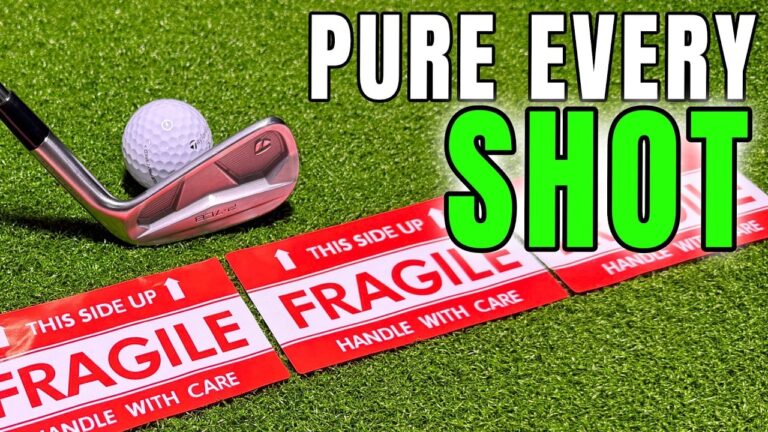


Have you ever wondered how to achieve those crisp, perfect iron strikes every golfer dreams of? This guide offers a roadmap to mastering your golf swing through simple yet effective drills, designed for players at all skill levels.
Introduction
To enhance your golf game, mastering pure iron strikes is essential. Consistency, precision, and power come from controlling where your club meets the turf. This comprehensive guide will take you through a sequence of practical drills and steps that promise to refine your iron play effortlessly.
Table of Contents
- Step 1: Drill — The Tape Feedback Method to Improve Ball Striking
- Step 2: Using Your Arms Effectively
- Step 3: Mastering the Correct Ground Contact
- Step 4: Achieving Optimal Club Extraction Post-Impact
- Common Mistakes and Fixes
- Suggested Practice Session
- On-Course Tips
- FAQs
- Final Thoughts
Step 1: Drill — The Tape Feedback Method to Improve Ball Striking
Start by placing a piece of tape on the ground and position your ball about a clubhead width in front. The aim is for your club to make contact with the ground on the target side of the ball, without disturbing the tape.
- Immediate feedback — Mistakes are obvious; if you disturb the tape, your contact is too far back.
- Simple setup — This low-tech method provides clear indicators of your turf interaction, crucial for golf success.
- Place the tape and ball as instructed.
- Perform easy half-swings, preserving the tape underfoot.
- Keep track, noting how often you maintain a clean strike.
Step 2: Using Your Arms Effectively
Many golfers fear hitting the ground, leading to topping shots. Understanding that the arms should lead the downswing is pivotal. By focusing solely on your arms’ downward swing, the club will naturally contact the ground.
- Arms Descend — Direct your club head downward through motion control.
- Embrace Turf Contact — It’s integral to iron play; focus on precise placement.
Common issue: Topped shots stem from shallow swings. Remedy this by focusing on arm movements alone, stabilizing the body.
Step 3: Mastering the Correct Ground Contact
To land your shot in the right spot, you’ll use three key movements:
- Swing your arms down efficiently.
- Utilize lateral hip shifts toward the target.
- Incorporate body rotation to direct the swing.
Envision shifting the swing’s arc forward, ensuring impact happens slightly in front of the ball for optimal divots.
Step 4: Achieving Optimal Club Extraction Post-Impact
Focus on your body’s extension through impact, ensuring the club exits the turf with ease. Heavy divots usually indicate a need for better body extension post-impact.
- Start in a forward stance; this shapes the arm path.
- Transition smoothly from impact into extension, facing the target.
- Practice small swings, following through with extension in mind.
- Ensure your extension naturally lifts the club post-impact for clean strikes.
- Combine the extension cue with the tape drill to maintain consistent divot patterns.
Common Mistakes and Simple Fixes
- Topping — Clubhead is too high. Solution: Focus drills on arm descent.
- Fat shots — Point of contact is early. Solution: Include lateral shifts and rotation training.
- Digging — Insufficient extension. Solution: Practice body extension drills.
Putting the Practice Session Together
A structured practice session to hone your golf skills:
- Begin with warm-up swings and chip shots for five minutes.
- Perform left-hand-only swings, integrating shift and rotation in sets. Rest between each set.
- Transition to full swings using two hands, maintaining focus on seamless integration of learned techniques.
- End with full swings, ensuring you finish with proper extension.
Focus on steady progress, using the tape as your guide. Adjust for precision and aim for clean contact.
Quick Cues for On-Course Excellence
- “Arms down” — Correct shallow swings.
- “Shift forward” — Moves the impact forward effectively.
- “Rotate and extend” — Ensures efficient club extraction.
Keep cues simple and focus on one at a time to avoid overthinking during play.
FAQs
Why should my irons hit the ground?
Striking the ground compresses the ball for consistent flights and spin. Controlled contact is integral to solid iron play.
How much should I shift laterally?
This varies, typically between six to eight inches. Practice with the tape drill to fine-tune your personal shift requirement.
Final Thoughts on Improving Your Golf Ball Striking
Performing flawless iron strikes involves understanding a few key principles: arm descent, lateral shift, rotational movement, and extension. By consistently practicing these components, coupled with tape drills, your accuracy and comfort on the golf course will improve significantly. Focus diligently on each element, then combine them for enhanced play.
Remember, regular practice leads to success in golf. Keep swinging for excellence!
0 Comments