
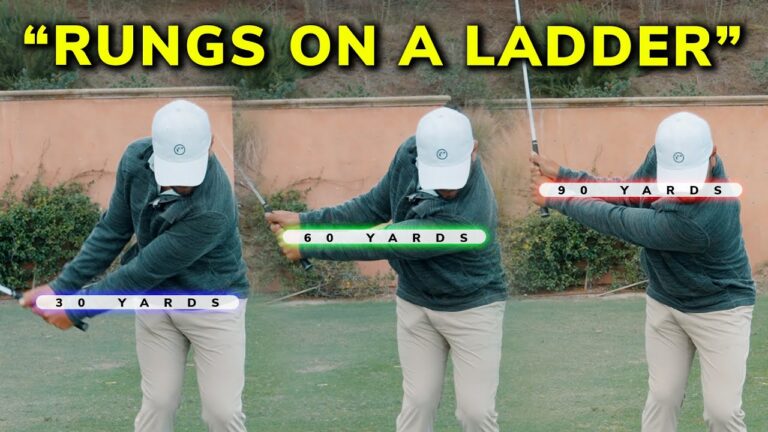


Unleash your short game potential with pro-level strategies to master wedge distance control inside 100 yards. Discover a repeatable system that will sharpen your accuracy and confidence around the green.
The fastest, most reliable way to shave strokes from your score lies inside 100 yards. This guide provides a simple, repeatable wedge distance control system used by the pros: body landmarks, consistent tempo, and practical practice routines. Follow these steps to transform your short game into a scoring engine.
Table of Contents
- Step 1: Find Your 50 — the foundation of wedge distance control
- Step 2: Build a ladder — map body landmarks to yardages
- Step 3: Use one club and a consistent tempo for wedge distance control
- Step 4: Stop one frame shorter than you think
- Step 5: Match setup width to shot size
- Step 6: Always maintain positive movement — never stall
- Step 7: Practice drills to lock in wedge distance control
- Step 8: Apply percentages — why the short game matters more than you think
- Step 9: Use the clock to create a consistent feel
- Step 10: Transfer practice to pressure situations
- Frequently Asked Questions
- Closing Thoughts
Step 1: Find Your 50 — The Foundation of Wedge Distance Control
Begin by mastering a reliable 50-yard shot. This single, dependable distance becomes your wedge distance control anchor. Aiming for 50 yards allows you to easily scale your shots up or down, enhancing your short game flexibility.
Find your 50. Once you know where your 50 is, 60, 40, 30, and 70 become far easier to dial in.

Why 50? Because it sits in the short game range you’ll use most often. It’s long enough for a committed swing and short enough for frequent practice. Master the feel of a 50-yard swing, and your judgment and execution of other distances improve dramatically.
Step 2: Build a Ladder — Map Body Landmarks to Yardages
Translate yardages into repeatable body locations you can rely on. Visualize your torso as a ladder: each rung corresponds to roughly 10 yards. Map these landmarks to your body for consistent reference points, so you instantly know the feel for any distance.
- 30 yards — right pocket
- 40 yards — belt
- 50 yards — belly button
- 60 yards — base of the sternum
- 70 yards — mid chest
- 80 yards — shoulders
- 90 yards — neck
- 100 yards — ear (rarely used with lob wedge)

These cues aren’t scientifically perfect but offer consistency. Choose landmarks that make sense for you. The goal is that when you call “50,” your brain and body know the desired movement’s shape and length.
Step 3: Use One Club and a Consistent Tempo for Wedge Distance Control
Simplify your inside 100-yard game by using one club for various distances with the same tempo. This reduces decision paralysis and mechanical variation, allowing the club to adapt based on where you stop on your body ladder.
Maintain the same cadence on every shot. Tempo drives rhythm, which outperforms mechanics under pressure. Imagine a steady clock: one-two, letting the finish length dictate the yardage. You’ll feel the ball leave the club consistently.

Train one tempo’s feel and allow swing stopping point to control the distance. Fluctuating tempos lead to inconsistencies; the aim is to preserve swing speed and modify only the finish arc.
Step 4: Stop One Frame Shorter Than You Think
For accurate wedge distance control, stop your hands just short of the intended landmark. Your hands will naturally continue beyond your conscious stopping point.
This trick compensates for the lag between intention and reality, crucial for pitches on tight lies. By stopping one frame earlier, you achieve your target more precisely.

Drill tip: aim for a 30-yard target. Stop at a landmark one rung lower than intended, observe the result, and adjust as needed. Repeat until the intended stopping point achieves the desired outcome.
Step 5: Match Setup Width to Shot Size
Adopt a stance size that reflects the shot’s scope. Small chips call for narrow stances, while a 50-yard pitch requires a slightly wider stance and more body rotation. Avoid setting up for a long shot when aiming for 50 yards.
This minor adjustment affects balance and leverage. A narrow stance limits lower body movement and keeps the swing compact, while increasing stance width for longer shots allows fuller rotation and weight shifts.

Progression drill: arrange three targets at 20, 35, and 50 yards. Use a stance proportional to each distance, switching targets to feel how stance width affects shots.
Step 6: Always Maintain Positive Movement — Never Stall
Avoid stalling the club on short shots; this common mistake leads to inconsistency. Maintain a smooth, continuously flowing swing, ensuring cleaner strikes with predictable spin and roll.
Top short-game players seem to effortlessly harness gravity and tempo, focusing solely on direction and finish. Your objective is to keep movement positive, moving through impact to the finish.

Tip: Maintain a consistent one-two rhythm to prevent stalling, training your body to keep moving.
Step 7: Practice Drills to Lock in Wedge Distance Control
Practice purposefully with these drills to solidify your short-game consistency:
- 50-yard anchor drill — hit 50 shots at a 50-yard target. Track your dispersion and adjust until you consistently land within a small area.
- Ladder drill — use body-rungs to hit sequences of 30, 40, 50, and 60 yards, stopping at corresponding landmarks. Repeat for consistent 10-yard changes.
- Stop-short practice — aim to stop a frame earlier than desired, observing the physical and mental difference.
- Tight-lie micro swings — practice 10-30 yard shots on tight turf, maintaining tempo to ensure finesse.
- On-course rehearsal — during practice rounds, play from 70 yards in, applying your ladder technique to various targets.

Keep a log or note of your yardage-to-landmark conversions to reinforce muscle memory, enabling you to recall under pressure.
Step 8: Apply Percentages — Why the Short Game Matters More Than You Think
The short game significantly impacts scoring, with about 70% of strokes lost or gained inside 70 yards. Focused practice in this area proves beneficial, leading to quicker score improvements compared to full-swing moves.

Invest in practicing wedge control to witness rapid score improvements.
Step 9: Use the Clock to Create a Consistent Feel
Picturing a clockface simplifies rehearsing consistent swing lengths. Dubbing the backswing as “9 o’clock” for shorter shots helps coordinate hand positions for longer pitches using corresponding body-ladder references.
With the clock idea, the goal is a mental image facilitating repeatable motion, avoiding overthinking mechanics.
Step 10: Transfer Practice to Pressure Situations
Once consistent at the range, simulate pressure on the course. Play games targeting proximity to the hole, recording outcomes to introduce measurable consequences, making practice more challenging and improving course performance.
Turn practice into a pressure test, which eases execution during actual games.
Frequently Asked Questions
How do I find my 50?
Should I use the same wedge for all shots inside 100 yards?
What if my body landmarks feel different on the course than at the range?
How often should I practice these drills?
Why do I still stall on short shots despite practicing?
Can this system help with bunker shots and lob wedges?
Closing Thoughts
Your short game is crucial for lowering scores rapidly. Build a simple yet effective system: anchor a reliable 50-yard shot, map your body landmarks, maintain tempo, and stop short of your target. Practice strategically to test your routine under pressure.
Commit to this approach and trust the feel. Consistent wedge control boosts confidence around the green, directly impacting your score.
0 Comments