


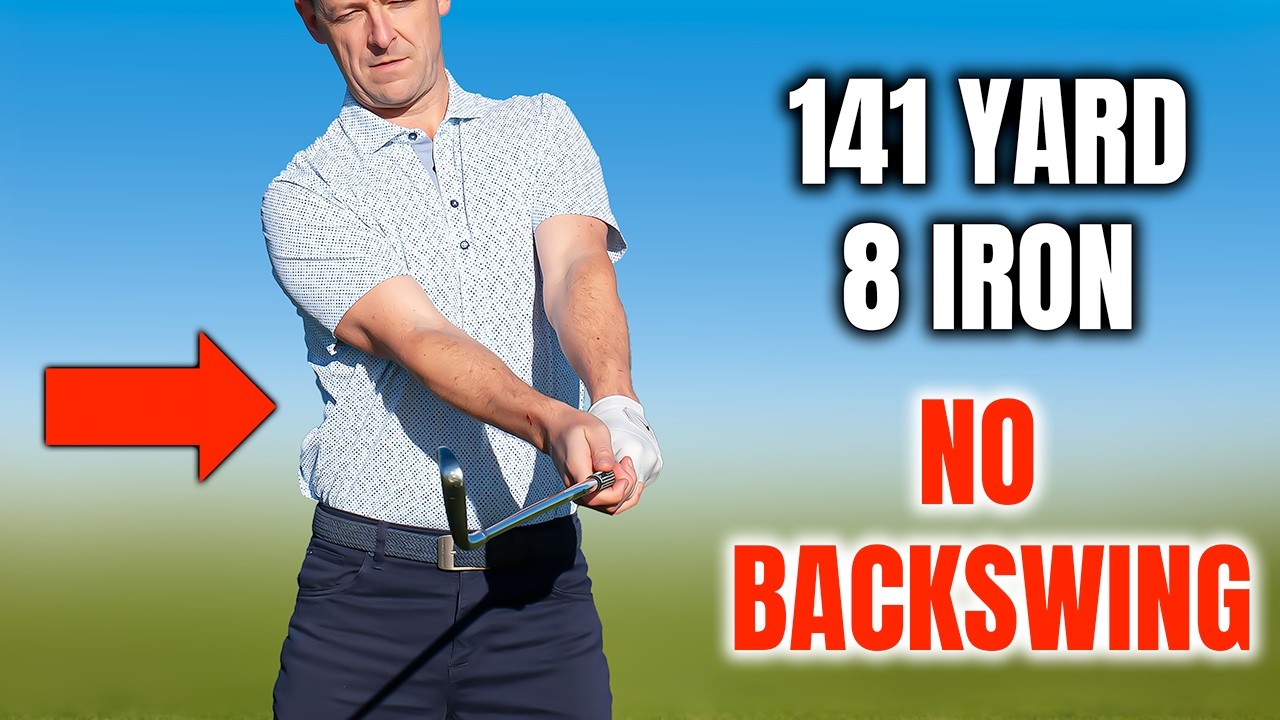
Want to hit your irons longer without extending your backswing? Discover how two simple techniques can boost your distance, focusing on swing efficiency and rhythm, to maximize power effortlessly.
Table of Contents
- Step 1: Optimize Your Setup for Iron Distance
- Step 2: Master the Rhythm Drill
- Combining Techniques for Best Results
- The Science Behind the Technique
- Avoid These Common Errors
- A 4-Week Success Guide
- Summary of Key Drills and Cues
- FAQs
- Final Thoughts
Step 1: Optimize Your Setup for Iron Distance
Enhance your initial position before making a swing change. Many golfers limit their potential by crouching over the ball. This closes off the body, forcing the arms and hands alone to generate power, which reduces swing efficiency.
Instead, adjust your stance by envisioning a friend calling your name from behind, prompting you to glance over your trail shoulder. This subtle adjustment achieves several crucial objectives:
- Opens your chest slightly, directing it upwards rather than at the ground.
- Creates more room for your arms, minimizing wrist compensation.
- Facilitates torso rotation, enabling core and leg muscle involvement, rather than relying solely on arms.
Step 2: Master the Rhythm Drill
With an effective setup, focus shifts to integrating club weight with body rhythm. This 5-second drill accentuates effortless speed through timing, not force.
Begin by holding the club and letting the head swing like a pendulum to build club mass awareness. Initial slow swings cultivate kinesthetic awareness of the club’s heaviness.
- Allow the club to swing back and forth, moving only enough for gravity to guide it.
- Gradually increase momentum, letting the club feel heavier and timing the interaction between club and hands.
- Add gentle body movement, feeling down-and-up motion through the midsection synchronized with the club’s swing.
- Execute short chips with the rhythm in a compact swing, concentrating on the timing and club mass driving the motion.
Combining Techniques for Best Results
Integrate the setup and rhythm drills during practice. The setup creates room for full body engagement, while the rhythm drill harnesses muscle and club connection, eliminating effort from swing speed generation.
- Keep the swing compact, allowing free torso rotation from your setup.
- Employ rhythm to engage large muscles and naturally drive the clubhead forward.
- Progress slowly, focusing on repeatable, efficient motion before swing lengthening.
The Science Behind the Technique
The improvement is attributed to two main factors:
- Space and torque: An upward chest rotation and a lean into the body’s rotation creates arm space, preventing over-reliance on wrists and promoting ground-up torque through your core.
- Mass acceleration and timing: The clubhead’s mass, when timed with subtle body movements, accelerates naturally through impact without exertion.
Avoid These Common Errors
- Excessive head rotation: A minor shoulder glance suffices to maintain ball visibility in periphery.
- Prioritizing speed over timing: Power emanates predominantly from well-coordinated club and body timing.
- Overhauling setup: Emphasize small, consistent adjustments over drastic posture changes.
- Premature lengthening: Establish efficient motion before extending the backswing.
A 4-Week Success Guide
Implement this four-week structured plan to automate effective swing mechanics:
- Week 1 — Foundation:
- Engage in daily 10-minute setup drills.
- Perform the club-mass pendulum exercise for 5 minutes daily.
- Week 2 — Integrate Short Swings:
- Execute compact chips and 3/4 shots emphasizing rhythm and setup.
- Capture swings on video to assess contact quality improvements.
- Week 3 — Build Speed Without Length:
- Enhance momentum in the rhythm exercise and translate it into short, full swings.
- Document distance progression and control.
- Week 4 — Incremental Length Increase (Optional):
- Expand swing length only when accuracy and contact quality remain stable.
Summary of Key Drills and Cues
- Setup Cue: Gently glance over your trail shoulder, elevating the gaze back to the ball, maintaining a slight upward chest orientation.
- Rhythm Cue: First swing the club mass, allowing your body to engage in a down-and-up sequence, promoting a seamless club acceleration through impact.
- Prioritize Short Swings: Establish efficient compact motions before opting for length lenencement.
FAQs
Will this method work with my driver as well as my irons?
Do I need to make my swing longer to gain distance?
How long until I see distance improvements?
Can beginners do these drills?
What should I feel at impact?
Final Thoughts
Achieving greater iron distance doesn’t necessitate a burdensome backswing. Embrace space in setup, align body movement with club mass, and prioritize efficient swings. Utilize these techniques for consistent improvements and greater course confidence.
Adopt simplicity in practice and emphasize timing for effective results.
0 Comments